By Eunice Hilda A. Mensah
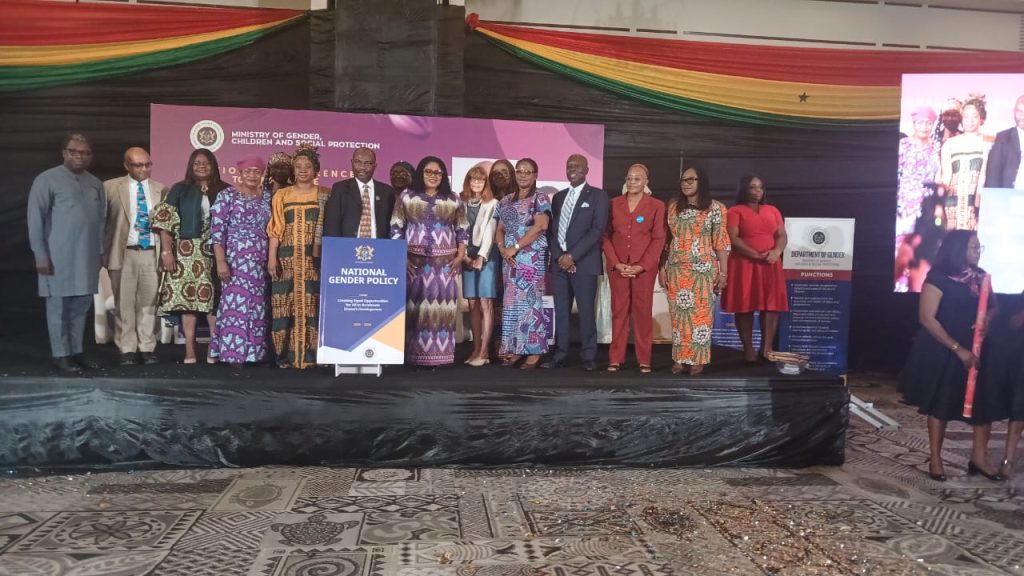
Accra, March 4, GNA- The Government has launched the National Gender Policy 2025–2034, reaffirming its commitment to advancing women’s rights, justice and empowerment, as part of activities marking this year’s International Women’s Day (IWD).
The policy was launched at a national conference in Accra, ahead of the global observance of International Women’s Day on March 8.
Dr Agnes Naa Momo Lartey, Minister of Gender, Children and Social Protection, said International Women’s Day remained a historic platform for promoting women’s rights, labour justice, political inclusion and social equity.
She noted that this year marked 115 years of International Women’s Day celebrations worldwide, describing the milestone as a testament to decades of courage, advocacy and progress in breaking barriers and shaping inclusive policies.
“It represents 115 years of courage, advocacy and progress in breaking barriers, shaping policies, amplifying women’s voices and driving systemic change towards a more just and inclusive world,” she said.
Dr Lartey said the 2026 global theme, “Rights, Justice, Action for All Women and Girls,” underscored the need to move beyond declarations to concrete, deliberate and sustained interventions.
“Rights alone are not enough; they must be protected by justice and backed by deliberate and sustained action,” she emphasised.
The celebration, she said was also supported by the global “Give to Gain” campaign, which called for equitable opportunities and platforms to enable women and girls to access and share resources fairly.
The Minister referenced deliberations at the 39th Ordinary Session of the Assembly of Heads of State and Government of the African Union in Addis Ababa, Ethiopia, where President John Dramani Mahama, in his role as the AU Gender Champion, reiterated that gender equality was not only a moral imperative but also an economic necessity and a driver of sustainable development.
She said the position captured Ghana’s renewed resolve to achieve equality across all sectors of national life.
Dr Lartey explained that Government’s “Resetting Ghana Agenda” placed women’s rights, justice and inclusive action at the centre of national development, with commitments to strengthen legal, institutional and social protection systems to safeguard the dignity and freedoms of women and girls.
She cited key gender-responsive laws and frameworks, including the Domestic Violence Act, 2007 and the Affirmative Action Act, 2024, as critical tools for eliminating discrimination and increasing women’s participation in leadership and decision-making.
The Minister said the Ministry was expanding access to justice for survivors of gender-based violence through the strengthening of shelters, legal aid, psychosocial services and improved coordination among institutions such as the Domestic Violence and Victim Support Unit (DOVVSU) of the Ghana Police Service and the Ghana Health Service.
She added that efforts were also underway to promote women’s political participation by supporting policies and programmes that prepared and resourced women to contest elections and assume leadership roles in governance and public service.
Dr Lartey said the National Gender Policy 2025–2034, launched on the theme “Creating Equal Opportunity for All to Accelerate Ghana’s Development,” would mainstream gender equality across education, health, agriculture, governance, digital transformation, infrastructure and economic planning.
She emphasised that its successful implementation would require coordinated efforts from Parliament, civil society, development partners and the private sector.
“Celebration must be matched with systemic change. Gender equality is a national development priority. Inclusion must be mainstreamed across all sectors, decisions must be accountable and empowerment must be measurable and sustainable,” she added.
Madam Rita Naa Odoley Sowah, Deputy Minister of Local Government, Chieftaincy and Religious Affairs, also called for concrete and sustained action to advance gender equality, stressing that celebration alone was not enough.
She said the theme of the celebration challenged stakeholders to move beyond reflection to decisive action in promoting the rights and empowerment of women and girls.
“Today, we celebrate Ghanaian women across all sectors – farmers, traders, teachers and the young girls who represent Ghana’s future,” she said.
Madam Sowah noted that while recognising women’s contributions to national development was important, meaningful progress required deliberate policies backed by implementation, accountability and adequate resources.
She urged government institutions, civil society organisations, traditional authorities and the private sector to work collaboratively to eliminate structural barriers that hindered women’s full participation in economic, political and social life.
Meanwhile, Madam Helen Adjoa Ntoso, Chairperson of the Parliamentary Select Committee on Gender, Children and Social Welfare and Head of the Women’s Caucus in Parliament, commended the Ministry for organising the conference.
She said Ghanaian women in both the formal and informal sectors remained central to the country’s economic activity, social cohesion and democratic stability.
While acknowledging progress made over the years, she noted that policies alone could not transform lives without effective implementation, adequate budgetary allocation and strong parliamentary oversight.
Madam Ntoso assured the Ministry of Parliament’s commitment to its oversight responsibilities, including advocating increased resources and promoting cross-sector collaboration to ensure the full realisation of the objectives of the National Gender Policy.
The conference brought together government officials, development partners, civil society organisations and women’s groups to renew national commitment to advancing women’s rights and accelerating inclusive national development.
GNA
Edited by George-Ramsey Benamba