By Prince Acquah
Cape Coast, Dec 13, GNA – The University of Cape Coast (UCC) School of Business has climaxed its golden jubilee with a firm commitment to provide future-relevant business education, produce industry-ready graduates and become the leading business school in Africa.
Already, the school has established specialised departments alongside strategic centres including the Centre for Entrepreneurship and Small Enterprises Development and the UCC Business Incubator to strengthen its relevance to industry, policy and the innovation ecosystems.
Professor Denis Worlanyo Aheto, the Acting Vice Chancellor of UCC, noted that the school’s remarkable evolution since 1975 and its responsiveness to emerging challenges gave it significant leverage for the future.
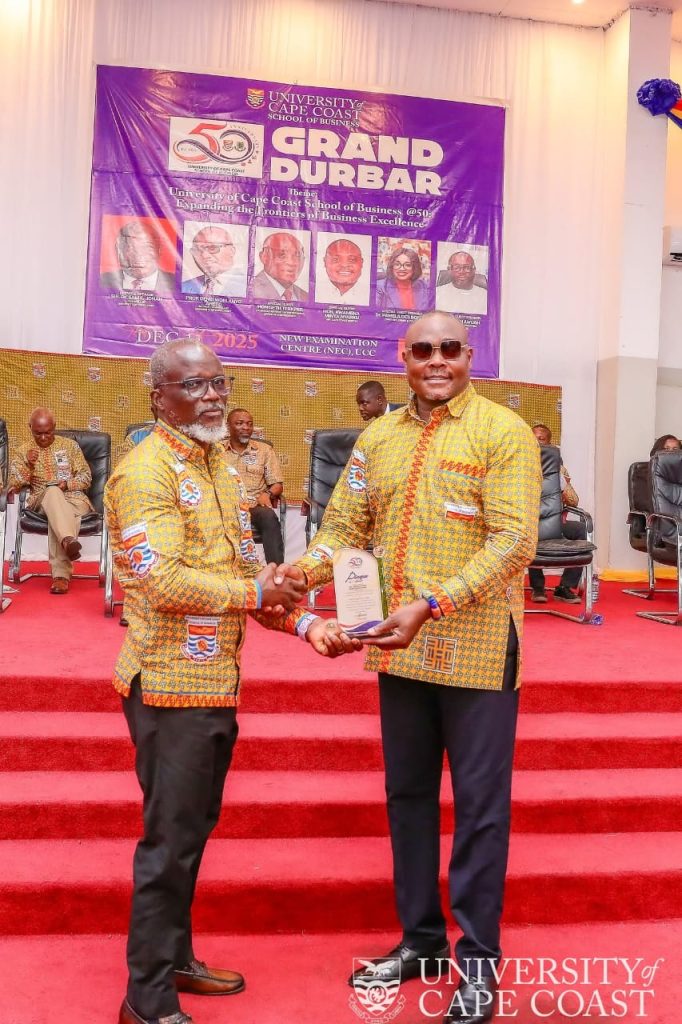
“We are confident that the next phase of the school’s journey will be defined by deeper industry engagements and intellectual prowess, impactful research, digital transformation, entrepreneurial education, sustainability and global competitiveness,” he stated.
“In the era of rapid technological change including AI and the complex socio-economic challenges, it is our hope that the School of Business will continue to produce business leaders and innovative thinkers and problem solvers for Ghana, Africa and beyond,” he added.
The anniversary was climaxed with a colourful grand durbar under the theme: “University of Cape Coast School of Business @50: Expanding the frontiers of business excellence.”

Before the climax, activities for the celebration included a float, a business challenge for Senior High Schools, a public lecture on AI and business solutions, a health outreach, and a clean-up exercise.
The UCC School of Business started in 1975 with two undergraduate programmes under the Department of Economics and Business Studies.
It later progressed to become a department and eventually, a fully autonomous school in 2006 under its inaugural Dean, Emeritus Professor Kofi Awusabo-Asare
The school now boasts of nine undergraduate programmes, 30 masters’ programmes, and one research doctoral programme with a total population of more than 6,000 students including 20 foreign students.
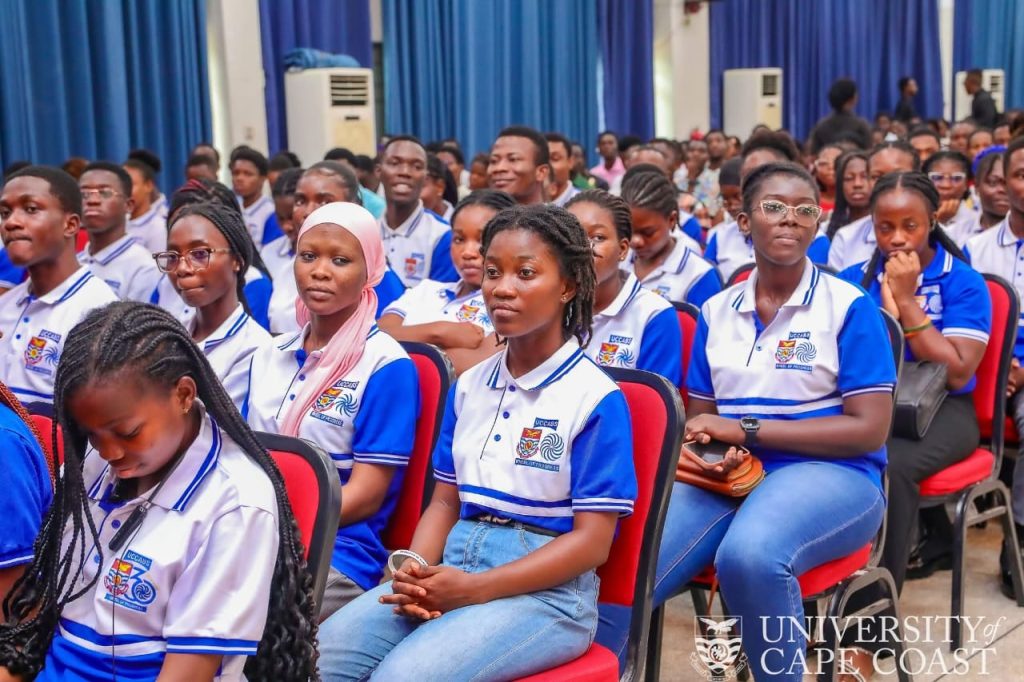
Programmes offered include accounting, finance, human resource management, marketing, supply chain management, public policy, health services chain management, customs administration, entrepreneurship and business engineering.
Prof Aheto expressed the commitment of the university to support the School of Business to become the best in Africa and beyond.
Sir Dr Sam Jonah, Chancellor of UCC and business mogul, highlighted some contributions of the School of Business to national development but was quick to challenge it to brace up for the future.
He charged the school to embed Artificial Intelligence (AI) and data analytics, digital entrepreneurship, and other emerging disciplines in its programmes to meet the demands of the disrupted job market.
He also charged them to move away from rote learning and produce students who were critical thinkers and creative, noting that “the future belongs to problem solvers and innovators do not note reciters.”
Sir Dr Jonah further urged stronger collaboration with industry, backed by mandatory internships to give students real job experiences.
He emphasised the need to produce ethical and courageous leaders as smart people without integrity could destroy an entire nation.
Prof Samuel Kwaku Agyei, the Dean of the School of Business, touted some achievements of the school and announced a dramatic surge in the demand for postgraduate studies.
Reaffirming the commitment to becoming Africa’s number one business school, he maintained that they had built adequate staff profile and structures to achieve that goal.
However, he said inadequate infrastructure was a major hurdle to the goal.
“Our infrastructure level is woefully inadequate to support the growth agenda of the school. Virtually all existing infrastructure are less appropriate for running modern day postgraduate business programmes,” he said.
Prof Agyei indicated that the school was raising funds to establish a befitting postgraduate complex and called for the support of the university council and management to complete an abandoned GETFund project which had stalled since 2009.
“Given the stature of UCC School of Business in Ghana and beyond, these infrastructural deficits must be addressed intentionality with urgency, and commitment,” he appealed.
Prof Daniel Agyapong, Provost, College of Humanities and Legal Studies, described the school as one of the productive units of the College with significant impact in teaching, research and community outreach.
He reiterated the need for the school to rise to the expectations of the changing world while it strived to build more internal partnerships and deepen community engagements.
Mr Seth Tekper, Technical Advisor on the Economy to Government, challenged UCC to establish a school or department for government to foster the efficient use of public resources, check malfeasance and ensure proper government accounting.
He observed that the lack proper accounting fuel malfeasance and wasteful use national resources with little to no consequences.
Mr John Awuah, CEO, Ghana Association of Bankers, entreated the school to make ethical leadership a cornerstone of knowledge delivery.
Dr Kwamena Minta Nyarku, Member of Parliament for Cape Coast North, reiterated government’s commitment to tertiary education, highlighting various interventions for students and universities across the country.
GNA
Edited by Alice Tettey /Kenneth Odeng Adade