By Desmond Davies, GNA Special Correspondent
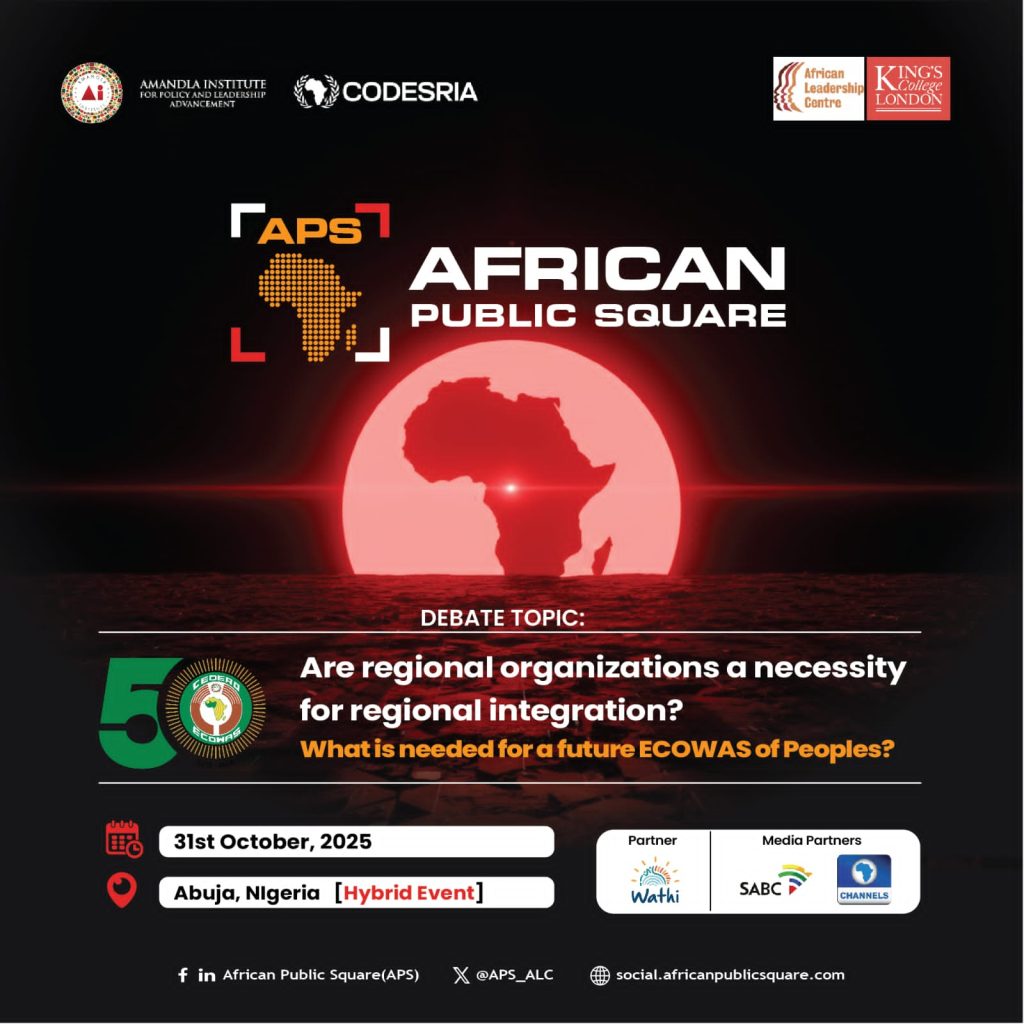
Abuja, Oct 30, GNA – Fifty years after the creation of the Economic Community of West African States (ECOWAS), the future of regional integration will be under the spotlight at the second gathering of the African Public Square (APS) in Abuja.
The APS was established by the African Leadership Centre at King’s College London in 2023 as a continental platform to “facilitate transformative dialogue on peace, security and development in Africa”.
The APS will take place alongside
the ECOWAS at 50 Conference on October 31 and November 1 at the regional organisation’s headquarters in Abuja.
Organised in partnership with the Amandla Institute, the Council for the Development of Social Science Research in Africa (CODESRIA), and the West African Think Tank Initiative (WATHI), the event aims to reflect on ECOWAS’s journey over the past five decades and to reimagine its role in shaping the future of regional integration and governance in West Africa.
According to Shuvai Busuman Nyoni, Executive Director of the ALC, the gathering will serve as both a celebration and a moment of reflection for the continent.
“This year’s event marks both a milestone and a call to action,” Nyoni said.
“As ECOWAS turns 50, it is time to look back with clarity and forward with courage – to ask what kind of regional organisation Africa needs for the next 50 years.”
The APS brings together an “intergenerational community of African public intellectuals to exchange ideas, debate policy challenges and chart new directions for Africa’s global engagement”.
“The African Public Square is about reclaiming the intellectual and policy space for African voices – across generations – to lead conversations that define our collective future,” Nyoni explained. “It provides a forum for co-leadership and innovation that addresses persistent conflicts, governance challenges and global inequalities affecting the continent,” she added.
A highlight of the 2025 edition will be a high-level public debate on the question: Are Regional Organisations a Necessity for Regional Integration? What is Needed for a Future ECOWAS of the People?”
The debate is expected to feature prominent African scholars, policymakers and young leaders, offering a mix of historical reflection and forward-looking perspectives on the relevance of regional institutions in a rapidly changing global context.
Following the debate, the ECOWAS at 50 Conference will convene for a day and a half under the theme Looking Back to Look Forward.
Participants will assess ECOWAS’s achievements and challenges while exploring strategies for building a more inclusive, responsive and people-centred regional body.
The discussions will revolve around five thematic areas drawn from ECOWAS’s ongoing consultations and Vision 2050 framework:
ECOWAS Vision 2050 and Emerging Technologies: Artificial Intelligence, Digital Transformation, Communication, and Social Media
The Future of ECOWAS’s Partnerships and International Relations
Regional Economic Integration and Sustainable Development in West Africa
Women and Girls in Governance, Peace, Security, and Regional Integration
ECOWAS of the People: Peace and Prosperity for All
“This is not just a commemorative event,” Nyoni said.
“It is a moment to think critically about what an ‘ECOWAS of the People’ truly means; how we can move from rhetoric to reality and ensure regional institutions genuinely serve the citizens they represent,” she added.
The two-day conference is expected to draw leading African intellectuals, regional policymakers, civil society organisations and youth representatives from across the continent.
Together, they will explore how ECOWAS can adapt to the evolving political, economic and technological landscape while remaining anchored in the aspirations of West African citizens.
As the region marks half a century of ECOWAS’s existence, the ALC’s initiative underscores a growing call among African thinkers and institutions to reimagine regionalism from the ground up – one that is participatory, equitable and responsive to the continent’s diverse realities.
GNA
Edited by Beatrice Asamani Savage