By Prince Acquah
Cape Coast, Nov 09, GNA – Professor Michael Osei Adu, a Professor of Crop Ecophysiology and Improvement at the University of Cape Coast (UCC), has called for more research and increased investment in neglected and underutilised food crops to strengthen food security in Ghana and Africa.
He observed that about 60 per cent of the world’s food energy came from just rice, maize and wheat, warning that overreliance on the three crops did not augur well for global food security.
He therefore stressed the need to diversify food production by investing more in other staple crops, particularly those that had been largely neglected.
Prof Adu, who is also the Deputy Director of UCC’s Directorate of Research, Innovation and Consultancy, made the call during his inaugural lecture on the topic: “The underground gospel: roots, the neglected, and the tuberous route to Africa’s food security.”
He argued that the potential of many neglected crops such as cocoyam, taro, water yam and garden eggs remained largely untapped because of inadequate research, limited crop improvement and weak seed systems.
However, these crops offered important benefits, including high nutritional value, resilience to environmental conditions, preservation of cultural heritage and support for rural livelihoods.
For him, food security was not only about increasing crop yields but also ensuring access to nutritious food, insisting that “they don’t lack value, instead, their value has been neglected.”
Prof Adu further stressed the importance of studying plant root systems, which determined how crops accessed water and nutrients from the soil.
He said understanding root architecture could help scientists develop crop varieties better adapt to challenges such as erratic rainfall, drought, poor soil fertility and pest attacks.
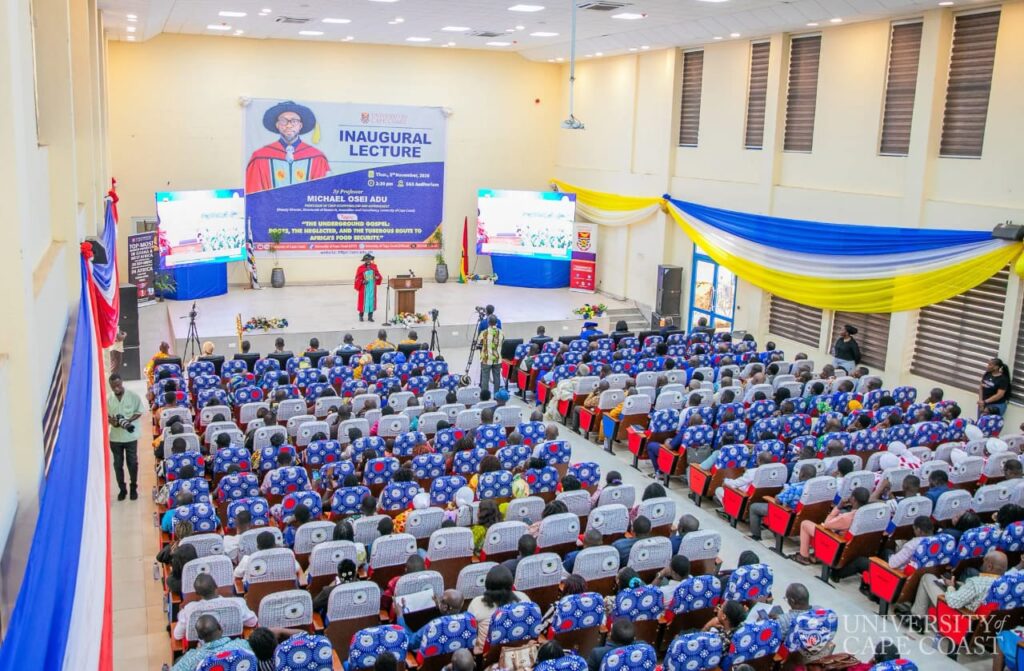
With particular emphasis on root systems, Prof Adu called for increased research into neglected crops and other root and tuber crops to improve their productivity and resilience to environmental stresses.
He said institutions and countries must invest in the establishment of well-equipped laboratories, improved research infrastructure, human resource development and partnerships to strengthen Africa’s capacity to study plant root systems.
Citing challenges such as erratic rainfall, drought, and poor soil fertility in Ghana and many parts of Africa, he said more work was required to make the crop roots more resilient and productive.
To contribute to the effort, Prof Adu said he and his research team had conducted studies and collected data to help predict and improve the yields of several crops, including maize, cowpea, yam, cassava, sorghum, millet and okra.
He recounted that a recent study conducted by him and his team found that only 17 per cent of 893 research works reviewed focused on root systems of roots and tubers.
The study also found that countries such as the United States and those in Asia were conducting more research on cassava than Ghana and Nigeria, despite the crop’s importance to their food systems.
Prof Adu further called for the establishment of dedicated crop-breeding programmes to develop improved varieties of root and tuber crops with higher yields and greater resistance to pests, diseases and changing climatic conditions.
He stressed that deliberate efforts to diversify food production and invest in neglected crops were essential to building resilient food systems and safeguarding Africa’s food security.
GNA
Edited by Alice Tettey /Kenneth Odeng Adade
Reporter: Prince Acquah
E-mail. [email protected]