A GNA Feature by Emmanuel Nyatsikor
Ho, Nov. 09, GNA – Storytelling was once a vital pillar of education, identity and community life in Ghanaian culture, especially in the evenings.
This was when the young ones gather around the elders in their homes or community squares to hear stories from them.
Long before written history, oral tradition passed down customs, myths and ancestral events.
Fables and folktales, most notably the cunning Ananse stories teach children and youth about resourcefulness, and wit, while also serving as cautionary tales against greed, dishonesty and selfishness.
Gathering storytelling strengthens family and community bonds, instilling a shared sense of belongingness, cultural pride and mutual responsibility.
Storytelling in indigenous languages preserves local vocabulary, proverbs, tonal patterns and aesthetics across genial.
It helps the younger ones to understand community standards, respect for elders and prepare them to take on future leadership.
So, storytelling is therefore not only for entertainment.
Sadly, storytelling is fading in the Ghanaian communities and schools.
Why is storytelling fading?
The fading of the art of storytelling can be attributed to urbanization, westernised entertainment, formal education gaps and generational disconnect.
Fortunately, Madam Betsy Benoit, Co-Founder and Project Lead of the Hidden Story Project, a USA based non-government organisation, launched a pilot programme of the Project in the Adaklu Kodzobi District Assembly Basic School in the Adaklu District of the Volta Region to help revive storytelling in Ghanaian communities and schools.
In partnership with the Campfire Tales, the Project is helping children tell their own stories, engage with community elders and prepare them to become mentors themselves.
Since July, this year, Madam Benoit and Madam Ryan Mcabery, founder of Portland, Oregon-based Campfire Tales prior to the launch of the project, selected 14 pupils of the school ages 11 to 14 years and took them through 13 weeks of zoom training.
The workshop was built on the rich Ghanaian tradition of folktales and oral history by helping children recognize stories in their own experiences: a lesson learned, a family memory or an ordinary moment in school.
Madam McAbery told the Ghana News Agency that she has long believed in the power of storytelling but at Adaklu Kodzobi, she witnessed how sharing a story can lead to immediate, tangible change, when Noel, a 15-year-old fifth grade student told his personal story, saying his education was delayed due to family challenges.
Noel said he dreamed of becoming a farmer who could hire and pay workers so that everyone could eat so a piece of land at the school was given to him as a garden.
“It’s incredible to think that the introduction of personal Storytelling can bring real results to people here in Ghana, it is amazing to witness.
“What surprised me most was how little the teachers and pupils knew about one another’s personal lives. When we learn to tell our own stories and hear the stories of others around us we feel seen, and real exchange takes place,” Madam McAbery said.
Mr Robert Tornu, Community Development Advocate, Programmes and Policy Advisor for Friends of Adaklu noted that storytelling needed to be revived in all Ghanaian communities and schools as it focuses in preserving cultural heritage, passing down indigenous knowledge and bridging the gap left by modernization and digital media.
He disclosed that to make the Storytelling partnership possible, “Our Future Prize’s” has donated 285 Starlink devices to rural schools in Ghana adding “Internet access allows our rural children to access the world.”
Mr Charles Kugbeadzor, Headteacher of the school stated that they have noticed improvements in the pupil’s writings, confidence, English language skills, public speaking abilities and leadership since the inception of the Project.
The selected pupils now known as Hidden Story Project Ambassadors will begin mentoring pupils in sister schools in the Adaklu district and the Volta region and educate them on the importance of storytelling.
They have already visited schools in Adaklu Hehekpoe and Adaklu Dawanu, where they read their stories to introduce the programme to them.
Teachers of the school will also receive training to bring personal narrative storytelling into their classrooms.
The organizers of the programme hoped the traditional “fireside storytelling” would be revived through monthly gatherings where children, parents, teachers and elders can share experiences.
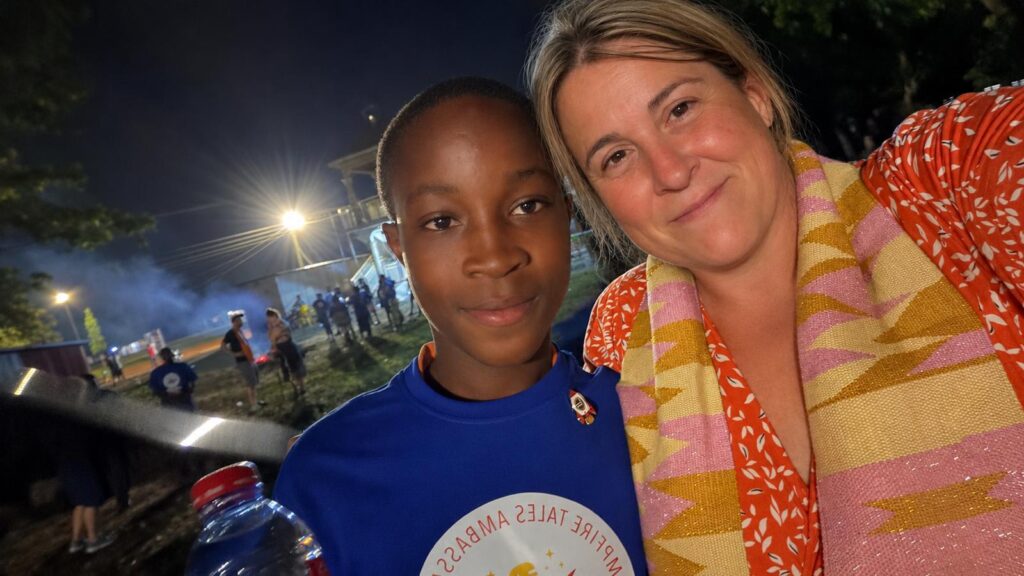
As a starting point, members of the Project and the community organized “by the fireside” where both young and old told stories.
The original Ambassadors told stories about mangoes, family, and school whilst the elderly told stories about Ananse and others to the admiration and amazement of the young ones.
Mr Tornu stated that at the “by the fireside” gathering the children showed they had listened closely enough to want to know more and rather than simply receiving wisdom from the older generation they participated actively in the programme.
Angel “Kikito” Cordona, a member of the delegation, brought a story prompt workbook that was quickly adopted into the school and community.
Mr Tornu said Tomorrow Labs, co-founded by Weston Cox is developing a multilingual technology to help document stories in Ewe and English.
“Our role is to be a bridge; we are helping to build a personal Storytelling tradition that they will lead and carry forward long after we are gone,” Madam McAbery said.
The Centre for National Culture (CNC) plays a central role in preserving and promoting oral traditions, folklore and storytelling in Ghana.
Sources at the CNC say storytelling promotes and bridges traditional oral heritage with modern education, youth competitions, theatre and creative industry partnerships.
The Centre uses storytelling to promote Ghanaian languages and helps rekindle the interest of the youth in storytelling by organizing storytelling competitions in schools as part of their mandate.
Madam Felicia Asamoah-Poku of the Department of Languages, Saint Louis College of Education in Kumasi, in her paper, “Preserving Traditional Folklore through Storytelling” noted that storytelling has long been the lifeblood of Ghanaian communities.
She postulated it served as a timeless medium for transmitting knowledge, instilling values and fostering unity.
According to Mad Asamoah-Poku, this rich tapestry of Ghanaian culture is woven with threads of vibrant folklore, myths and legends passed through generations.
She added that storytelling is steeped in tradition and wisdom and more than mere stories but “the soul of our cultural heritage.”
Madam Asamoah-Poku stated that it also played a vital role in shaping an individual’s sense of cultural identity, fostering pride in one’s life and promoting social cohesion.
She said: So storytelling cannot be wished away because of modernity and education because it is the soul of our cultural heritage, the tapestry of our culture, the lifeblood of our communities and the timeless medium for transmitting knowledge.
Way forward
Because Storytelling has faded in our communities, the younger generation of today cannot understand proverbs and idioms in their local languages.
Madam Asamoah-Poku added: Also, they do not know why certain things are taboos that should not be said or done, the origin of certain words in their languages, cultural and traditional backgrounds.
The Hidden Story Project has “awakened us from our slumber” so let us revive this cultural heritage in our schools and communities to help preserve local fire spread to the other Adaklu communities and the Volta Region in general.
It is the hope of this Writer that the ”by the fireside storytelling” that is reignited by Madam McAbery would spread to the other Adaklu communities and the Volta region as a whole.
GNA
Edited by Maxwell Awumah/Benjamin Mensah