By Edward Dankwah, GNA
Accra, Nov. 03, GNA – Mr Haruna Iddrisu, Minister for Education, has sworn into office the newly constituted Governing Council of the Chartered Institute of Bankers, Ghana (CIB Ghana), led by its President and Chairperson, Dr Mrs Ellen Ohene-Afoakwa, FCIB.
At a ceremony held at the Ministry of Education in Accra, members of the Council took the Oaths of Office and Secrecy in accordance with the Chartered Institute of Bankers, Ghana Act, 2019 (Act 991).
The Council comprises Dr Mrs Ohene-Afoakwa, FCIB, President and Chairperson; Mr Woelinam Dogbe, FCIB, Vice President; Mr Benjamin Amenumey, FCIB, Immediate Past President; Mr Robert Dzato, FCIB, Chief Executive Officer; Mrs Rosemond Amoo, FCIB, Member; and Mrs Doris Yaa Aggrey Ahiati, FCIB, Member.
The rest are, Mr Daniel Kweku Arhin, ACIB, Member; Mr John Awuah, Member, representing the Ghana Association of Banks; Mr Elliot Adu Amoako, Member, representing the Bank of Ghana; Mr Kudjo Andy Ameckson, Member, representing the Ministry of Finance; and Mr Emmanuel Oteng, Member, representing the Ministry of Education.
Mr Iddrisu urged the Council to discharge its statutory mandate under Act 991 by promoting professional excellence, strengthening ethical standards and responding to emerging challenges in Ghana’s banking sector.
He highlighted the Institute’s responsibilities under the Act, including regulating professional banking practice, setting standards of knowledge, competence and conduct, administering professional examinations and promoting continuing professional development (CPD).
The Minister expressed concern about the growing risks associated with cybercrime and digital banking fraud and called on the Council to support efforts to strengthen the industry’s capacity to address such threats.
“We expect that you will respond to the new emerging challenge of artificial intelligence and how that can impact on fraud associated with banking in Ghana,” he said.
Mr Iddrisu also called for greater attention to non-performing loans (NPLs), regulatory compliance and sound corporate governance, stressing that professional integrity must remain central to banking practice.
He challenged the Council to ensure that gains made in the banking industry are sustained through stronger governance, professional competence and responsible banking practices.
The Minister further requested that CIB Ghana advise the Ministry of Education on the feasibility of incorporating financial literacy into the national curriculum and the appropriate level at which it should be introduced.
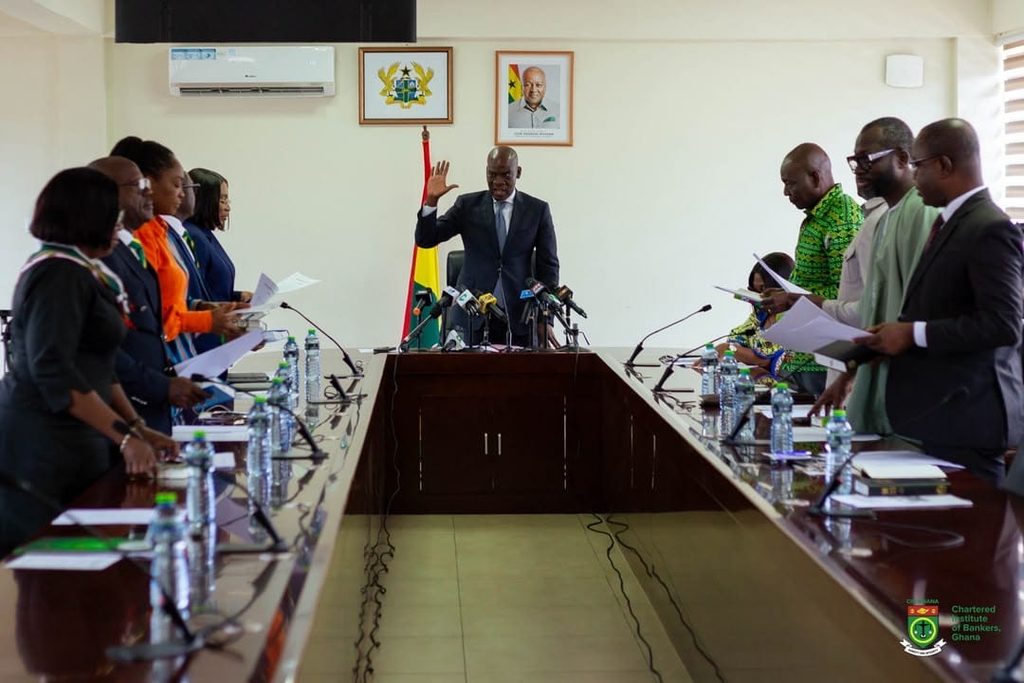
Dr Mrs Ohene-Afoakwa expressed appreciation to President John Dramani Mahama and the Minister for the confidence reposed in the Council, as well as the wider banking community for its support of the Institute.
She said beyond providing strategic direction and oversight, the Council had the responsibility of helping to shape the future of the banking profession in Ghana as technology, innovation and emerging risks continue to redefine the industry.
According to her, the Council would focus on strengthening professional standards, advancing capacity in digital finance, promoting good governance and ethical leadership, and creating stronger pathways for the next generation of banking professionals.
“Banking is ultimately more than just institutions and transactions. It is about enabling business to grow, supporting investments, creating opportunities and contributing to the economic progress of our country,” she said.
Dr Mrs Ohene-Afoakwa acknowledged the Minister’s concerns regarding cyber fraud, digital fraud and NPLs, describing them as priorities that aligned closely with the Council’s agenda.
She said the Institute had already incorporated cybersecurity, virtual assets, data analytics and green finance into its curriculum to prepare banking professionals for the evolving demands of the financial sector.
She added that success for the Council would be reflected in fewer fraud cases, ethical banking professionals who add value and a workforce equipped to improve credit management and help reduce NPLs.
Mr Robert Dzato, Chief Executive Officer of CIB Ghana, reaffirmed the Institute’s commitment to strengthening continuing professional development as a key requirement for maintaining professional competence.
“To be a member in the institute going forward, it’s not just paying subscription, but you must take a certain minimum number of credit hours in a year to continue to maintain that status as a chartered banker,” he said.
Mr Dzato said the Institute was placing greater emphasis on leadership, soft skills and digital competencies, while introducing new content in areas such as virtual assets.
He added that the Institute was also strengthening its faculty through training, recruitment and the engagement of teaching assistants, alongside the expansion of digital learning platforms.
GNA
Edited by Lydia Kukua Asamoah
Reporter: Edward Dankwah