Millions of Ghanaian families cook on charcoal and firewood. Doctors say the smoke is making them sick, and the country has no plan to stop it.
By Albert Appong-Ansah, GNA
Accra, Oct. Esther Asante lights the charcoal and waits for the fire to take. The first daughter of four children in a family who live in this apartment in the fast-growing suburb of Ashaley Botwe, cooking is her responsibility.
Like many homes here part of the living room has been converted into a kitchen, so the stove sits where the family lives. Today Esther cooks banku, a local staple made from fermented corn and cassava dough mixed with water, which requires here to stand over the smoke stirring constantly for about 45 minutes.
Within minutes her eyes react.
“Usually, my eyes itch so bad and often follows tears as if I was crying,” says the 26-year-old. “I feel I may have issues with my sight if I don’t act fast.”
Esther’s kitchen is one of many across urban Ghana where family meals come with a hidden price: serious health impacts from the smoke people breathe while cooking.
About half of households depended on firewood, and about three in ten used charcoal in 2021, according to the Census. That puts them at great risk according to experts.
“When you burn wood or charcoal, you are not just producing heat. You are also producing pollutants that affect human health,” says Professor Reginald Quansah, an environmental epidemiologist.
Tiny particles can travel deep into the lungs, he explains, making breathing harder and worsening infections. The smallest and most dangerous particles penetrate the bloodstream and are then conveyed into every one of the body’s organs.
Over years, they damage the lungs and the heart and raise the risk of Ghana’s biggest killer diseases – diabetes, hypertension, cardiovascular and respiratory diseases, and cancer.
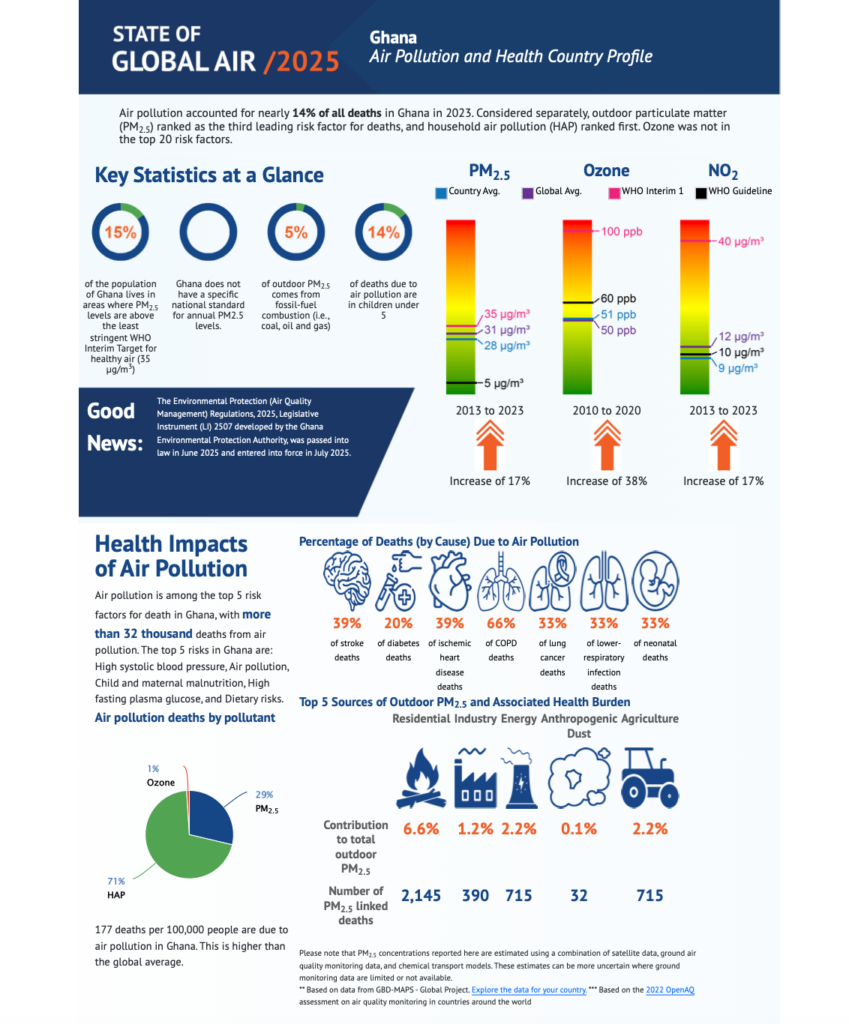
According to the State of Global Air report, air pollution was linked to more than 32,500 premature deaths in Ghana in 2025. That is about 89 people every day; nearly four every hour.
“If you compare cigarette smoke with smoke from traditional cooking fuels, they share many of the same harmful components,” Professor Quansah says. “So, the health risks are very serious.”
He says traditional cooking also releases carbon monoxide, a colourless, odourless gas that interferes with the blood’s ability to carry oxygen.
Burning just one kilogram of wood can produce levels many times above international health guidelines.
If a room is closed-up and not ventilated to let the carbon monoxide out it can replace the oxygen in the room and suffocate humans and animals within.
Families thinking they are protecting sleeping babies by closing doors and windows have caused the death of their children this way.
A burden women and children carry
The redness in Esther’s eyes is constant now. It is not helped by the long days she spends looking at a screen working as a graphic designer at a printing press for her mandatory 12-months national service, a requirement of all graduates of accredited tertiary institutions.
After cooking, she experiences flu-like symptoms – a constant cough, running nose, head congestion. She needs to save up her allowance for two months to pay for a visit to an eye doctor.
Kingsley, Esther’s 15-year-old brother, fans the coal pot to keep them burning. He makes similar complaints.
“The worst part of it is the smoke and the food smell stays in the room for long before fresh air takes over,” Esther says.
Experts say a person breathes about 20,000 times a day. Women like Esther may cook over wood or charcoal twice a day for as long as 60 years.
It is not surprising then that women make up the majority of high blood pressure cases at outpatient departments, says Dr Allen Steele-Dadzie, National Secretary of Ghana Respiratory Association. He is calling for a study to find out whether cooking is linked to those cases.
At the annual General Scientific Meeting of the Ghana Thoracic Society held recently in Accra, Dr Lawrence Ofori-Boadu, Director of the Institutional Care Division at the Ghana Health Service, said household air pollution is a major contributor to the sharp rise in chronic obstructive pulmonary disease (better known as COPD) deaths in Ghana over the past three decades.
Household smoke from solid fuels accounts for the largest single share of those deaths. The same exposure is implicated in a third of lung cancer deaths and a third of lower respiratory infection deaths.
Dr Ofori-Boadu told the meeting that Ghana has failed four tests: diagnosis, treatment, containment and prevention. And it is the country’s poorest people – most likely to depend on charcoal, wood for fuel, to burn household waste and work in the air pollution caused by transport – who are carrying the burden.
“Basic instruments like spirometry, instruments of respiratory diagnosis, are not available in facilities,” he said. “In treatment we pass in parts and fail in parts, and the parts where we fail are where the poorest people live. For prevention it is an uncomfortable one.”
Built into the house
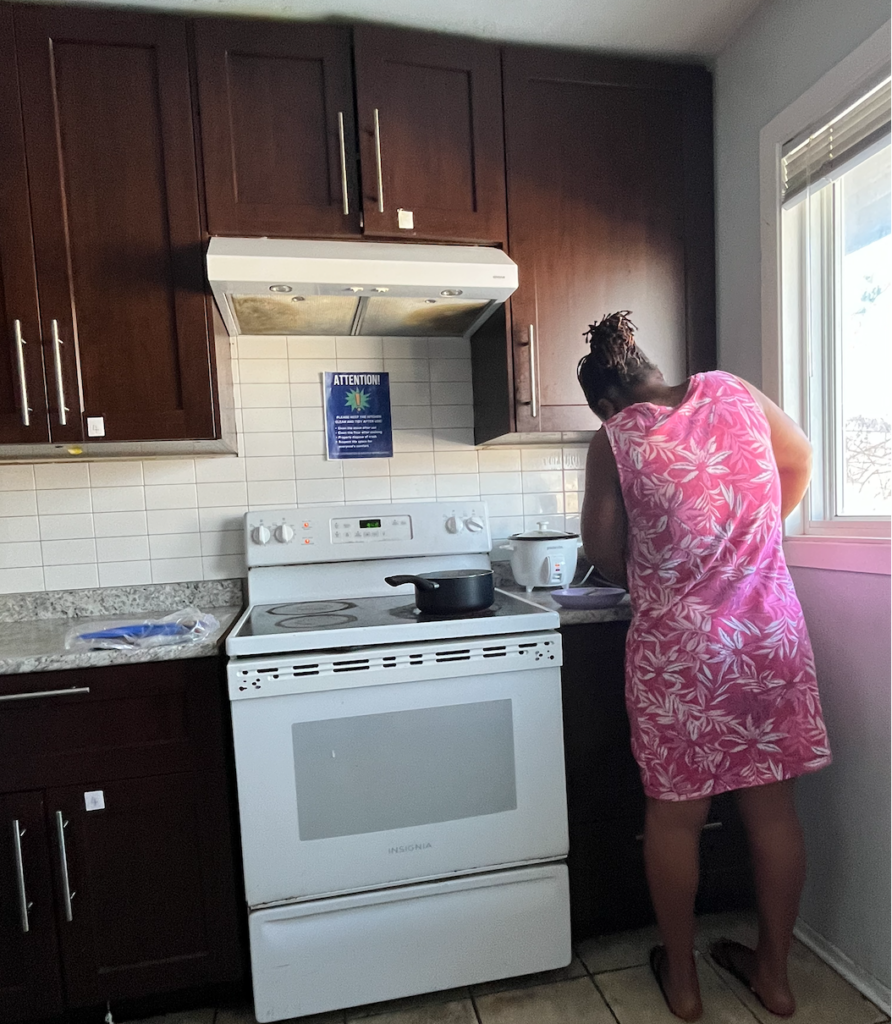
Part of the problem is how homes are built. Traditional kitchens were detached from bedrooms. Many modern urban homes are not.
“You realise most of these have no mechanism that extracts the smoke out,” says Charles Amissah-Koomson, President of the Architectural Society of Ghana. “Women – who normally cook – breathe in the dirty air from the time they set fire through cooking and after. Not only them, but all household members get their share.”
He says architects must now design to get emissions out of the room, and he is calling for a law requiring extractors in urban homes.
A policy still on paper
Ghana has promoted improved cookstoves and alternative fuels for over a decade. Liquefied petroleum gas, known by Ghanaians as LPG, also emits significantly less carbon dioxide and other air pollutants than wood or charcoal, but many households have abandoned it because of cost and access.
But a 2024 study published in the The Lancet Planetary Health found that in Ghanaian settings there was so much pollution coming from neighbours’ fires, roadside traffic and waste burning that using LPG did not make a significant enough difference for real exposure reductions.
Cleaner ways to cook
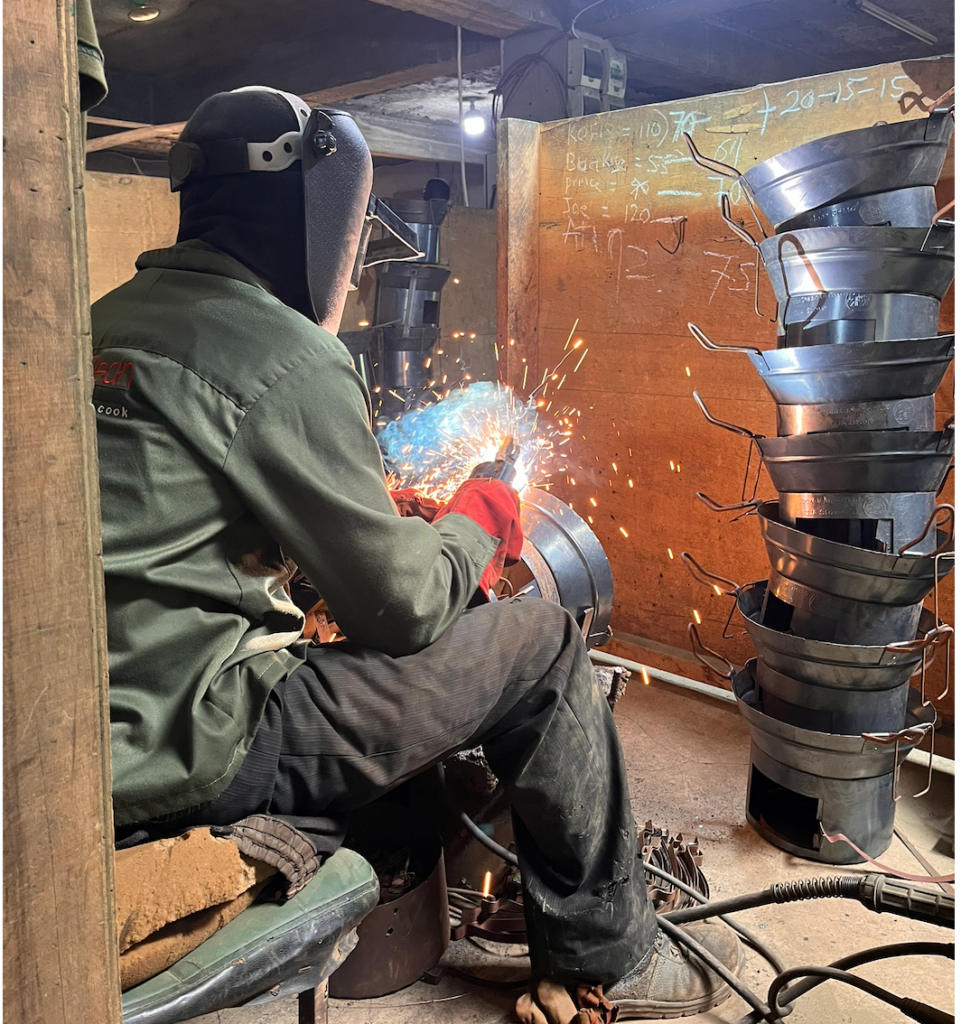
Beyond LPG, several alternatives are already being tried in Ghana. Electric and induction cooking is fast and smoke-free and is being promoted through initiatives such as Building Pathways to Electric Cooking, under the carbon credit initiative with Upenergy.
Energy experts say it works best where the power supply is reliable.
In February 2025 George Kwame Aboagye, a Member of Parliament from the Eastern Region, challenged the government to speed up the adoption of electric stoves.
“Electric-cooking devices present a practical, sustainable solution for achieving universal access to clean cooking facilities by 2030,” he said.
Government agencies are also looking into ethanol stoves. Ethanol burns a liquid fuel made from crops such as cassava and sugar and produces little or no smoke.
Groups such as Africa Center for Energy Policy have been running pilot programmes in Ghana.
Experts say long term answers combine technology, affordable fuels, standards and public education. Ventilation helps manage exposure, they note, but cannot make a highly polluting stove clean.
A National Clean Cooking Policy, drawn up with funding from the World Bank, is awaiting stakeholder validation before it goes to the government for consideration.
It aims adoption of clean cooking in 50 percent of homes by 2030. For now, agencies have their hands tied.
“There is currently no dedicated policy specifically designed to promote clean cooking along the entire value chain,” says Seth Mahu, Acting Director of Renewable Energy at the Ministry of Energy and Green Transition.
“This gap has made it difficult to implement coordinated interventions.”
As always money will be an issue for Ghana’s cash strapped government. Mahu says the Ministry has identified carbon markets as one potential source of revenue to support a broader adoption of clean cooking stoves.
One clause in the 2015 global pact to combat climate change known as the Paris Agreement, allows countries use cuts in emission of the so-called “greenhouse gases” that cause climate change, to generate carbon “credits”, which they can sell to another country on a carbon market.
In July 2025, Ghana transferred 11,733 tonnes of verified emission reductions to Switzerland from clean cookstoves. In exchange, the buyer country typically provides investments, capacity building support, or technology and uses the carbon credits to help meet its own climate goals.
Mr Mahu says such initiatives could help 180,000 smallholder farmers in rural homes access affordable clean.
Professor Emilia Udofia, a Consultant Physician at the University of Ghana Medical School, urges government to prioritise respiratory care, build a national respiratory surveillance system, speed up clean cooking adoption, strengthen regulation and enforcement, and improve ventilation standards in housing.
Dressing these suggestions, she says would prepare the country well to deal with current and future respiratory issues.
Back in Esther’s kitchen, the fire is lit again. For her, and for the households across Ghana that cook this way, clean cooking is about more than saving fuel or protecting the climate. It is about whether providing means for the family will cost them their health.
GNA
Edited by Kenneth Odeng Adade
22 October 2026
This story is a collaboration with New Narratives. Funding came from the Clean Air Fund which had no say in the story’s content.
Reporter: Albert Oppong-Ansah
Email: [email protected]