A GNA Feature by Albert Futukpor
Savelugu (N/R), Oct 27, GNA -District Assemblies across 10 districts in Northern, North East and Savannah Regions have outlined interventions and made commitments to address unpaid care work (UCW) issues following community engagements under the United for Care-sensitive Approaches to Rights and Empowerment (UCARE) project.
The commitments focused on improving access to water, sanitation, labour-saving technologies and essential infrastructure services that could reduce the time and effort women and adolescent girls spent on unpaid domestic and care responsibilities.
The commitments emerged from Gender Model Family (GMF) District Summits, held from 22 to 29 September 2026 across Kumbungu, Savelugu, Mion, Zabzugu, West Gonja, Central Gonja, East Gonja, Mamprugu-Moagduri, East Mamprusi and West Mamprusi Assemblies.
The summits brought together 381 participants including district planning officers, coordinating directors, gender desk officers, and representatives from social welfare, works, the Ghana Education Service, Ghana Health Service amongst others.
The summits provided a platform for communities to present their priorities and engage district authorities and relevant departments on practical responses to challenges that contributed to women and girls’ care burden.
UCARE is a five-year project funded by Global Affairs Canada and implemented by Alinea International in partnership with SEND Ghana and women’s rights organisations (WROs) with the participation of the Ghana Statistical Service (GSS), the National Development Planning Commission (NDPC), Regional Coordinating Councils (RCCs) and MMDAs.
The project seeks to reduce the unequal burden of unpaid care and domestic work borne by women and adolescent girls through two key outcomes: stronger policies and development plans that recognise and address UCW, and greater agency for women and adolescent girls to have their care work recognised and valued.
The project responds to evidence from the GSS’ Ghana Living Standards Survey Round 6 (GLSS 6), which highlights gender disparities in unpaid domestic and care work. The report is cited as showing that women spend three times more time on unpaid care work than men nationally with an even greater disparity in northern Ghana (GSS, 2013). These inequalities can limit women and girls’ opportunities for education, income generation, rest and participation in decision-making.
Through the GMF approach, led by SEND Ghana, households across 450 project communities are being encouraged to share domestic and care responsibilities more equitably.
Community members and leaders have also taken steps to address local UCW challenges through initiatives such as borehole repairs and the construction of wells and dams.
However, priorities requiring greater resources, technical expertise and institutional support call for action beyond the household and community level making collaboration with MMDAs essential.
Beyond household chores: Understanding the care burden
Unpaid care work involves activities such as cooking, cleaning, fetching water, caring for children and other household members, and performing other domestic tasks without financial remuneration.
Although these activities are essential for family and community well-being, they are often disproportionately performed by women and girls, sometimes at the expense of their education, livelihoods and personal development.
The GMF District Summits built on community-level engagements under the UCARE project, during which families, traditional leaders, gender champions and other stakeholders identified barriers to the equitable sharing of household responsibilities.
The district-level engagements sought to move the conversation beyond encouraging men to participate in domestic chores to addressing the infrastructure and social challenges that make care work unnecessarily difficult and time-consuming.
At Mion, Mr Azindow Hamza, Mion District Chief Executive challenged traditional perceptions that categorised certain activities as exclusively men or women’s work.
He said “Men may say that farming is for men and kitchen work is for women yet they expect women to join them on the farm.”
He called for household responsibilities to be shared fairly taking into account family members’ needs, abilities, available time and circumstances.
His remarks reflected a central message of the summits: reducing unpaid care work required challenging restrictive gender norms while creating conditions that enabled families to share responsibilities more equitably.
When community voices influence decisions
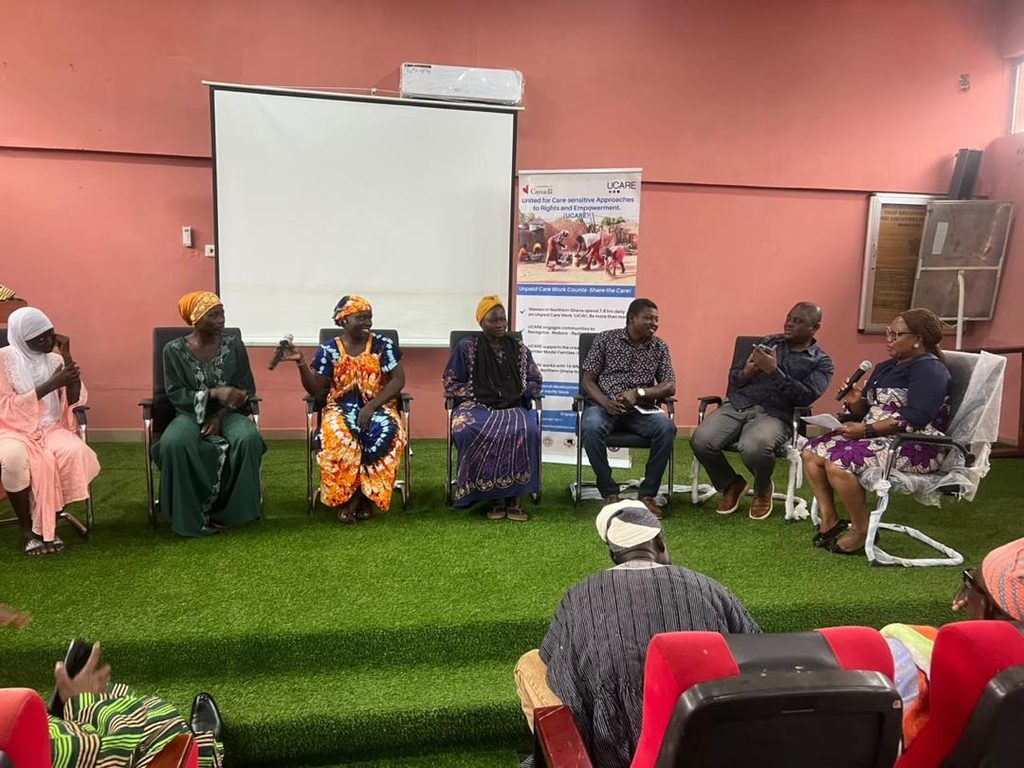
For many participants, the summits offered an opportunity to demonstrate that changing household practices could improve relationships, promote joint decision-making and give women and girls greater control over their time and choices.
During panel discussions, GMFs and community leaders shared experiences of men taking greater responsibility for domestic tasks, improved relationships among co-wives and increased participation by women in household and community decisions.
Christabel Dery, an adolescent girl from West Gonja, recounted how her parents involved her in deciding the university course she intended to pursue.
She said “Before applying for the university, my parents and I decided on the course I was going to pursue. I was very happy because my voice was heard and my parents did not impose the course on me.”
Her experience illustrated how equitable decision-making within families could extend beyond sharing household chores to recognising girls’ aspirations and giving them a voice in decisions affecting their futures.
Community leaders also highlighted locally driven initiatives to address problems affecting women and girls.
The Magajia of Old Buipe described how community leaders introduced fines for individuals, who assaulted women on their way to fetch water, replacing an earlier approach that relied on physical punishment without compensation for victims.
The initiative underscored the importance of community leadership in protecting women’s safety and dignity while accessing essential services.
Other community-led responses included sensitisation through religious and social platforms, community contributions towards repairing infrastructure and efforts to challenge stereotypes that discourage men and boys from participating in household work.
However, participants emphasised that behavioural change alone could not resolve challenges arising from broken boreholes, inadequate sanitation facilities, poor roads and the limited availability of labour-saving technologies.
From community concerns to district commitments
The discussions provided an opportunity for district authorities to examine how community priorities could be incorporated into development plans and budgets.
District Planning Officers presented planned interventions relating to unpaid care work in their respective MMDAs’ Medium-Term Development Plans and Annual Action Plans.
Officials from the MMDAs and decentralised departments including the Ghana Health Service, Ghana Education Service and Department of Agriculture subsequently examined the concerns raised and identified possible interventions.
Access to safe and reliable water emerged as a major priority with several communities reporting broken boreholes, inadequate water systems and insufficient water storage facilities.
In West Gonja, the Assembly committed to conducting technical assessments of broken boreholes and supporting their rehabilitation based on the findings.
East Gonja pledged to incorporate borehole maintenance and rehabilitation into its 2027 Annual Action Plan and budget, strengthen water management committees and monitor water facilities regularly.
The Assembly also committed to supporting the completion of a mechanised borehole at Kakoshie and providing technical assistance for a proposed new borehole at Kapito.
At Mamprugu-Moagduri, commitments included replacing faulty pumps and pipes, rehabilitating existing boreholes, extending water distribution systems and providing additional storage facilities.
At Savelugu, the Assembly will allocate resources to training the water and sanitation committee members on water facility management, financial accountability and record-keeping.
These interventions are expected to reduce the time women and girls spend searching for water especially in communities where unreliable sources force them to travel long distances to meet household needs.
The MMDAs also identified labour-saving technologies as an important part of the solution. West Gonja committed to assessing community needs and exploring partnerships with suppliers to improve access to affordable and durable equipment.
East Mamprusi pledged to incorporate the provision of grinding mills into the 2027 Annual Action Plan and facilitate linkage with development partners/private operators where necessary while Zabzugu committed to engaging civil society organisations and non-governmental organisations to support the acquisition of a grinding mill for Jemoni.
Mamprugu-Moagduri also identified opportunities to link vulnerable households with development partners and private suppliers to obtain affordable blenders, gas cylinders and energy-efficient stoves.
The commitments extended to sanitation, roads and other infrastructure. East Gonja pledged to liaise with NGOs like iDE Ghana to support household toilet construction through an instalment payment arrangement, and to improve sanitation monitoring while Mion committed to providing basic equipment for community cleaning activities.
At Zabzugu, the Assembly undertook to pursue the construction of feeder roads and a bridge linking Jemoni and Lagbani through engagement with the relevant roads authorities.
Such interventions could ease access to essential services and livelihoods while reducing the additional time and physical effort associated with poor infrastructure.
The discussions also addressed concerns about practices that increased girls’ care responsibilities. At Mamprugu-Moagduri, participants raised concerns about schoolgirls being assigned water-fetching duties after school.
Proposed responses included rehabilitating school boreholes, improving access to drinking water and sensitising teachers on unpaid care work with the Ghana Education Service and relevant district departments identified as key stakeholders.
Recognising families leading change
The summits ended with the recognition of 40 high-performing GMFs comprising four from each participating MMDA: one monogamous family, one polygamous family and two gender champions.
The families received time and labour-saving technologies including gas cylinders, water storage drums, multipurpose cookers and blenders to reinforce positive practices and reduce the time spent on domestic activities.
For Suweba Abutu, a high-performing gender champion at West Gonja, the support offered practical relief especially during pregnancy.
She said “Using the blender will make my work easy and save my time and energy especially as a pregnant woman.”
Her husband, Iddrisu Ismail, said the recognition had motivated him to encourage other community members to embrace the GMF approach.
Accountability: Turning promises into progress
The summits brought together community representatives, district officials, decentralised departments and regional stakeholders to establish a stronger link between community concerns and district development planning.
To support accountability, an MMDA UCW Action and Commitment Tracker was used to document proposed solutions, responsible departments, resource requirements, implementation timelines and indicators for measuring progress.
The MMDAs are expected to finalise the trackers and incorporate relevant priorities into their 2027 Annual Action Plans and composite budgets.
SEND Ghana is also expected to document promising GMF experiences and support follow-up on commitments including through assembly members’ participation in local planning processes.
However, translating the commitments into tangible improvements will depend on adequate funding, technical assessments, effective partnerships and sustained monitoring.
Ultimately, the UCARE initiative’s success will be measured not simply by the number of commitments made but by whether communities gain reliable water supplies, accessible labour-saving technologies, improved sanitation and safer infrastructure.
For women and girls, who spend hours every day meeting household needs, these improvements could mean more time to study, earn an income, rest and participate in decisions that shape their lives.
The challenge now is to ensure that the commitments made in the district meeting rooms translate into practical changes in homes and communities making unpaid care work a shared responsibility rather than a burden borne disproportionately
GNA
Edited by Eric K. Amoh
Reporter: Albert Futukpor
Email: [email protected]