By Albert Oppong-Ansah, GNA
Accra, Aug. 31, GNA – For decades, the story of development in many African communities has followed a familiar pattern.
Donors and development agencies design projects in distant capitals, secure funding, and arrive in communities with ready-made solutions. Villagers are often consulted only after decisions had already been made.
Today, some communities in Northern Ghana are challenging that model, part of an Africa-wide movement of civil society organisations determined to put development decisions in African hands.
More than 200 representatives from 30 African countries will converge in Accra from September 1 to 3rd, 2026 this week for the Africa Centre Convening under the theme “Africa at the Centre: Leading Change, Shifting Power”.
This first gathering of African civil society organisations is determined to create a new approach to development that gives Africans, from governments to communities, greater power to determine development priorities and how money is used.
“Let’s shift away from those of us who want to control communities to a situation where communities are in the driving seat,” said Charles Kojo Vandyck, of the West Africa Civil Society Institute, organisers of the Africa at the Center convening, in an interview.
One of the models the group will consider is underway in Garizegu, a farming community in the Sagnarigu District of the Northern Region, where 27-year-old youth leader Yakubu Zakaria and the leadership of the community say development should begin with the people who live with the challenges every day.
His community’s priorities are straightforward: sustainable access to water, decent toilet facilities, and proper waste disposal systems.
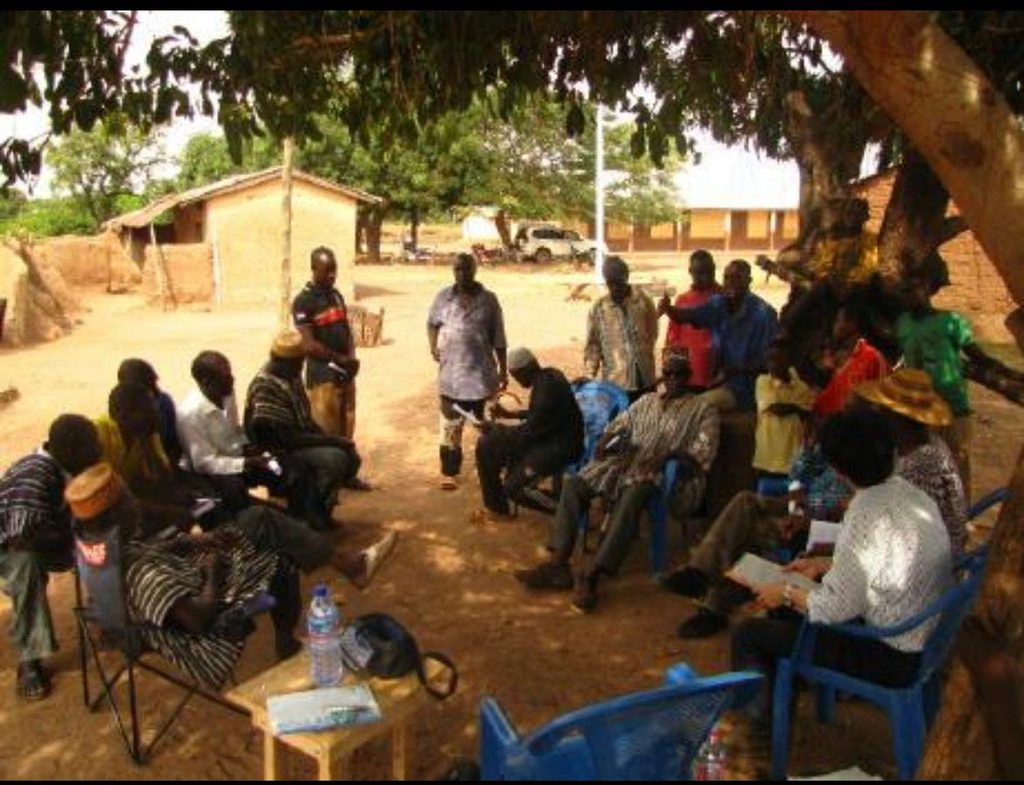
These needs emerged after community members went through a process of identifying and ranking their most pressing development challenges.
“It is not healthy for many people in the community to continue open defecation in the bush,” Zakaria told the Ghana News Agency.
“Children, youth and adults are all affected. Access to sustainable water is also a big issue for us. Support to connect water from Kumbungu is very important.”
The community’s priorities, however, differ from what many external actors have historically considered important.
“A number of organisations have come to the community with interventions such as school buildings, which were good, but they were not our most pressing needs,” he said.
Garizegu is one of several communities participating in an emerging approach that seeks to change how development projects are conceived, financed, and implemented.
Turning Development Upside Down
The initiative, championed by NORSAAC, a Tamale-based civil society organisation, is known as the “Reverse Call for Proposals”.
Instead of donors inviting communities and organisations to apply for funding based on predetermined priorities, communities themselves identify their needs, design proposals, and invite donors and development partners to support them.
The concept forms part of a growing global discussion on localisation and shifting decision-making power from international funding agencies to local communities.
For Awal Mohammed, Executive Director of NORSAAC, the approach is more than just a funding mechanism.
It is a challenge to decades of unequal power relations in development financing.
“The reverse call asks a simple question: What if those affected by poverty, poor sanitation, inadequate education or slow community development were the ones deciding what should happen in their communities?” he said.
“What if they were the ones packaging their ideas, communicating them to development partners and leading decisions around resource mobilisation and utilisation?”
According to him, traditional development systems have often prioritised money over local knowledge.
“The people affected by the issues bring valuable knowledge and experience, yet their contribution is often considered less important than the funding being provided,” he said.
He argued that many governance structures accompanying donor-funded projects inadvertently exclude the very people the interventions are meant to serve.
“You find steering committees, management teams and other decision-making structures being established without meaningful representation from the communities,” he noted.
Communities as Partners, Not Beneficiaries
The philosophy behind the reverse call challenges a deeply rooted perception in international development.
The success of the new paradigm in a community in Zambia, Nyankanga, in 2024, spurred the prompted the team in Ghana to localised and replicate.
Charles Kojo Vandyck, a leading advocate for locally led development and one of the voices behind the broader movement, said development had for years been built around a transactional relationship in which communities were viewed primarily as beneficiaries in need of rescue.
“The system has always been about someone somewhere needing help and someone else coming to rescue them,” he explained.
“Communities in the Global South are often seen only through their problems and needs rather than through their strengths, assets and capabilities.”
According to him, this has created dependency and weakened local ownership.
As a result, many projects lose momentum once funding ends.
“A lot of communities tell us that organisations came, built facilities and left. When the money ended, the projects stopped and the facilities were no longer used,” he said.
Vandyck said sustainable development requires communities to be recognised as co-investors rather than passive recipients.
“We are not saying international support should stop. We welcome support, but it should be on the communities’ terms and based on mutual respect and shared decision-making.”
Africa received $74 billion in official aid in 2023. In the same year, according to the Mo Ibrahim Foundation, the continent lost an estimated $90 billion to illicit financial flows, largely through trade mis-invoicing and tax avoidance. It paid a further $103 billion servicing external debt in 2024.
At the International Monetary Fund, where decisions of consequence require an 85 percent majority, the 46 nations of sub-Saharan Africa, a region with a combined economy larger than India’s, shared just two seats on the 24-member executive board until 2024.
Building Development from Community Assets
The reverse call approach began with a simple exercise.
Mr Awal explained that rather than focusing first on challenges, NORSAAC facilitated discussions that encouraged communities to identify assets already available to them.
Residents spoke about schools, community meeting spaces, water committees, women’s savings groups, voluntary associations, and local philanthropy.
They discussed how families support vulnerable members, contribute towards funerals and community projects, and pool resources for collective action, he said.
Many participants had never considered these activities as development assets.
“We realised communities already have many resources and support systems,” Mr Awal said.
“The problem is that these contributions are rarely recognised or organised in a way that forms part of development planning.”
After identifying existing strengths, community members were asked a critical question: If additional resources became available, what issue would they prioritise?
For communities such as Garizegu, water and sanitation emerged as the most urgent concern.
Working with district assemblies and technical experts, community members estimated the resources needed and developed proposals outlining their priorities and contributions.
NORSAAC then circulated those proposals globally and the response surprised many observers.
Within two months, approximately 11 organisations and individuals had expressed interest in supporting the communities’ priorities.
Challenging a Long-Standing Status Quo
Mr Awal, who has worked in the development sector for nearly two decades, said the initiative had exposed flaws in traditional development models.
He recalled projects whose objectives, strategies and budgets were largely designed overseas long before local stakeholders became involved.
“People sit in offices in the United States, the United Kingdom, Denmark or the Netherlands and define the issues, the solutions and even the implementation structure before communities are consulted,” he said.
He said this often forces communities to align themselves with donor priorities rather than the other way around.
“In many cases, success is measured by how well communities adapt to externally designed interventions instead of how well those interventions address local realities.”
For him, this approach is neither sustainable nor empowering.
“It takes power away from the people,” he said. “It robs communities of agency and ownership.”
Early Signs of Success
Although external funding for the community proposals has yet to materialise, NORSAAC says the initiative has already achieved important outcomes.
One of them is a renewed sense of confidence among community members.
Mr Awal said residents expressed satisfaction simply from having been given the opportunity to determine their own priorities.
“The communities have listed what they believe needs to be done, and they feel proud about it,” he said. “Whether funding comes or not, they now know what they can achieve themselves and what support they need from others.”
That sense of ownership could prove transformative.
Development experts argue that projects are more likely to succeed when beneficiaries become decision-makers.
In countries where aid resources are shrinking and international donors are increasingly re-evaluating their commitments; such locally driven approaches may become even more important.
For communities like Garizegu, the message is clear.
GNA
Edited by Linda Asante Agyei
31 August 2026
Reporter: Albert Oppong-Ansah
Email: [email protected]
This story was a collaboration with New Narratives.