Accra, Aug. 31, GNA – Financial irregularities in Ghana’s public sector fell by 62.9 per cent in 2025 – from about GH¢20.72 billion in the previous year to GH¢7.69 billion.
The reduction exceeded the Government’s 50 per cent target, reflecting improvements in public financial management and compliance with financial regulations.
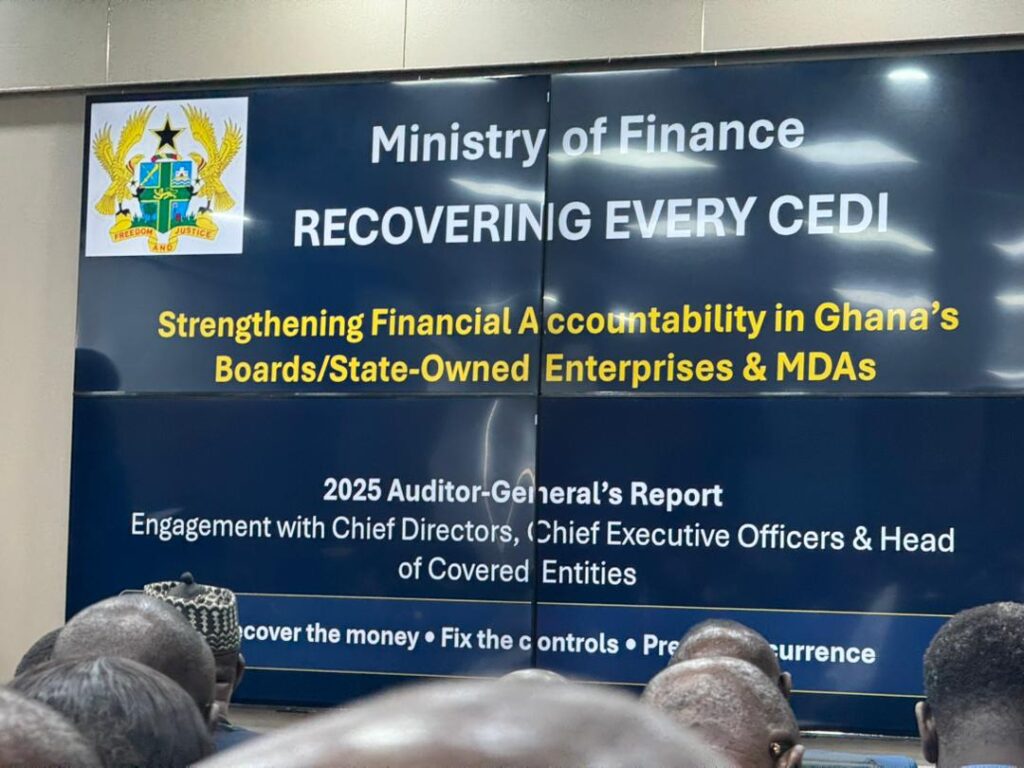
This was highlighted at the 2025 Auditor-General’s Report Engagement in Accra, organised by the Ministry of Finance in Accra.
It was under the theme: “Recovering Every Cedi: Strengthening Financial Accountability in Ghana’s Boards, State-Owned Enterprises and MDAs.”
The engagement brought together Chief Directors, Chief Executive Officers and Heads of Covered Entities to examine the Auditor-General’s findings and discuss measures to recover public funds and strengthen financial accountability.
Mr Thomas Nyarko Ampem, Deputy Finance Minister, who delivered the keynote address on behalf of the Minister of Finance, said public boards recorded the most significant decline in financial irregularities, while public universities and colleges of education also registered notable improvements.
Despite the gains, there was significant weaknesses in some institutions, particularly Metropolitan, Municipal and District Assemblies (MMDAs), where financial irregularities increased by 125.6 per cent in 2025.
The sharp rise occurred despite increased financial support to the assemblies as part of the Government’s decentralisation and local development agenda.
In the 2025 Budget, the Government announced that 80 per cent of the District Assemblies Common Fund (DACF) would be transferred directly to MMDAs to enhance project execution, improve service delivery and reduce bureaucratic delays in the release of funds.
The Deputy Minister described the situation at the local government level as unacceptable and called for immediate corrective measures, including improved financial controls, stronger oversight and enhanced accountability.
He cautioned against complacency over the overall reduction in irregularities, noting that some Ministries, Departments and Agencies (MDAs) also recorded increases.
“We must therefore look beyond the headline reduction and focus on the specific institutions, transactions and control weaknesses that continue to expose public resources to loss, misuse or abuse,” he stated.
The Ministry of Finance was now prioritising the recovery of public funds identified as recoverable in the Auditor-General’s Report, rather than merely recording the irregularities, he emphasised.
Mr Nyarko Ampem said once an amount was identified as recoverable, the Chief Executive Officer, Chief Director or Head of the covered entity concerned was responsible for pursuing its recovery.
He stressed that the process must move from audit findings to agreed action plans, actual recovery and stronger internal controls capable of preventing future irregularities.
He said recovery of public funds should not be left solely to the Auditor-General, as MDAs, MMDAs and other covered entities had knowledge of the transactions and persons involved.
He said the Government would continue to monitor compliance, track recovery efforts and apply the applicable public financial management laws where officers failed to act diligently on recoveries.
He urged MMDAs and other public institutions to take audit recommendations seriously and strengthen preventive controls to reduce future financial irregularities.

Mr David Klotey Collison, Technical Advisor to the Chief Director of the Ministry of Finance, said audit findings should serve as a basis for action rather than routine administrative records.
He urged the participating institutions to carefully examine issues affecting them and leave the engagement with clear action plans to address the findings and prevent their recurrence.
He said the theme: “Recovering Every Cedi”, reflected the Government’s commitment to protecting the public purse, restoring public confidence and ensuring value for money in the use of public resources.
GNA
Edited by Beatrice Asamani Savage