Accra, Sept. 3, GNA – Mr Wisdom Kofi Dogbey, Managing Director of Cocoa Marketing Company (Ghana) Limited (CMC), has called for a fairer distribution of cocoa value benefits across the global cocoa supply chain.
Mr Dogbey made the call at the 4th CAA International Cocoa Conference 2026 in Singapore, where global cocoa and chocolate industry stakeholders are discussing supply, prices, sustainability, investment and other developments shaping the sector.
He urged traders, grinders, manufacturers, investors and other international cocoa stakeholders to treat farmer income as a supply-security issue rather than merely a social intervention.
He warned that Ghana and other cocoa-producing countries could not sustainably rebuild production if farmers remained economically disadvantaged.
He said cocoa farmers, who carried out the hard work of producing the crop, received less than 10 per cent of the profits generated across the international value chain.
The future of cocoa supply, he noted, should be considered beyond international prices, trading strategies and sourcing diversification.
It should also focus on whether farmers had sufficient incentive to maintain, rehabilitate and replant their farms.
“Put the money back into the farm,” he told the conference.
“Our adversary in this cycle is volatility, not each other,” he added.
He said the future of cocoa supply should be considered beyond international prices, trading strategies and sourcing diversification.
It should also focus on whether farmers had sufficient incentive to maintain, rehabilitate and replant their farms.
Mr Dogbey said the administration of President John Dramani Mahama had converted its policy of ensuring that Ghanaian cocoa farmers received 70 per cent of the world market price into law through the newly enacted Ghana Cocoa Board Act, 2026.
The Act, assented to on August 26, 2026, provides statutory backing for several farmer-focused measures.
These include a minimum farmer share of FOB value, the Cocoa Farmers Pension Scheme, an educational trust for farmers’ children, protection of cocoa farmland and support for increased domestic processing.
The statutory guaranteed of at least 70 per cent of FOB value represented an important step in strengthening farmer protection.
“That is the transmission question answered in statute rather than in communiqués,” he said.
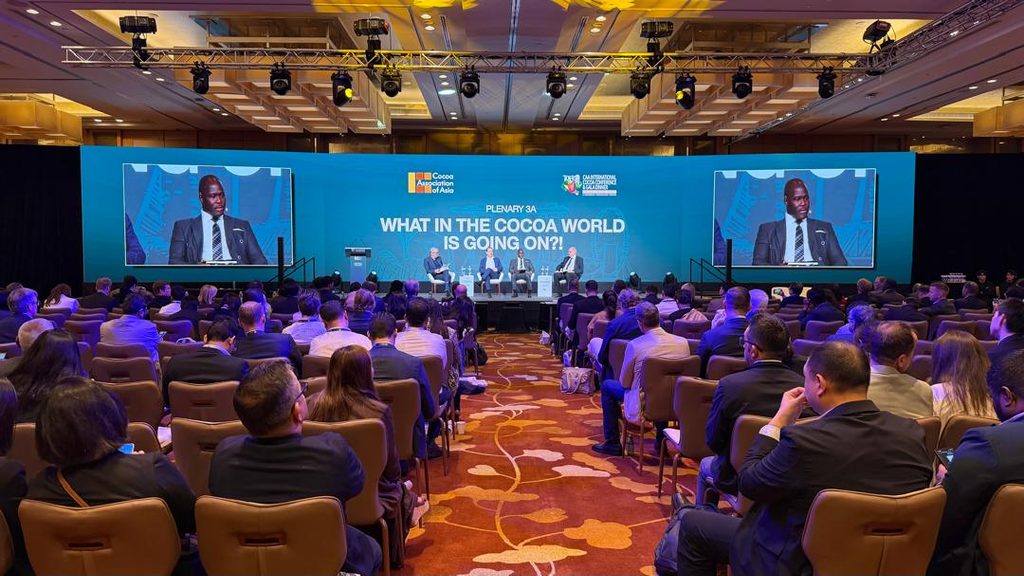
Mr Dogbey said Ghana’s cocoa production challenges, including Cocoa Swollen Shoot Virus Disease, ageing trees, excessive rainfall, changing weather patterns, mining encroachment and declining productivity, could not be addressed sustainably unless farming provided producers with a compelling reason to reinvest.
“The replanting rate is set by what the farmer expects to earn when the new tree bears, not by what the extension service recommends,” he said.
“Farms go unreplanted when the return does not justify replanting. That is not a Ghanaian failing; it is arithmetic.”
He also called for the Living Income Differential, introduced by Ghana and Côte d’Ivoire to improve producer incomes, to be allowed to deliver its intended benefits.
“I am not asking for a new instrument. I am asking that the one already agreed be allowed to work,” Mr Dogbey explained.
On sustainability and traceability requirements, he said the financial burden should be fairly shared.
Ghana, he noted, had invested significantly in farm mapping, geolocation and farmer registration to meet international due-diligence requirements.
“If compliance is worth having, it is worth paying for,” he said.
Mr Dogbey also urged international cocoa companies to invest in Ghana’s productive capacity rather than merely source cocoa from the country.
“Diversification redistributes exposure. It does not create supply where the supply is at risk,” he said.
International grinders, investors and equipment suppliers must “invest at origin, not only source from it”.
The sustainable recovery of Ghana’s cocoa sector required investment in farm rehabilitation, improved inputs, accessible finance, new planting and opportunities for irrigated cocoa production.
He emphasised that the future of the global cocoa industry ultimately depended on creating an economically sustainable cocoa farmer.
GNA
Edited by Beatrice Asamani Savage