By Solomon Gumah, GNA
Tamale, Aug 11, GNA – Forty-five frontline nurses at the Tamale Teaching Hospital (TTH) have been trained to improve the early identification and timely escalation of chemotherapy-induced toxicities amongst cancer patients.
The day’s interactive training, formed part of a quality improvement project, aimed at strengthening the safety and quality of cancer care at the hospital by equipping nurses outside the Oncology Unit with basic knowledge and practical skills to recognise treatment-related complications.
The project is being implemented in partial fulfilment of the requirements for the award of a Postgraduate Certificate in Oncology Nurse Leadership under Cohort II of the Oncology Nurse Leadership Programme (ONLEP) in Africa.
The ONLEP is a leadership development programme designed to equip nurses and midwives involved in cancer care with leadership, critical-thinking and quality-improvement skills to identify and address gaps in oncology care within their institutions and communities.
The programme is an initiative by Professor Lydia Aziato, hosted by the University of Health and Allied Sciences (UHAS), Ho, and implemented in partnership with the International Society of Nurses in Cancer Care (ISNCC), City Cancer Challenge (C/Can), and Amgen.
Participants for the training were drawn from the Accident and Emergency Department, General and Specialist Outpatient Departments, Corporate Clinic, Oncology Unit, Polyclinic, Obstetrics and Gynaecology Emergency Unit of the TTH.
They were taken through cancer and chemotherapy treatment at the TTH, gastrointestinal and haematological toxicities, as well as the early identification and escalation of chemotherapy-related complications.
A major component of the training was the introduction of the TTH Chemotherapy-Induced Toxicity Identification and Escalation Wall Algorithm, a decision-support tool, developed to guide frontline nurses in assessing patients, who had recently received chemotherapy.
The algorithm, developed from relevant literature and clinical guidelines, provides a quick reference for nurses assessing patients who may be experiencing treatment-related complications. It is intended to support timely clinical decision-making and referral to oncology specialists.
The training was facilitated by Dr Abdul-Rashid Timtoni Iddrisu, Medical Oncologist at TTH, Mrs Gifty Sarfo Annan and Miss Evelyn Osei-Amoah, both Oncology Nurse Specialists at TTH and Mr Mohammed Ziblim Osman, also an Oncology Nurse Specialist at the Northern Regional Hospital, amongst others.
All participants received certificates of participation.
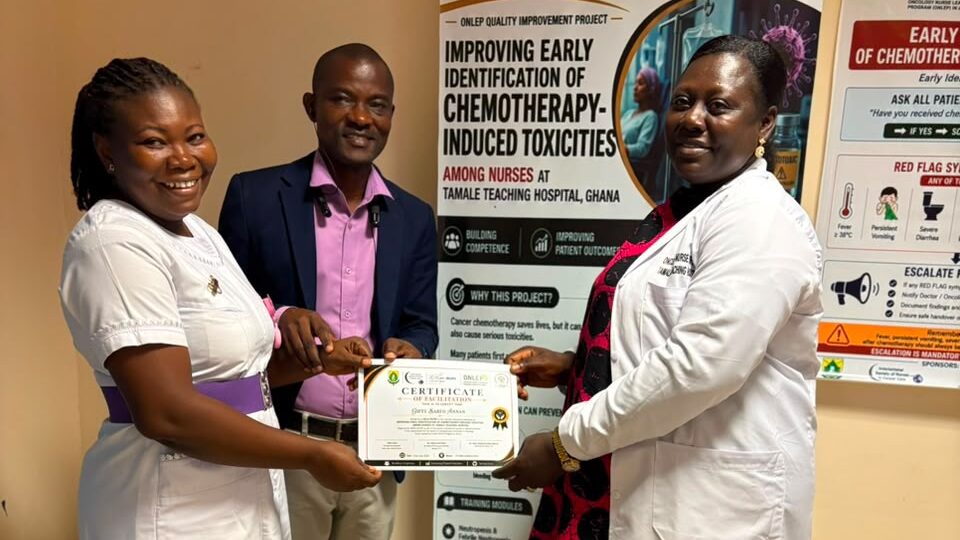
Mr Amos Azure, an Oncology Nurse Specialist at TTH and leader of the project, said the initiative was necessary because chemotherapy services at the hospital were largely provided on an outpatient basis.
He said patients could develop complications after leaving the Oncology Unit and subsequently seek care at other departments where nurses might not have specialised oncology training.
He said: “Chemotherapy complications do not always present in the Oncology Unit, patients may seek help wherever care is available.”
He added “When frontline nurses can recognise the warning signs and act promptly, we save precious time, prevent avoidable harm and give our patients a better chance of recovery.”
Mr Azure said the training was therefore designed to bridge the knowledge gap and enable frontline nurses to recognise common chemotherapy-related toxicities and identify warning signs requiring immediate assessment and escalation to specialist teams.
He said extending basic oncology knowledge beyond the specialised cancer unit would help create a more coordinated response to chemotherapy-related complications and improve patient safety.
Participants undertook pre-and post-training assessments to measure changes in their knowledge and confidence in identifying and responding to chemotherapy-induced toxicities.
The training was also used to present findings from the project, which was expected to inform discussions on integrating chemotherapy-toxicity education and the decision-support algorithm into continuing professional development and staff orientation programmes at the TTH.
Mr Azure called on policymakers, health authorities and development partners to support the expansion of similar capacity-building initiatives to other health facilities across the country.
He said strengthening the capacity of frontline nurses to identify chemotherapy-related toxicities early would help reduce avoidable delays in care, improve patient safety and contribute to better cancer treatment outcomes.
Ms Millicent Kumassey, Deputy Chief Nursing and Midwifery Officer for the Obstetrics and Gynaecology Department, TTH, who represented the Acting Director of Nursing and Midwifery Services, lauded the initiative and said the knowledge gained would translate into improved cancer care outcomes at the facility.
GNA
Edited by Eric K Amoh/Benjamin Mensah
Reporter’s email address: [email protected]