By Issah Mohammed, GNA
Accra, Aug. 5, GNA – Christian and Muslim leaders have pledged to deepen collaboration to address rising indiscipline in Ghana’s schools through coordinated action involving families, schools, religious bodies, government and civil society.
The leaders said restoring discipline and strengthening values-based education required a collective national effort to shape responsible citizens.
The commitment was made at the Fourth Annual Dialogue Meeting between the Ghana Catholic Bishops’ Conference and the Office of the National Chief Imam in Accra on the theme: “Addressing the Challenges of Rising Indiscipline in Our Schools: The Role of Faith-Based Organisations.”
Co-chairing the meeting, Most Rev. Matthew Kwasi Gyamfi, President of the Ghana Catholic Bishops’ Conference, said student indiscipline reflected broader concerns about the kind of citizens the country sought to nurture.
“A nation is not built by skilled professionals alone, but by women and men of integrity, capable of discerning what is right, choosing it freely and placing their talents at the service of the common good,” he said.
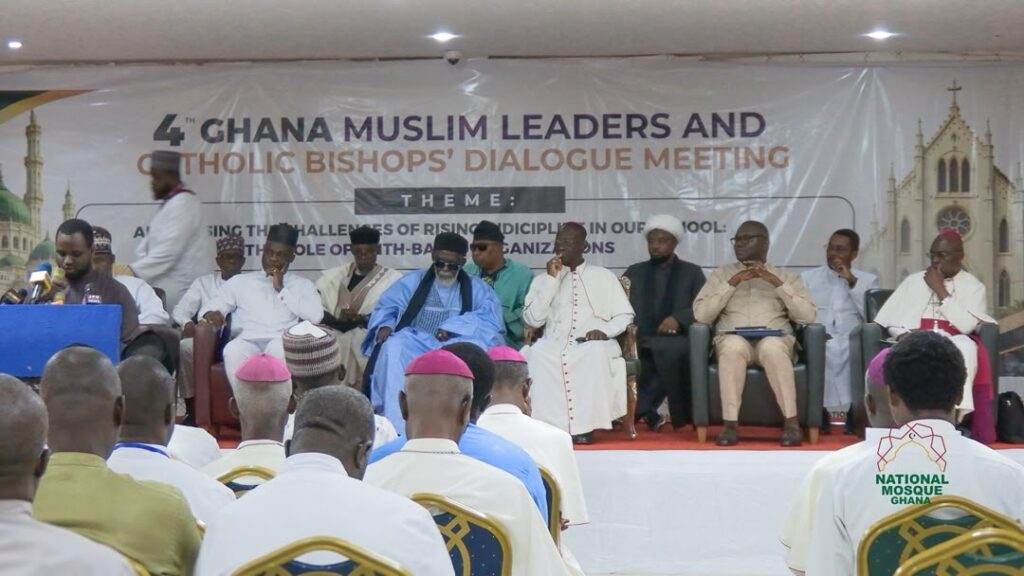
Most Rev. Gyamfi said education should extend beyond academic instruction to cultivate wisdom, reverence for God, respect for human dignity, honesty, responsibility, self-discipline and solidarity.
He said Christianity and Islam shared moral values that were essential to promoting justice, peace, national cohesion and responsible citizenship.
Quoting the African proverb that “it takes a whole village to educate a child,” Most Rev. Gyamfi said authentic education required collaboration among families, schools, religious communities, public authorities and civil society.
“Young people must be formed to think clearly, love rightly and act responsibly,” he said.
Most Rev. Gyamfi said Pope Leo XIV had sent a goodwill message to the National Chief Imam and Ghana’s Muslim community, congratulating both faith communities for sustaining dialogue and encouraging them to continue promoting unity, mutual understanding and peaceful coexistence.
He said Christians and Muslims belonged to one human family and should continue working together to promote national development and social harmony.
Speaking on behalf of the National Chief Imam, Sheikh Armiyawo Shaibu said the choice of the theme reflected growing public concern over rising indiscipline in schools and other sectors of national life.
He described dialogue as the most effective means of building sustainable peace in a world increasingly characterised by religious prejudice, communal tensions and geopolitical instability.
Quoting the preamble to UNESCO’s Constitution, he said: “Since wars begin in the minds of men, it is in the minds of men that the defences of peace must be constructed.”
Sheikh Shaibu announced that a joint working committee would be established to implement the dialogue’s recommendations.
He said the committee would develop an action plan, mobilise the required resources, oversee implementation and submit progress reports at the next dialogue meeting scheduled for 2027.
Addressing the meeting, Mr Ahmed Ibrahim, Minister for Local Government, Chieftaincy and Religious Affairs, said the partnership between Christians and Muslims offered a practical model for national development and social transformation.
He said Ghana’s schools were experiencing challenges including substance abuse, violence against teachers, examination malpractice, dishonesty and declining respect for authority, with implications for academic standards, employment and national productivity.
Drawing on his experience as a student, Mr Ibrahim said faith-based youth organisations had inspired many young Muslims to pursue education and leadership through persuasion, discipline and mentorship.
“What we are seeing today is what we sowed yesterday. If we do not like the results, then we must begin sowing today for the future we desire,” he said.
Mr Ibrahim urged religious leaders to continue instilling discipline, honesty and integrity in young people, saying moral formation was essential to Ghana’s long-term development.
The annual dialogue platform, established in 2022, provides a framework for engagement between the Ghana Catholic Bishops’ Conference and the Office of the National Chief Imam.
It seeks to strengthen interfaith cooperation, promote peaceful coexistence, resolve differences through dialogue and collaborate with state institutions on issues of national interest, including preventing violent extremism and terrorism.
GNA
Edited by Kenneth Sackey
Reporter Issah Mohammed