By Iddi Yire, GNA
Accra, Oct 27, GNA – Ghana is advancing gender parity in its security forces and peacekeeping operations through institutional quotas, legislative backing, and international partnerships, a report by the Foundation for Security and Development in Africa (FOSDA), has revealed.
The content of the report, which indicated that Ghana’s security services are leading the way on women, peace and security was made known by Mrs Theodora Williams-Anti, the Executive Director of FOSDA, at a stakeholder validation meeting on the Final Evaluation of FOSDA’s Monitoring of Ghana’s Second National Action Plan on Women, Peace and Security (GHANAP II).
The Project, which is being implemented by FOSDA with founding support from Global Affairs Canada and the Canadian High Commission in Accra, tracks the implementation of United Nations Security Council Resolution (UNSCR) 1325 on Women, Peace, and Security (WPS).
Mrs Williams-Anti in a statement read on her behalf said Ghana was in a stronger position on Women, Peace and Security than it was at the beginning of GHANAP II, which was 2020.
She said the evaluation documents important developments in the legal, policy and institutional landscape, including the Affirmative Action (Gender Equity) Act, 2024; the National Gender Policy for 2025–2034; the Armed Forces gender policy; Ghana Immigration had a gender and Gender Based Violence (GBV) policy with a training manual; and parliamentary approval of Ghana’s ratification of the African Union Convention on Ending Violence Against Women and Girls.
She noted that they had also witnessed encouraging developments in women’s representation and leadership.
She said women now head the Ghana National Fire Service and Ghana Prisons Service, adding that the Peace Council had increased women’s representation on its Board from one to three members out of thirteen, while the Fire Service reports an increase in women in leadership posts from six to 12.

Mrs Williams-Anti said these developments matter because inclusive leadership was not merely a question of representation.
She said it was also about whose experiences inform decisions, whose security needs were prioritised and who had the opportunity to shape peace and security policies.
“We particularly acknowledge the security institutions (Ghana Armed Forces, Ghana Immigration, Ghana National Fire Service and Ghana Prisons Service) interviewed for this evaluation for the progress they have made in gender mainstreaming,” she said.
The Executive Director said the findings show encouraging institutional initiatives, including gender policies, gender focal structures, staff training and efforts to integrate gender perspectives into institutional operations.
She said the Ghana Armed Forces and the Ghana Immigration Service provide notable examples of institutions that have treated gender as an institutional responsibility, rather than leaving it exclusively to gender units.
She said they commend these efforts and encourage other institutions to build on this progress, declaring that at the same time, gender mainstreaming must go beyond having policies, offices and focal persons.
“It must be reflected in budgets, recruitment, promotion, operational practices, accountability mechanisms and the everyday experiences of women and men within our institutions,” she stated.
“Our task is to consolidate the gains and close these gaps.”
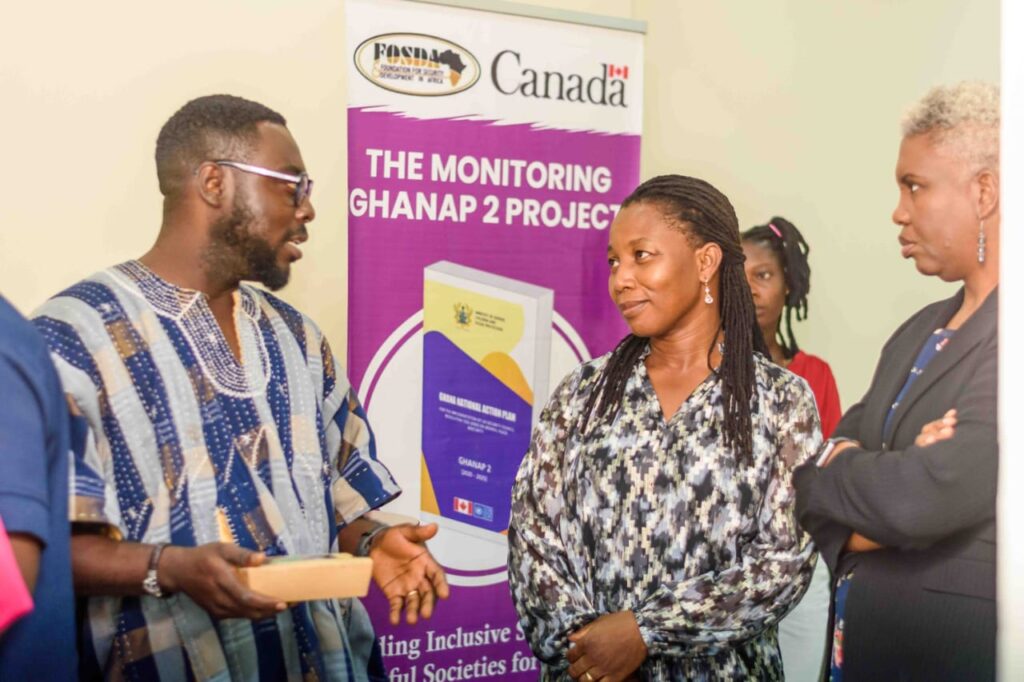
Madam Bertha Desmennu, Senior Programme Liaison Officer, High Commission of Canada in Accra, commended FOSDA for convening the workshop and for its continued leadership in advancing the Women, Peace and Security agenda in Ghana and that Canada was pleased to support these efforts.
She said with GHANAP II now concluded, the final evaluation provides an important opportunity to assess progress achieved, identify remaining challenges, and capture lessons learned that could help inform the next phase of Ghana’s National Action Plan on Women, Peace and Security.
She noted that advancing the Women, Peace and Security agenda requires sustained commitment and collaboration, and the implementation of GHANAP II reflects the efforts of a broad range of
stakeholders including government institutions, civil society, traditional leaders and local communities working toward a common objective.
Madam Desmennu said Canada remains a committed partner in advancing the Women, Peace and Security agenda in Ghana through their support to civil
society organizations, including FOSDA, and their partnerships with Ghanaian institutions.
Madam Dorothy Barnes, FOSDA WPS Project Coordinator, said at FOSDA, they believed that human security was inseparable from dignity, justice, equity and opportunity.
“Peace cannot be sustained where women are excluded from decisions, where survivors cannot access justice, or where communities are left without the resources to prevent violence,” she stated.
“Our message is simple: Ghana has made progress. Our responsibility now is to make that progress sustainable, inclusive and measurable.”
GNA.