By J. K Nabary
Gomoa Fetteh Kakraba (C/R), Aug 11, GNA- Vice President Professor Jane Naana Opoku-Agyemang has stated that meaningful reset began with education and people, prepared to develop practical solutions and serve their country with competence, integrity and compassion.
She said: “Ghana’s transformation will be achieved through the collective efforts of citizens who are educated, innovative, patriotic and committed to the national cause.”
She explained that it was for that reason the government had placed education and human capital development at the centre of the national development agenda.
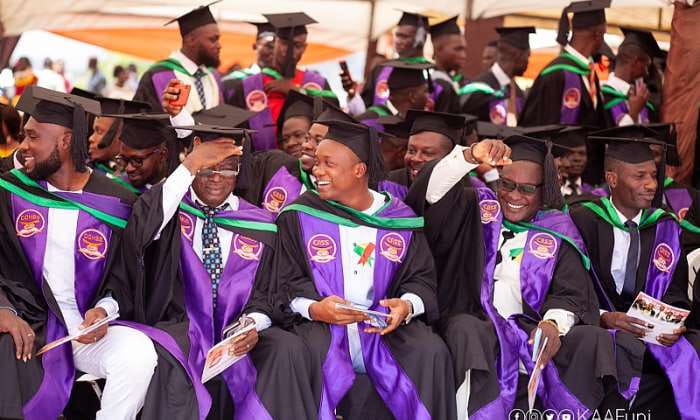
Vice President Prof Opoku-Agyemang noted this as the Guest Speaker at the15th Congregation ceremony of the KAAF University, held on the theme: “Transforming Lives, Transforming Ghana,” at Gomoa Fetteh Kakraba.
She urged the graduating students: As you leave these walls you must become active participants in the Resetting Ghana Agenda by exhibiting integrity at work, being innovative and entrepreneurial, rejecting corruption and mediocrity, creating employment, solving community problems and using the means to improve the lives of others.”
She added: “Our country stands as a defining moment in its development, and building the Ghana we want requires collaboration among governments, academia, industry, civil society and every citizen.”
“The theme for this ceremony reminds us that the national development really begins with the development of individuals and also aligns with government’s resetting Ghana agenda, restoring public trust, strengthening national institutions, promoting inclusive growth and creating opportunities.”
The Vice President said through the No-Fee Stress initiative, for instance, the government was helping to remove the burden of academic fees for first-year students in public tertiary institutions, while the Students Loan Trust Fund had also been reformed to provide more responsive and sustainable financial support to eligible students throughout their academic journeys.
“Another intervention is the Teacher Housing Initiative, designed to provide decent housing facilities for teachers and the project is to be implemented through the decentralised system managed by the District Assembly’s Common Fund, and the Ministry of Education to address accommodation challenges, so that rural posting is not primarily a hardship.” The Vice President said.
The Vice President disclosed that the launching of Ghana’s National Artificial Intelligence Strategy marked another important moment to provide a roadmap for building a responsible inclusive and human-centered artificial intelligence ecosystem for developing local talents, research and innovation.
“KAAF university has already shown its commitment to producing graduates with the knowledge, values, and practical skills needed to succeed in an increasingly technology-driven world,” she said
The Vice President congratulated the institution and encouraged it to make full use of the national initiative by integrating digital literacy and emerging technologies into its academic programmes.
It should also promote interdisciplinary research, support technology-based entrepreneurship and prepare graduates to use artificial intelligence responsibly.
She stated that with the graduating statistics of 58 percent females meant the University recognised the importance of women in higher education, while celebrating the contributions of the men working alongside the women.
The Vice President, who is also a former Vice Chancellor of the University of Cape Coast, said a university such as the KAAF University had a role to play at advancing engineering excellence, supporting sustainable infrastructure, driving digital innovation and natural business leadership, strengthening governance and public policy, training highly skilled healthcare professionals and producing legal practitioners committed to justice and the rule of law.
“I encourage the University to further strengthen research and its partnerships with industry to continue producing graduates whose skills respond to the development aspirations of our beloved country,” she said.
She indicated that the government’s vision of resetting Ghana could not be realised by government alone, but required institutions that produced solutions, industries that invested in local talent and citizens prepared to become ethical leaders and responsible professionals.
“I therefore commend the dedicated lectures, administrators and the support staff of the university for working tirelessly to bring the university this far and hope together we will continue transforming lives and strengthen Ghana’s future.”
She remained the graduating class of 2026 that their graduation was m the beginning of greater responsibility and they must inspire others to do even better and further than they had gone.
GNA
Edited by Alice Tettey/Benjamin Mensah