By Maxwell Awumah
Ho, Aug. 12, GNA – A new compendium of Square Kilometre Array Observatory (SKAO) science has been released, presenting an up-to-date picture of the vast range of astronomical research to be enabled by the SKA telescopes.
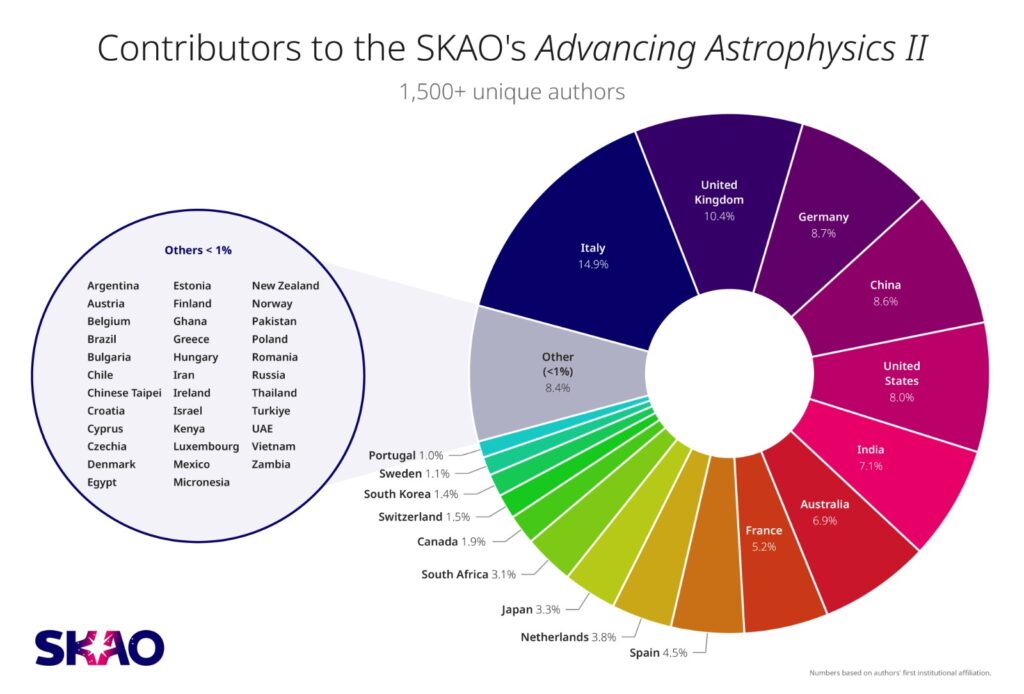
Advancing Astrophysics II is a testament to the global science collaboration behind the SKAO, with contributions from more than 1,500 scientists in 51 countries, a community extending far beyond the Observatory’s member states, according to its release, available to the Ghana News Agency.
With 221 peer-reviewed papers, plus an introduction from SKAO Chief Scientist, Professor Naomi McClure-Griffiths, the book details scientists’ plans for observations across all areas of SKA science.
“This collection of papers shows not only the dazzling array of science our community will seek to address with the SKA telescopes when complete, but also how the community has grown in size and ambition since our last science book in 2015, with hundreds more contributors this time,” Prof McClure-Griffiths said.
SKAO Head of Scientific Services, Dr Anna Bonaldi, said the science cases presented in the book would shape the SKAO’s scientific strategy as the telescope arrays grew towards completion and inform priorities for upgrades and the continued evolution of the Observatory’s capabilities in the coming years.
The SKA telescopes are currently under construction in Australia and South Africa and have begun test observations with partial arrays.
SKA-Low, which will ultimately have 131,072 antennas, released its first test image using 1,024 antennas in March 2025. The same milestone is expected for SKA-Mid later this year using four dishes. It will eventually have 197 dishes, incorporating SARAO’s existing MeerKAT radio telescope.
The telescopes are being delivered through a phased approach and will start to surpass the capabilities of current facilities part-way through construction, at the stage known as Array Assembly 2, comprising 68 SKA-Low stations and 66 SKA-Mid dishes.
The compendium is divided into six broad sections: Sun, Earth and planets; Formation and evolution of stars; From the Milky Way to distant galaxies; The cosmos; The extreme Universe; and Methods and techniques.
Dr Bonaldi said: “Our science explores the Universe across every scale and physical regime, leveraging the SKA telescopes’ transformational sensitivity, survey speed, and imaging capabilities, together with powerful synergies across the world’s leading facilities.”
She said the number of submissions also demonstrated that the science community’s enthusiasm was growing as the SKAO approached its first science.
The SKAO is an intergovernmental organisation composed of member states and partner organisations from five continents, headquartered in the United Kingdom.
Its mission is to build and operate cutting-edge radio telescopes to transform understanding of the Universe and deliver benefits to society through global collaboration and innovation.
Its two telescopes, under construction in Australia and South Africa, will be the two most advanced radio telescopes on Earth.
Together with other state-of-the-art research facilities, the SKAO’s telescopes will explore the unknown frontiers of science and deepen understanding of key processes, including the formation and evolution of galaxies, fundamental physics in extreme environments and the origins of life.
Through the development of innovative technologies and its contribution to addressing societal challenges, the SKAO will play its part in addressing the United Nations’ Sustainable Development Goals and delivering significant benefits across its membership and beyond.
The SKAO recognises and acknowledges the Indigenous peoples and cultures that have traditionally lived on the lands on which its facilities are located.
In Australia, it acknowledges the Wajarri Yamaji as the Traditional Owners and Native Title Holders of Inyarrimanha Ilgari Bundara, the CSIRO Murchison Radio-astronomy Observatory, where the SKA-Low telescope is being built.
GNA
Edited by: Audrey Dekalu
Reported by: Maxwell Awumah
Email: [email protected]