A Feature by Jibril Abdul Mumuni, GNA
Jomoro (W/R), July 21, GNA- The road to Ezinlibo winds through a landscape that defines Jomoro. On one side, endless coconut plantations sway in the Atlantic breeze.
On the other, cassava and oil palm farms stretch toward the horizon, broken only by patches of wetland and the occasional fishing canoe pulled ashore.
This is Ghana’s westernmost frontier — a district of lagoons, sandy beaches, red earth, and communities whose livelihoods have for generations depended on the sea, the soil, and, more recently, gas.
But today, the conversation in Jomoro is not only about fish and hydrocarbons. It is about chalk, classrooms, and a new college that residents believe will change the destiny of the enclave and Ghana.
The proposed Jomoro College of Education (JOCoE)— Ghana’s first Technical and Vocational Education and Training and Science, Technology, Engineering and Mathematics-focused teacher training institution — is steadily moving from blueprint to reality. And with it comes a wave of excitement rarely seen in the district.
Government Walks the Land
For the past four days, a high-level government delegation led by Professor George K.T. Oduro, Technical Advisor to the Minister of Education, toured Jomoro. They met political leaders, education directors, youth groups, and traditional rulers across Western Nzema.
The mission was simple: assess readiness and build consensus for a college designed to produce teachers who can teach skills, not just theory.
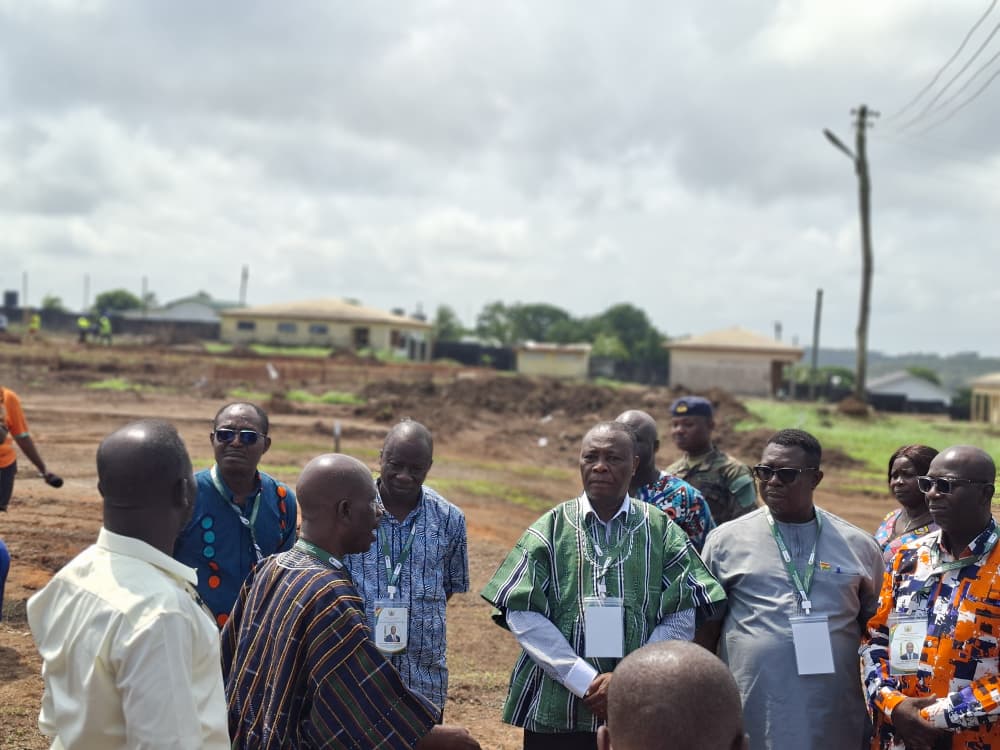
The tour ended at Ezinlibo, the proposed site. Here, against a backdrop of palms and open sky, delegation members inspected existing buildings — old school blocks, offices, and dormitories that once served other purposes.
The sight drew audible approval.
“I am very much impressed, especially noting that there are structures already on the land,” Prof. Oduro said, pausing to look across the compound.
“For me, I think we could have even started the college with some of the structures that I see here. This gives us a head start.”
Officials said the presence of usable infrastructure could significantly cut the time needed to operationalise JOCoE.
What JOCoE Will Look Like
Project documents show an ambitious plan. In its first phase, the college will admit about 2,000 students. The campus will include lecture theatres, science and ICT laboratories, workshops for TVET subjects, a library, residential halls, a dining hall, and administrative blocks.
The 10-year master plan outlines about 20 major infrastructure projects. But what makes JOCoE different is its integration.
Aside from tertiary facilities, the plan includes nursery, kindergarten and basic schools on campus. These will serve as demonstration schools where trainee teachers can practice STEM and TVET methods in real classrooms.
Contractors on site said they were confident of meeting timelines. “The foundation is already here,” one engineer told the delegation. “We just need to build on it.”
Chiefs Give Their Blessing
In Jomoro, no major project moves without the chiefs. And the chiefs have spoken with one voice.
At Beyin, during a durbar attended by elders in full regalia, Awulae Agyefi Kwame II, Paramount Chief of the Jomoro Traditional Area and President of the Western Nzema Traditional Council, announced unanimous support.
“This college is not just for Jomoro. It is for the whole Western Region and Ghana,” Awulae Agyefi Kwame II said to applause.
“It will give our children opportunities and also prepare the skilled manpower we need for the Petroleum Hub and other industries coming to our land.”
The endorsement matters. In this part of Ghana, chiefs control land and command community trust. Their backing is widely seen as the biggest boost yet for JOCoE.
Outside the palace, the mood was celebratory. Women in Nzema cloth danced. Students from Half Assini SHS lined the streets with placards reading “We Want JOCoE Now.”
“Our brothers and sisters travel to Accra, Kumasi, or Tamale to train as teachers,” said Madam Efua Sam, a trader at the Beyin market.
“Now the college is coming to us. This is development.”
From Classroom to Industry
The delegation also visited the Ghana Gas Processing Plant at Atuabo. The contrast was deliberate — to show how education and industry can meet.
Officials discussed future partnerships where JOCoE graduates would teach technical subjects, and where industry experts would come to campus as adjunct lecturers.
Stakeholders believe the college can bridge a critical gap. Jomoro sits next to oil and gas infrastructure, and near the proposed Petroleum Hub. But for years, residents complained that jobs went to outsiders because local youth lacked technical skills.
“This topography demands a new kind of education,” said Mr. Joseph Aidoo, a district education officer.
“We have the sea, the gas, the farms. We need teachers who can train young people in welding, in coding, in agro-processing, in renewable energy. JOCoE will do that.”
A Coalition Behind the Dream
JOCoE is not the work of government alone. It is being championed by a coalition of education experts, academics from universities in Ghana, traditional authorities, and development partners.
Unlike traditional colleges of education that focus mainly on general pedagogy, JOCoE is being designed from the ground up to embed TVET and STEM in teacher training. The goal aligns with national policy to reposition education toward skills and innovation.
For residents, that distinction matters. In a district where unemployment pushes many youth to migrate, a college that teaches practical skills is seen as an anchor.
Voices of Hope
The excitement was most visible among young people. At Ezinlibo, dozens of JHS and SHS students gathered to watch the delegation. Some had walked kilometers.
“I want to be a STEM teacher,” said 16-year-old Rosemond Blay. “If the college comes, I will apply here. I don’t want to leave my mother.”
Her friend, Kofi Essel, wants to study technical education. “We hear about robotics and coding in Accra. Now maybe we can learn it here in Jomoro.”
Teachers were equally hopeful. “For years we have taught theory because we had no labs,” said Mr. Daniel Ackah, a science teacher.
“With JOCoE training our teachers, the next generation will learn by doing.”
A New Chapter for Western Nzema and Ghana
As the delegation departed Ezinlibo at dusk, the sky turned orange over the coconut trees. The site was quiet again, but the conversations it sparked will not be.
For Jomoro — a land of fishermen, farmers, and now gas — the college represents more than infrastructure. It represents identity. A chance to move from being a resource-rich district to a knowledge-driven one.
The Jomoro College of Education project still faces funding, staffing, and accreditation hurdles. But with government commitment, traditional support, and community enthusiasm, officials are optimistic.
“Every great institution starts with a dream and a piece of land,” Prof. Oduro said before leaving.
“In Jomoro, we have both. Now we must build.”
And in Jomoro, the people are ready to build with him.
GNA
Reporter: Jibril Abdul Mumuni
Email: [email protected]
Edited by: Samuel Osei-Frempong
–