By Morkporkpor Anku
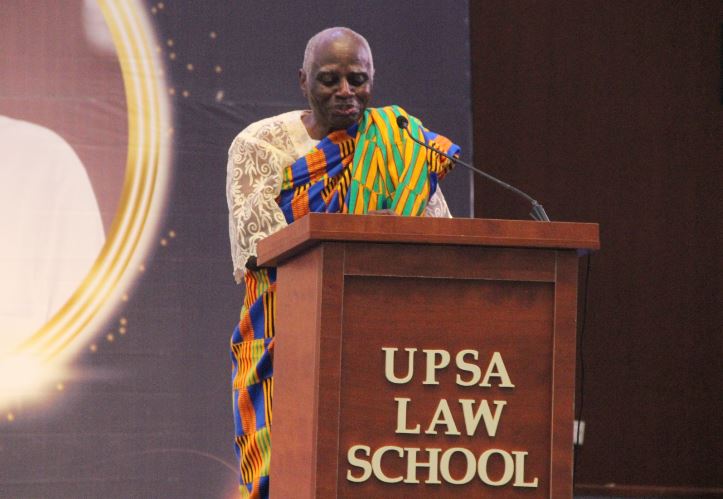
Accra, April 16, GNA – The UPSA Law School has conferred a Lifetime Achievement in Law Award on Mr. Tsatsu Tsikata in recognition of his outstanding career, teaching and impact.
Mr Tsikata is being celebrateed for his remarkable lifetime achievements as distinguished lawyer, public servant, and legal academic
The event, the third of UPSA Law School’s Honorific Lecture and Award, recognised Mr. Tsikata’s exceptional contributions to the legal profession, his
enduring commitment to constitutional development, and his unwavering advocacy in the public interest.
It also recognised his influence in shaping generations of legal practitioners and scholars in Ghana and beyond.
The event convened a distinguished audience, including members of the bench and bar, academia, public service, the diplomatic corps, and other notable stakeholders to celebrate the achievements of one of Ghana’s most respected legal figures.
Notable among them were Vice-President Professor Jane Naana Opoku-Agyemang, Justices of the Supreme Court, Justice Francis Emile Short, Madam Anna Bossman, Prof Joshua Alabi, George Akilakpa Sawyerr, and Larry Gbevlo-Lartey.
Madam Betty Mould-Iddrisu, a former Attorney-General and Member of the Council of State, paid glowing tribute to the renowned legal practitioner, describing him as a symbol of resilience and excellence in Ghana’s legal profession.
She highlighted Mr Tsikata’s unwavering faith in the rule of law, adding that his life and career exemplified courage and commitment to justice, even under difficult personal and political circumstances.
She recalled moments in his career where he endured significant challenges, including periods of ill health and legal battles, yet remained steadfast in his belief in due process and the integrity of the legal system.
The Member of Council of State said such acts of conviction demonstrated the importance of trusting legal institutions.
She said the confidence in the rule of law was essential for sustaining democratic governance and political leadership.
Madam Mould-Iddrisu described Mr Tsikata as a brilliant legal mind whose influence had shaped generations of lawyers, not only through courtroom advocacy but also through mentorship and intellectual engagement.
She noted that his approach to law emphasised critical thinking and ethical responsibility, adding that he had inspired many to approach legal practice with rigour, honesty, and a deep awareness of the consequences of their actions.
Chief Justice Paul Baffoe-Bonnie commended Mr Tsikata for a lifetime dedicated to the pursuit of legal excellence, stating that the respect he commanded across the legal community was well deserved.
“Excellence in law is achieved through sustained dedication over time,” he said.
He noted that Mr Tsikata’s contributions to the legal profession had had a lasting impact on Ghana’s jurisprudence and the development of legal thought in the country.
Justice Baffoe-Bonnie encouraged young lawyers to emulate such dedication, adding that the legal profession required continuous learning, discipline, and a strong ethical foundation.
He said Mr Tsikata’s legacy served as an enduring source of inspiration for current and future generations of legal practitioners.
He emphasised that his contributions had not only strengthened the legal profession but also reinforced the principles of justice, accountability, and the rule of law in Ghana.

GNA
Edited by Samuel Osei-Frempong