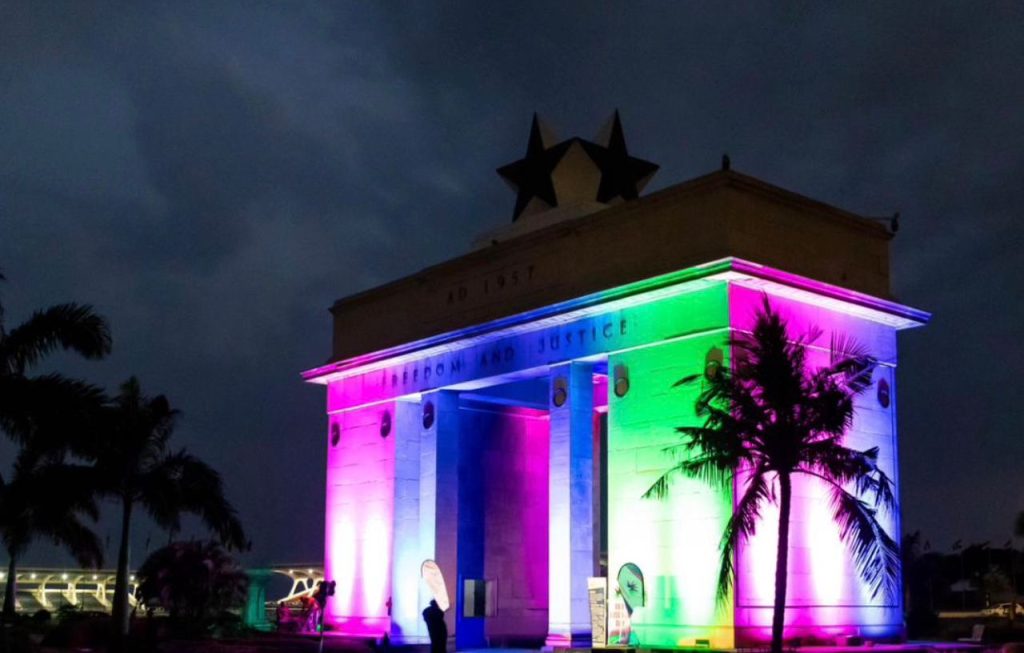
Accra, March 1, GNA – Ghana on Saturday marked Rare Disease Day 2026 with the lighting of Independence Square in Accra, as part of a global awareness campaign.
The symbolic event, organised by the Rare Disease Ghana Initiative at 1800 hours, formed part of the worldwide “Chain of Lights” campaign, under which landmarks are illuminated in the official Rare Disease Day colours to draw attention to rare conditions and the people living with them.
The event was held on the theme: “Moving Forward. Looking Ahead.”
Mr Samuel Agyei Wiafe, Founder and Executive Director of the Initiative, said the choice of Independence Square was deliberate, describing the monument as a symbol of justice, equity and national pride.
“It signifies our independence as a people, and everything we are advocating for is equity, justice and for the voices of the less privileged in the health sector to be heard,” he said.
He explained that Rare Disease Day is observed globally on the last day of February, noting that the month is considered symbolic because it is the rarest month in the calendar, with either 28 or 29 days.
Globally, more than 7,000 rare diseases have been identified, affecting an estimated 300 million people. In Ghana, the Initiative estimates that about three million people may be living with one rare condition or another, with over 200 cases recorded locally.
Mr Wiafe said beyond awareness creation, the organisation was focused on tackling stigma, financial hardship and poor coordination of care.
“For a typical person with a rare disease, you are going to see multiple specialists and visit multiple healthcare systems. The cost of diagnosis is very expensive,” he said.
He noted that many rare conditions require genetic testing, which is not readily available in Ghana, adding that in some instances the organisation had raised close to 10,000 dollars to support a single family to access testing abroad.
He also cited social challenges confronting affected families, saying misconceptions about the genetic nature of many rare diseases often led to blame and stigma.
“We are here to instil hope. We want families to come out and add their voices because if they don’t, people will continue to pretend these conditions do not exist in our healthcare system,” he urged.
Prof. Ebenezer Badoe, Consultant Pediatric Neurologist at the University of Ghana Medical School, said rare diseases were often difficult to diagnose because of their low prevalence.
He explained that a condition could be classified as rare when it affected a very small fraction of the population, sometimes as low as one in tens of thousands or one in a million births.
Because of their rarity, diagnosis was frequently delayed or incorrect, he said.
“If you mention malaria, everybody knows it and there is treatment readily available. But if I have a rare disease and there is a cure somewhere in the world, why should I not have access to it?” he questioned.
Prof. Badoe called for systematic documentation and characterisation of rare diseases in Ghana to support research and participation in international clinical trials.
“I cannot walk to the Ministry with a rare disease, but a parent group can,” he said, urging families to organise and advocate collectively for policy attention.
Organisers said they would intensify advocacy and stakeholder engagement to ensure persons living with rare diseases were not left out of national health planning.
GNA