By Christiana Afua Nyarko
Accra, Feb. 27, GNA – Government has launched a strictly regulated cannabis licensing regime limited to medicinal and industrial purposes, maintaining that recreational use remains illegal in Ghana.
“Dealing in weed is still illegal,” Mr Mohammed Muntaka Mubarak, Minister for the Interior said at the official launch of the medicinal cannabis licensing programme in Accra.
He said Section 45 of the Narcotics Control Commission Act criminalised the purchase, sale or possession of narcotic plants without lawful authority, stressing that Ghana was not legalising recreational cannabis.
Mr Mubarak said the programme was anchored on the Narcotics Control Commission Act, 2020 (Act 1019), as amended by the Narcotics Control Commission (Amendment) Act, 2023 (Act 1100), and operationalised through the Narcotics Control Commission (Conservation and Management of Cannabis) Regulations, 2023 (LI 2475).
He described the launch as a milestone in Ghana’s commitment to responsible drug control, public health, national security and economic development.
Act 1019 established the Narcotics Control Commission (NACOC) and provided the legal framework for controlling narcotic drugs and psychotropic substances.
Section 43 mandated the Minister for the Interior to grant licences for cannabis-related activities strictly for industrial and medicinal purposes.
Following legal challenges on procedural grounds, Parliament passed Act 1100 in 2023 to amend and reinsert Section 43, paving the way for the passage of LI 2475 in November 2023 to regulate the cultivation, processing, transport, import, export and related activities concerning low-THC cannabis.
Under LI 2475, only cannabis with a tetrahydrocannabinol (THC) content not exceeding 0.3 per cent on a dry weight basis-classified as therapeutic or industrial hemp- is permitted.
High-THC cannabis associated with recreational use remains prohibited.
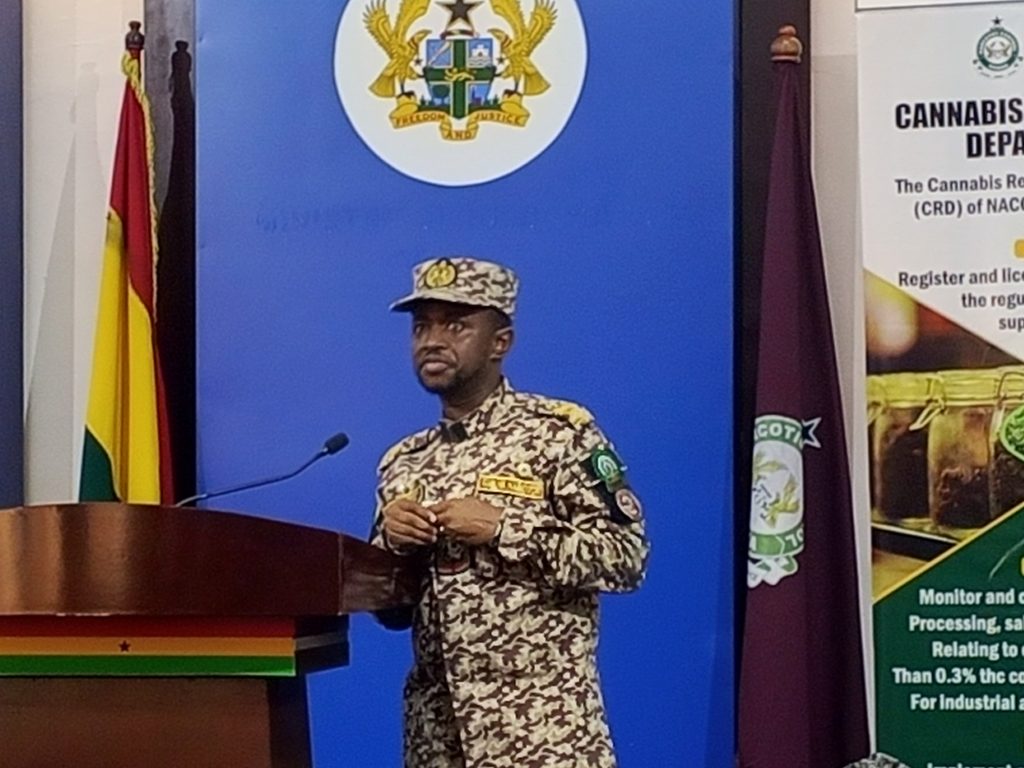
Dr Pharmba Basha Ligbi, Head of the Cannabis Regulation Department at NACOC, said Ghana was among countries that had legalised cannabis solely for medicinal use and not for recreational consumption.
“The recreational use and trafficking of cannabis is still illegal in Ghana,” she reiterated.
She explained that the law permitted only CBD-dominant cannabis for therapeutic and industrial purposes and not THC-dominant psychoactive varieties.
Dr Ligbi outlined 11 categories of licences under LI 2475, including breeding, cultivation, processing, research and development, storage, transport, import, export, sales and distribution, as well as advertisement and promotion.
She said applicants must be at least 18 years old and either Ghanaian citizens or legally resident in Ghana, while corporate bodies must have at least 50 per cent Ghanaian shareholding or a majority Ghanaian board composition to promote local participation.
Dr Ligbi said the application process was fully digitised, with payments made only upon approval, and cautioned prospective investors against engaging middlemen.
“NACOC has not sanctioned anyone to act on its behalf. Deal directly with the Commission,” she said.
Grounds for refusal include submission of false information, links to illicit drug diversion, inadequate security protocols, public health risks, or failure to meet prescribed standards. Licences are valid for three years, subject to renewal.
The regulations prohibit cultivation near schools, recreational centres and residential areas, and empower inspectors to conduct announced and unannounced inspections, enter premises, take samples and seize evidence where necessary.
Mr Mubarak and Dr Ligbi underscored the use of technology in enforcement, with NACOC deploying specialised software, QR-coded identification cards for licence holders and drone surveillance to monitor farms and ensure compliance.
Responding to questions, Mr Mubarak said Government would not supply cannabis seeds but would permit licensed importers to import approved seeds under strict supervision.
“We need to go through a vigorous process to ensure we are importing only the right seeds,” he said, adding that Ghanaian researchers would be encouraged to develop local seed varieties to reduce long-term dependence on imports.
Mr Mubarak said the programme would involve collaboration among security agencies, including the Police, Immigration, Prisons, Fire Service and the National Intelligence Bureau, to prevent abuse.
“If we joke and get it wrong, Ghana could be blacklisted, and all the effort will come to nothing,” he warned.
Mr Mubarak said the regulated cannabis industry had the potential to attract local and foreign investment, create jobs, particularly in rural communities, and generate revenue through licensing fees and exports.
He proposed the formation of farmer cooperatives to enable smallholder farmers to transition from illegal cultivation to regulated production.
The Minister urged the media to communicate accurate information to the public.
“This is about job creation, medicine and revenue—not about recreational use of drugs. Ghana is not legalising weed,” he stressed.
Dr Ligbi said NACOC would intensify public education to prevent confusion between legal low-THC hemp and illegal high-THC cannabis.
She said the programme’s success would depend on strict monitoring, inter-agency cooperation and full compliance by licence holders to safeguard public health and national security while positioning Ghana to compete in the medicinal cannabis industry.
GNA
Edited by Kenneth Sackey