By Michael Foli Jackidy, GNA
Ho (V/R), Dec. 23, GNA – Mr James Gunu, the Volta Regional Minister, has outlined major achievements and ongoing interventions across key sectors of the Volta Region commending the stakeholders in the region for their commitments and dedication to the successes chalked.
Delivering his address at the Second Volta Regional Coordinating Council (RCC) Meeting for 2025, the Regional Minister acknowledged the critical role of traditional authorities, members of the RCC, Municipal and District Chief Executives (MDCEs), technical officers and partner institutions for their commitment to advancing the region’s development agenda.
He also expressed appreciation to farmers, fisherfolk, processors, and cooperatives for their contributions to food security and economic stability, particularly following the 41st National Farmers Day celebrations.
Touching on peace and security, the Regional Minister said the NDC Government, under President John Dramani Mahama, had allocated a GH¢1 billion retooling package for security agencies nationwide, from which the Volta Region continued to benefit from through enhanced policing, intelligence, and emergency response.
He noted that the inauguration of a Regional Signal Command in Ho had strengthened security coordination, contributing to the peaceful atmosphere in the region, despite occasional chieftaincy and land disputes.
Mr Gunu urged MDCEs to ensure the effective functioning of their Municipal and District Security Councils, stressing that peace and stability in the Volta Region were non-negotiable.
On road infrastructure, he said the region was significantly benefiting from the Big Push Programme, with several major road projects currently under construction.
He highlighted the Ho–Denu–Aflao Road as one of the most critical corridors expected to enhance cross-border trade with Togo upon completion.
Mr Gunu described access to clean water as a fundamental human right and noted that the region required over 900 additional mechanised boreholes to meet equitable access standards.
He said the Adidome Water Treatment Plant Phases I and II had been completed, while efforts were underway to extend pipelines under Phase III.
He reaffirmed the RCC’s commitment to the Water for All Initiative, aligned with Sustainable Development Goal Six.
On agriculture, the Regional Minister said government had allocated over GH¢1.5 billion under the Feed Ghana Programme to modernise the sector through irrigation, mechanisation, storage, and value-chain development.
He encouraged farmers to take advantage of emerging international markets, including tariff-free access to the United States for Ghanaian agricultural exports.
He also highlighted youth-focused initiatives such as the Youth in Agriculture Programme, the National School Agriculture Programme and the Nkukorkitikitin poultry support scheme.
Mr Gunu described the Volta Trade and Investment Fair and the maiden Volta Economic Forum as major milestones in positioning the region as a hub for investment and innovation.
He said the Aflao Model 24-Hour Market and the Aflao Ashigame Development Project would harness the economic potential of Ghana’s busiest land border and support the government’s 24-hour economy vision.
In the area of job creation, he reported that the Youth Employment Agency had engaged over 3,300 young people across the region in 2025 through various modules, while the National Apprenticeship Programme had enrolled over 2,000 apprentices under trained master craft persons in diverse trades.
Mr Gunu said construction of eight Agenda 111 District Hospitals in the region had stalled, but plans were underway to resume work. He also reported progress in digital health delivery with the rollout of the Ghana Health Information Management System, improvements in maternal and child health services, and the successful HPV vaccination campaign, which achieved 81.6 per cent coverage among eligible girls in the region.
The Regional Minister said more than 34,000 qualified Junior High School graduates were placed in Senior High and Technical Schools under the Free SHS Programme in 2025.
He also highlighted the distribution of over 32,000 learning tablets, implementation of the Secondary Education Reform, support for basic education, and the provision of over 467,000 sanitary pads to promote girl-child education.
He noted that GETFund had secured funding for 278 educational infrastructure projects across about 180 institutions in the region.
Mr Gunu reaffirmed the RCC’s commitment to President Mahama’s resetting agenda, calling for stronger collaboration, effective monitoring, and community engagement to sustain development gains.
Alhaji Akape Avona, Chief Director of the RCC, said the meeting was to review annual reports from assemblies, departments, and institutions, and assess performance, particularly in revenue mobilisation. He commended assemblies performing well and urged others to improve.
Presentations were also made to Council members, including an update on outcomes of the Volta Economic Forum by Dr Elikplim Afetorgbor of the National Development Planning Commission, a briefing on the 24-hour District Model Markets and the Aflao Ultra-Modern Market Project, as well as findings from a University of Ghana survey which identified Central Tongu, Agortime-Ziope and Adaklu as among the poorest districts in the region.
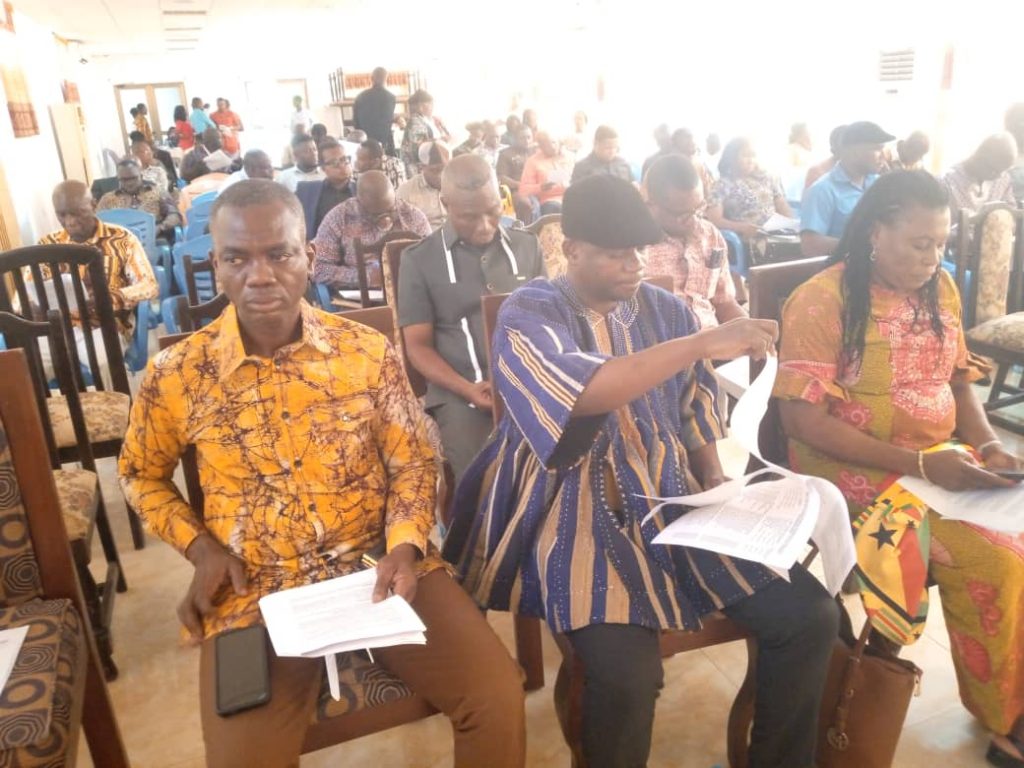
The meeting was attended by MDCEs, Presiding Members, heads of departments, and heads of state institutions across the Volta Region.
GNA
Edited By: Maxwell Awumah/Linda Asante Agyei