By Morkporkpor Anku
Accra, June 21, GNA – Ghana has reaffirms its unwavering commitment to transforming its prison system from a punitive model to a correctional, care, and reintegration one.
Mrs Baffoe-Bonnie (Esq), the Director-General of Prisons, said the commitment aligned with international standards such as the Nelson Mandela, Bangkok, and Tokyo rules.
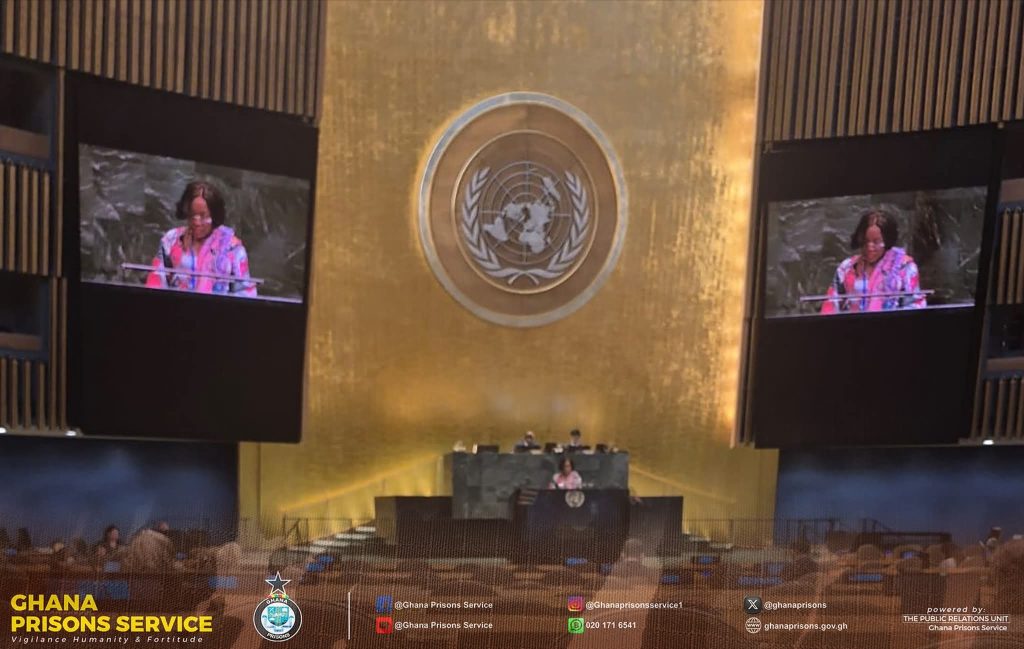
The Director General of Prisons said this when she addressed delegates from over 193 nations, at the 79th session of the United Nations General Assembly held in the United States.
The session was on the theme: “A Second Chance: Addressing the Global Prison Challenge.”
It was held by the President of the General Assembly to mark the 10th anniversary of the adoption of the United Nations Standard Minimum Rules (the Nelson Mandela Rules).
Mrs Baffoe-Bonnie acknowledged the leadership of the UN General Assembly President and the United Nations Office on Drug and Crime (UNODC) in orchestrating the important gathering.
She emphasised the opportunity it created to translate discussions into concrete actions for reforming prison systems in line with international standards.
She said Ghana was dedicated to improving infrastructure, staff training, international collaboration, healthcare, and agricultural mechanisation despite existing challenges.
Mrs Baffoe-Bonnie said prison officers were undergoing continuous training in Human Rights, Conflict Resolution, and Correctional Ethics to prepare them to effectively manage the evolving correctional environment.
“Ghana has made progress in separating inmates by gender and age (women, men, juveniles), though infrastructure limitations present ongoing challenges,” she added.
The Prison farms currently contributed 40 per cent of the daily food rations for inmates, she noted, adding that further investment in mechanised agriculture would meet national standards and simultaneously serve as vocational training centers.
That would equip inmates with practical skills for successful reintegration into society, the Director General said.
The Ghana Prisons Service, she said, provided both academic and skills-based education, as more than 700 inmates had participated in national examinations, while others were pursuing diplomas and degrees through distance learning.
Mrs Baffoe-Bonnie said vocational training such as carpentry, tailoring, welding, and aquaculture were offered to facilitate lawful reintegration.
Ghana was actively collaborating with UNODC to develop a tailored inmate classification tool, consistent with Mandela Rule 7, to enhance case management by ensuring proper categorisation and treatment of inmates.
She said the Government had also renewed its support to refurbish existing prisons, construct modern facilities, and establish a Prisons Industrial Hub, which would focus on skills training and income generation for inmates.
Mrs Baffoe-Bonnie pledged to improve officers and inmates’ welfare, digitalise case management systems, expand existing structures, modernise the Prisons Service, mechanise agriculture, and foster strategic partnerships to enhance the image of the Ghana Prisons Service.
“Ghana reiterates its conviction in rehabilitation over punishment… every individual deserves the opportunity to rebuild their life with dignity and purpose,” she added.
The DG pledged Ghana’s continued collaboration with international partners to promote justice, uphold human rights, and ensure that every prison sentence led to a genuine second chance.
GNA
Edited by Agnes Boye-Doe