Dunhuang, China, June 9, GNA – Media and development experts have called for the development of open-source, human-centred artificial intelligence (AI) systems to advance the objectives of the Global Civilisation Initiative (GCI).
They made the call at a parallel session on the theme, “Reconstruction and Renewal of Civilisation in the Era of Artificial Intelligence”, held during the Fourth Dialogue on Exchanges and Mutual Learning Among Civilisations in Dunhuang, Gansu Province, China.
The engagement highlighted the potential of people-centred AI to foster global connection and unlock human potential, if guided by cooperation, inclusiveness, and mutual respect.
The panellists likened this to the unifying legacy of the ancient Silk Road and the ideals espoused by the GCI.
The GCI, proposed by Chinese President Xi Jinping in March 2023, complements the Global Development Initiative and the Global Security Initiative.
It promotes respect for civilisational diversity, shared human values, the inheritance and innovation of civilisations, and robust international people-to-people exchanges and cooperation.
It emphasises equality, mutual learning, dialogue and inclusiveness, and advocates for cultural exchanges that transcend estrangement, learning that overcomes clashes, and coexistence that neutralises superiority.
Mr Hervé Juvin, President of the Eurogroup Institute, underscored the importance of decentralised and open-source AI models, such as China’s DeepSeek and France’s Mistral AI, in ensuring that technological progress served the broader good of all societies.
“A decentralised and open-source-based AI is a key for more common good AI, at the service of civilisations,” Mr Juvinnoted.
He expressed concern about the current commercial orientation of AI, noting that much of the global discourse remained focused on profit, often clouded by misinformation and exaggerated claims.
Drawing on his experience at a recent forum in California, Mr Juvin said the overwhelming focus on business risks, undermining AI’s potential to meaningfully contribute to human advancement unless its development was redirected towards ethical, inclusive, and sustainable ends.
He called for best practices in AI development – transparency, inclusiveness, ethical design, and broad accessibility – so as to promote equity, dignity and sustainability across societies.
He drew a historical parallel between the invention of the printing press and the emergence of AI, suggesting that AI could liberate the human mind and enable a new civilisation shaped by creativity, emotional depth and shared values.
“Rather than being feared, AI should be embraced as a tool to free humanity from monotonous and burdensome tasks,” he said.
From managing schedules to planning finances, AI could offer people more time for creativity, introspection, and the pursuit of meaningful living.
He envisioned a civilisation shaped not solely by logic and reason, but by the richness of human feeling -echoing the sentiment of Chinese philosopher Zhaoting Yang: “I feel, so I am.”
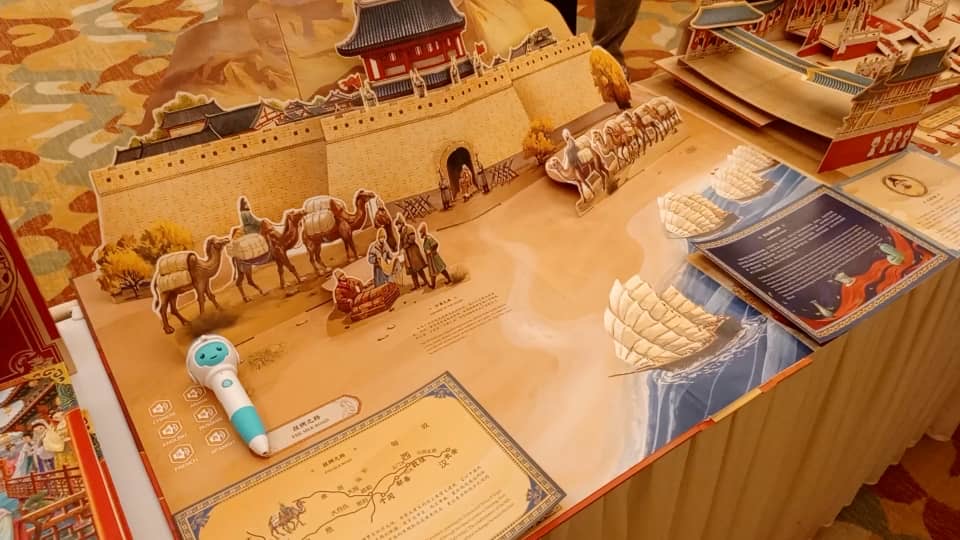
The Dialogue also marked the global launch of the Silk Road Pop-Up Book, an initiative by the Contemporary World Press.
The publication symbolises the enduring spirit of cultural exchange that the Belt and Road Initiative (BRI) seeks to carry forward.
Mr Juvin commended China’s continuing commitment to the BRI, describing it as a vital vehicle for promoting infrastructure development, people-to-people ties, and digital connectivity across continents.
He emphasised the natural alignment between such platforms and open-source AI, as both seek to dissolve boundaries, broaden access, and empower local innovation.
Civilisation, he noted, has always emerged from the interplay between nature and human ingenuity, as reflected in the ancient Buddhist caves of Dunhuang.
Mr Juvin, who leads the Localists movement in Europe, reaffirmed the need for expanded civilisational dialogue and urged all nations to embrace shared digital futures grounded in openness, sustainability and human flourishing.
Dr Bridget C. Onochie, Abuja Bureau Chief of The Guardian newspaper, highlighted the transformative power of AI in enhancing global harmony, security, and prosperity -particularly within the framework of the BRI.
She described AI as a catalyst for deepening international cooperation through innovation, improved communication, and sustainable development.
The integration of AI into the BRI, she said, had significantly advanced digital connectivity, helped bridge economic divides, and combated misinformation.
Dr Onochie likened the BRI to a modern-day Silk Road, connecting nations not only through physical infrastructure such as roads, railways, and maritime routes, but also through AI-powered solutions in sectors like logistics, healthcare, agriculture and infrastructure development.
She called for the active participation of young people, describing youth engagement as the engine of future progress.
Digital platforms, she said, should be leveraged to promote entrepreneurship, cultural exchange, and mutual understanding in line with the BRI’s spirit of sovereign equality and respect.
“With thoughtful use, AI can be the bridge that secures a peaceful, prosperous and interconnected world,” she added.
Mr Hazem Omar, Chairman of Egypt’s Committee on Foreign, Arab and African Affairs, shared insights on how his country had harnessed science, technology, and innovation to sustain the relevance of its 7,000-year-old civilisation.
While AI, he said, could simplify the storytelling process, it could not -and should not – replace human principles, values and critical thinking, but as an extension of human thoughts.
Professor Berry Lwando, Director-General of the Zambia National Broadcasting Corporation, and Mr Hatred Zenenga, Editor of Zimbabwe’s Sunday News, shared the positive impact of AI in media and development within their respective countries.
They commended China for its role in technology transfer and development cooperation and called for more youth exchange programmes to promote innovation and shared values.
Ms Li Ke, General Secretary of the Zhongguancun Ultra Internet New Infrastructure Alliance, said the DeepSeek AI model had opened new avenues for mutual learning and collaboration, aimed at creating a shared digital future.
Chinese experts also showcased creative works -including music and video content – produced through youth competitions, aimed at encouraging innovation in storytelling and promoting China’s cultural narrative on the global stage.
GNA
Edited by Beatrice Asamani Savage