Feature by Evans Worlanyo Ameamu, GNA
Anloga (V/R), Nov. 10, GNA – For generations, tomato farming has been a major economic lifeline for the people of the Anloga District in the Volta Region, supporting thousands of households, sustaining local businesses and contributing to Ghana’s food supply.
Across Anloga, Avume, Dzita, Anyanui and surrounding communities, farmers invest their time, labour and resources in tomato production to support their families, educate their children and improve their living conditions.
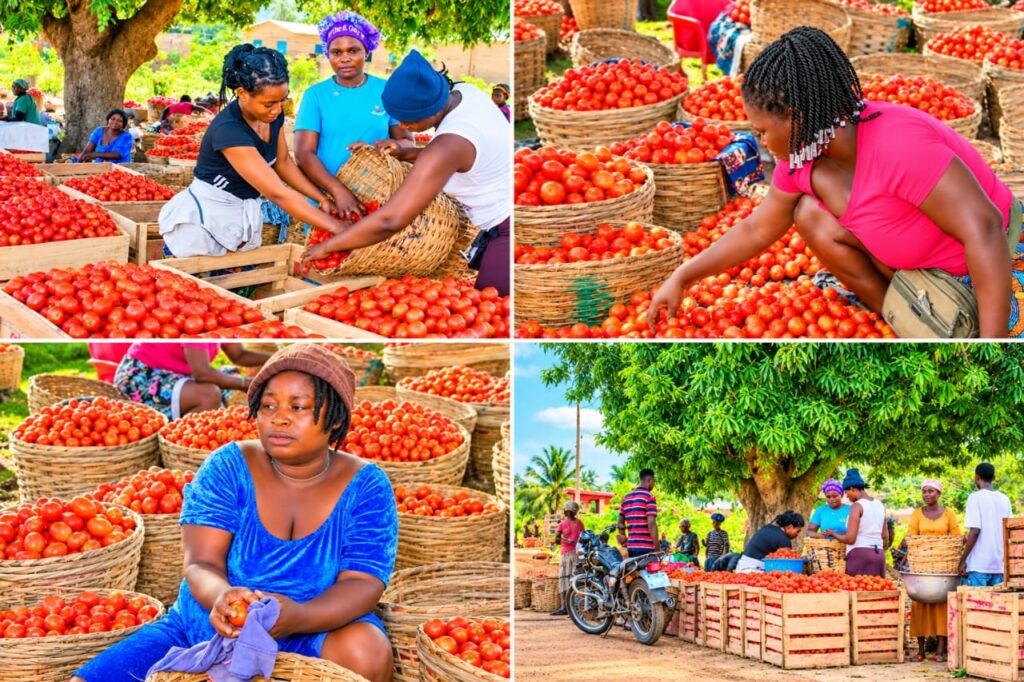
Yet, despite their efforts, farmers continue to struggle to secure reliable markets, preserve their harvests and obtain reasonable prices. During peak harvesting seasons, supply often exceeds demand, leaving tonnes of ripe tomatoes to rot on farms. Without adequate storage and processing facilities, agricultural abundance becomes a source of financial hardship.
A tomato processing factory in Anloga would therefore be more than an industrial project. It would protect farmers’ investments, create employment, strengthen food security and link agricultural production to industrial growth.
Anloga’s enormous production potential
Anloga is an important vegetable-producing area in the Volta Region. Irrigation practices enable farmers to cultivate tomatoes throughout the year, providing a potential and reliable supply base for a processing industry.
Investigations and reports gathered by the Ghana News Agency (GNA) from farmers in September 2026 estimated that the district had approximately 28,000 farmers, with between 18,000 and 22,000 engaged in tomato production annually.
However, this production capacity has not translated into economic security. Increased output can become a burden when buyers are unavailable.
In September, Mr Semabia Agbenyefia, a tomato farmer at Anloga-Avume, told the GNA that a box of tomatoes, which could ordinarily sell for between GH¢1,050 and GH¢2,500, sometimes fetched only GH¢70 to GH¢80 because of the absence of ready markets.
Another farmer, Ms Cecilia Seshie, said farmers invested between GH¢2,000 and GH¢9,000 or more in tomato production but risked losing their investments when buyers could not be found.
The situation worsened in September and October 2026, when tonnes of ripe tomatoes were reportedly left to rot on farms because of inadequate harvesting crates and limited market access.
Mr Daniel Kad Agboka, a farmer and Assembly Member for the area, said some farmers had borrowed money to finance their production and risked defaulting on their loans because they could not sell their produce on time.
He identified inadequate storage facilities, particularly cold rooms, as major challenges threatening farmers’ livelihoods.
Government interventions and the factory promise
On September 15, 2026, the Minister of Food and Agriculture, Mr Eric Opoku, launched the Ghana Tomato Self-Sufficiency Initiative (GHATSI) at the Anloga Senior High School Park.
He announced a target of approximately 100,000 tonnes of tomatoes for the 2026/2027 production season as part of a broader ambition to achieve annual production of 400,000 tonnes and reduce dependence on imported tomatoes.
The initiative seeks to strengthen the tomato value chain through irrigation, improved agricultural inputs, financing, insurance, processing, logistics and guaranteed markets.
The Minister also indicated that participating farmers would benefit from production financing estimated at GH¢20,000 per acre, alongside efforts to expand domestic processing capacity.
The Deputy Minister of Food and Agriculture, Mr John Dumelo, also responded to the difficulties confronting farmers.
Following reports of the tomato glut, he visited Anloga, joined farmers in harvesting and purchased 100 baskets of tomatoes for school feeding caterers in his Ayawaso West Wuogon Constituency.
Although the intervention provided immediate relief to some farmers, he announced plans for a tomato processing factory in Anloga, expected to be ready in 2027.
The Volta Regional Minister, Mr James Gunu, has also advocated the establishment of a processing facility in the region, identifying Anloga, Keta, Akatsi North and Agotime Ziope as important tomato-producing areas.
He said processing infrastructure would reduce post-harvest losses, create jobs and enable farmers to obtain greater value from their produce.
Beyond farming: Jobs and industrial development
The proposed factory would provide an alternative market for farmers while creating direct employment opportunities for machine operators, engineers, quality-control officers, accountants, administrative personnel and production workers.
Transport operators, packaging manufacturers, traders and food vendors could also benefit from increased commercial activities.
Women involved in vegetable trading, sorting and marketing could gain additional employment and business opportunities across the supply chain.
However, constructing the factory alone would not guarantee success. Reliable electricity and water supplies, accessible roads, modern storage facilities and efficient transportation systems would be essential.
Government must also ensure transparent management, adequate financing, technical training, quality control and dependable arrangements for purchasing tomatoes.
Without these safeguards, the facility could struggle to operate sustainably.
Collective action for a sustainable future
The demand for processing infrastructure has featured prominently in discussions among vegetable farmers in the Anloga and Keta agricultural corridor.
In June 2024, the Southern Sector Vegetable Farmers and Marketers Association, through its Public Relations Officer, Mr Afetorgbor Godfred, told the GNA that farmers were working towards standardised measurements and pricing to reduce losses caused by inconsistent market practices.
The association had also engaged buyers from major markets, including Makola and Agbogbloshie, to improve marketing arrangements.
These efforts demonstrate farmers’ recognition of the importance of collective bargaining and organised distribution systems in improving their livelihoods.
However, standardised pricing alone cannot resolve the structural challenges. Excess production without adequate buyers, storage or processing capacity would continue to undermine farmers’ earnings.
Mr Richard Kwame Sefe, Member of Parliament for Anloga, has supported the establishment of a processing factory as an alternative market for surplus tomatoes.
The facility could also encourage contract farming, enabling farmers to produce according to agreed schedules and quality requirements while providing processors with a dependable supply of raw materials.
Madam Sendra Seyram Kpedor, Anloga District Chief Executive, has also acknowledged the district’s capacity to produce tomatoes on a commercial scale.
An opportunity Ghana cannot afford to waste
The case for a tomato processing factory goes beyond preserving produce. It is about protecting farmers’ investments, reducing food waste, creating sustainable employment and ensuring that farming communities benefit from their labour.
Ghana cannot continue to encourage increased agricultural production while farmers struggle with inadequate markets, storage and processing infrastructure.
The proposed facility must therefore be supported by a clear implementation plan, sustainable financing and a reliable supply chain that prioritises local farmers.
For Anloga, the factory should not be viewed as a political favour but as an economic necessity and a strategic investment in the future of agriculture in the Volta Region.
The farmers are cultivating, the production potential exists, and the need for a lasting solution is evident.
What remains is the commitment to establish an industry capable of transforming their harvests and years of struggle into lasting prosperity while safeguarding Ghana’s food security in the long term.
GNA
Edited by Maxwell Awumah/Audrey Dekalu