By Jesse Ampah Owusu, GNA
Accra, Nov. 25, GNA – Dr Godfred Seidu Jasaw, Member of Parliament (MP) for Wa East, has urged researchers to include policymakers as partners in their research to strengthen the link between research evidence and policy.
He said this would enable them to develop evidence-based and appropriate research to inform policy decisions and interventions.
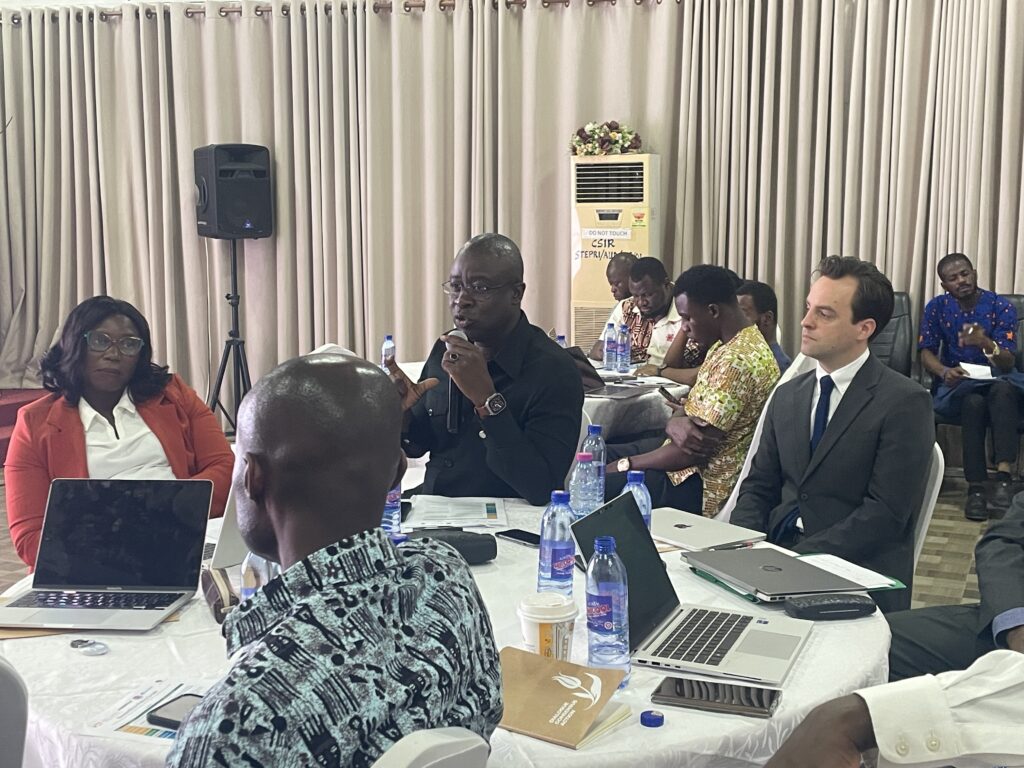
Dr Jasaw made the recommendation on Wednesday at the Research-to-Policy Co-Lab on “Strengthening Research-Government Collaboration for Ghana’s Agrifood Policy Decisions.”
It was organised by the Science and Technology Policy Research Institute of the Council for Scientific and Industrial Research (CSIR-STEPRI) with support from the Partnership for Economic Policy and the Strengthening Evidence-Based Policy Practice for Sustainable Food Systems under the EU-AU Partnership.
The Co-Lab aims to strengthen collaboration between research institutions and government agencies to promote the systematic use of evidence in Ghana’s agrifood policy processes.
Dr Jasaw, who is also Chairperson of Parliament’s Select Committee on Food, Agriculture and Cocoa Affairs, said involving policymakers in co-producing the research agenda would make them interested in the progress, output, and usability of the research.
“Once we are all involved in co-producing the research agenda, logically, even the policymaker will be interested in how progressive it has been, what the output will be, and how usable it will be,” the MP said.
Dr Jasaw said there was a consensus that research outputs should be readable and actionable, and not publication inspired.
Meanwhile, Dr. Justina Adwoa Onumah, a Principal Research Scientist CSIR-STEPRI, called for Ghana’s agricultural sector policy to align with the Comprehensive Africa Agriculture Development Programme (CAADP).
Presenting findings from a policy coherence assessment between Ghana’s Feeding Ghana (Feed Ghana) programme and CAADP, she said evidence showed strong alignment at the objective level but significant gaps at the intervention and target levels.
Dr. Onumah noted that interventions on irrigation, value addition, productivity, and agricultural finance were strongly aligned, while trade, markets, mechanisation, governance, social inclusion, climate resilience, and monitoring and evaluation showed only partial alignment.
“For governance, CAADP has its own governance system, which does not necessarily fit into Ghana’s governance structure, so we interpret that with caution. But climate resilience is a real missing gap in the Feed Ghana programme, and that is something we must address,” she added.
GNA
Edited by Linda Asante Agyei
Reporter: Jesse Ampah Owusu