By Iddi Yire, GNA
Accra, Nov. 19, GNA – President John Dramani Mahama has inaugurated a new Vaccine Research and Development (R&D) Laboratories and Human Identification (DNA) Laboratory at the Noguchi Memorial Institute for Medical Research, University of Ghana, Legon, to strengthen the country’s health security, scientific research and forensic capacity.
The facility was established in response to the military helicopter crash of August 6, 2025, in which eight eminent Ghanaians lost their lives and DNA samples had to be sent to South Africa for identification.
The Vaccine R&D Laboratories comprise dedicated vaccine development facilities, including an mRNA Expression Laboratory and a Protein Expression Laboratory, while the DNA Laboratory provides domestic infrastructure for human DNA testing and identification.
Speaking at the inauguration ceremony, President Mahama said the DNA laboratory would enable Ghana to provide families with timely answers during national tragedies, while the vaccine research laboratories would equip local scientists with the tools to develop vaccines in the country.
“I take immense pride in the progress we have made as a nation, and in the bold steps we continue to take to secure a healthier, stronger, more self-reliant future for generations of Ghanaians to come,” the President said.
The President said the commissioning of the facilities reaffirmed Government’s determination to build a nation capable of safeguarding its health security, advancing scientific innovation and charting its own path towards prosperity.
Referring to the August 6 tragedy, he said the incident exposed the urgent need for a national human identification laboratory.
“That painful episode made clear how much we need scientific expertise and technology to respond effectively to national emergencies and to provide affected families with timely answers,” the President said.
President Mahama noted that the country had no option but to send tissue samples recovered from the crash site to South Africa for analysis, forcing bereaved families to endure anxious days of waiting for results.
He noted that such a facility was essential to protecting public health and safety and to strengthening their ability to respond to emergencies.
“As you are aware, we had to take the tissues that were recovered from the accident sites to South Africa for analysis, and the families of the deceased had to wait for several nerve-wracking days for the results of the DNA to return.
“It was a day of shame for Ghana that we couldn’t carry out our own DNA analysis in-country. That will be a thing of the past,” he stated.
He expressed satisfaction that Ghana now possessed a world-class facility capable of strengthening both the nation’s forensic and public health systems.
According to him, the laboratory would help the country manage such situations with competence, dignity, and independence.
He emphasised that behind every request for identification was a family seeking closure and urged institutions that would rely on the laboratory to communicate promptly and compassionately with affected families.
“We must therefore apply the same care to communicating with families as to the scientific work itself,” he said.
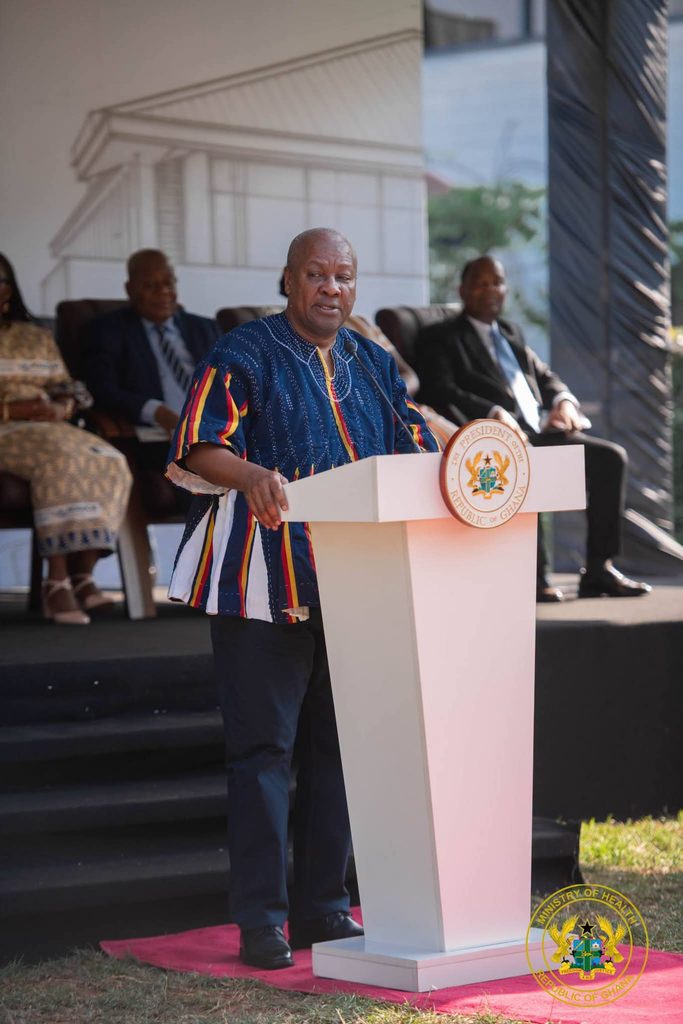
President Mahama noted that the DNA Laboratory would also support forensic investigations and assist in resolving paternity disputes through scientific analysis.
On the vaccine research laboratories, he described the facilities as a significant milestone in Ghana’s efforts to build local capacity to address public health challenges.
He said the COVID-19 pandemic exposed weaknesses in global vaccine supply chains and highlighted the vulnerability of African countries, which often received vaccines much later than developed nations.
He encouraged the agencies that would rely on the laboratory to work closely so that families receive clear information in a timely manner.
President Mahama stated that the DNA Laboratory would also assist in forensic investigations.
“It will also determine paternity. Maternity, we all know, the woman gives birth to the child, so we know the mother. But sometimes the paternity of the father is in dispute, and the laboratory will settle once and for all the questions of who owns the child.”
He said the establishment of facilities dedicated to vaccine research and development was an equally significant milestone.
He noted that it demonstrates government’s resolve to draw on Ghanaian talent, scientific expertise, and local capacity to address their health challenges.
“As global demand for vaccines and other medical countermeasures rose, weaknesses in the international supply chains became apparent, leaving many countries dependent on external support during a crisis, especially for African countries, who were the last in the queue,” he said.
The President noted that West Africa and the wider African continent continued to face recurrent threats from infectious diseases, including Mpox, Lassa fever, Ebola virus disease and Marburg virus disease.
He said the emergence and re-emergence of infectious diseases required countries to invest in preparedness and build scientific capacity before crises occurred.
“Preparedness requires foresight, investment and the courage to build capacity before a crisis strikes,” he stated.
President Mahama said the Government had consistently pursued policies aimed at developing Ghana’s pharmaceutical industry and positioning the country as a pharmaceutical manufacturing hub in West Africa.
He announced that the Government had allocated US$1 billion to the pharmaceutical sector under the Seventh Pillar of the New Economy Programme.
According to him, the investment would support the development of pharmaceutical and biomanufacturing hubs in the Eastern, Central and Volta regions.
Mr Kwabena Mintah Akandoh, the Minister of Health, said the new vaccine research laboratories would provide Ghanaian scientists with the tools required to develop vaccine candidates locally.
He said through collaboration among the National Vaccine Institute, the Food and Drugs Authority and research institutions, Ghana could move from vaccine discovery to clinical trials and ultimately local vaccine production.
Mr Akandoh described the inauguration of the facilities as an important step towards strengthening the country’s scientific and health research ecosystem.
GNA
Edited by Lydia Kukua Asamoah