Miotso, Nov. 26, GNA — The Vice-Chancellor of Central University (CU) has asked government to extend similar financial assistance given to students in public institutions to their counterparts in private universities.
“We appeal to government to reconsider this policy framework and extend the No Fee Stress support, or an equivalent financial assistance arrangement, to qualified students of accredited private universities,” Professor Samuel Kwasi Dartey-Baah said.
He made the call on Wednesday during the matriculation ceremony of the Central University at Miotso in the Greater Accra Region.
“Respectfully, there are Ghanaian students also in accredited private universities and they have the same aspirations, face similar financial challenges and are equally committed to acquiring an education that will enable them to contribute to national development,” he said.
Prof. Dartey-Baah said opportunities in education must extend beyond the boundaries of public institutions, to create fairness, equity and equal opportunities for students in both public and private institutions.
This, he said, would make public and private universities be seen as partners in national development and not as “competing categories of institutions deserving unequal consideration.”
He, therefore, encouraged government “to deepen collaboration with private universities through appropriate student financing arrangements, research support, institutional partnerships and other interventions that strengthen the entire tertiary education sector.”
He said this would lead to a situation in which no qualified Ghanaian student was denied the opportunity to pursue higher education because of the person’s financial circumstances.
Prof. Dartey-Baah observed that private universities had become partners in the development of Ghana’s human capital.
He said they complemented government efforts by expanding access to tertiary education, creating opportunities for thousands of young people and contributing to the training of the skilled workforce Ghana needs.
“It is therefore important that government policies intended to improve access to higher education should be inclusive, equitable and non-discriminatory,” he added.
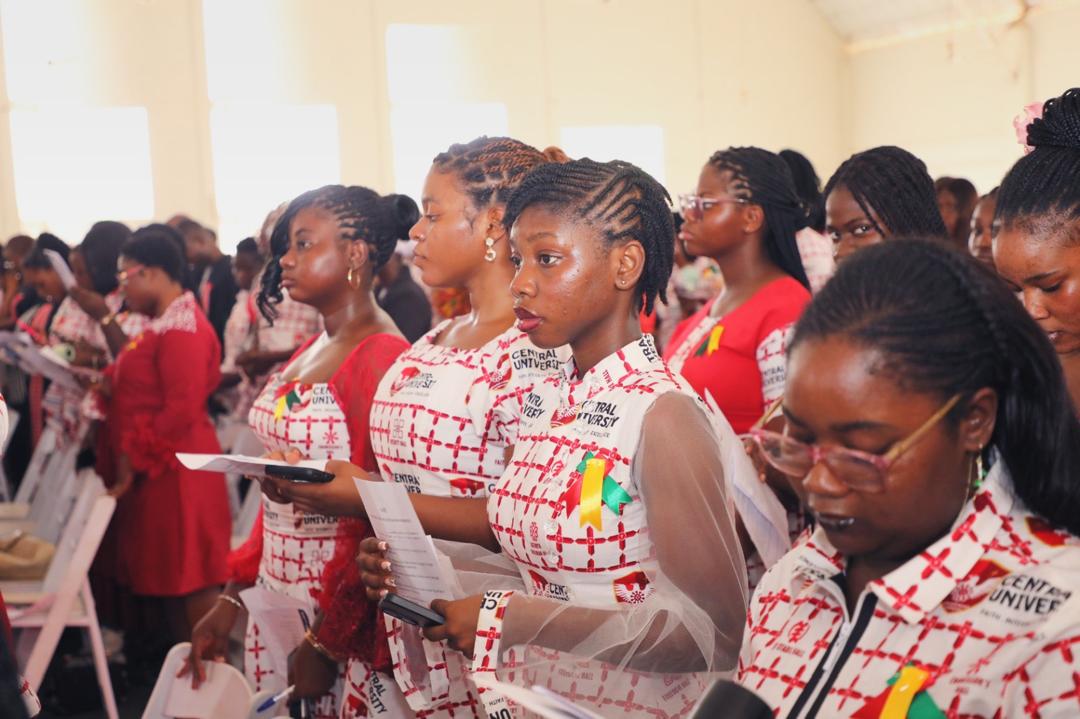
During the ceremony, Central University matriculated students into the Schools of Pharmacy, Nursing and Midwifery, Architecture and Design, Medical Sciences, Engineering and Technology, Business, Law, Graduate Studies and Research, Faculty of Arts and Social Sciences, and the Daniel Institute.
The Graduate School also admitted its second cohort of PhD and DBA students, whilst the Awards for Training and Higher Education (ATHE) enrolled diploma students.
What Is The No Fee Stress Policy?
The “No Fee Stress” policy, also called the No Academic Fees policy, was launched by President John Dramani Mahama on July 4, 2025, at the SDA College of Education, Asokore-Koforidua in the Eastern Region.
Under the policy, government, through the Students Loan Trust Fund (SLTF), pays the full academic facility user fees for all first-year students in public tertiary institutions — public universities, technical universities, nursing training colleges and colleges of education.
It is a non-repayable grant, not a loan. Students do not pay it back.
Persons with disabilities, by contrast, receive full tuition support throughout their studies, not just in the first year.
Continuing students at Levels 200, 300 and 400 are not covered by the No Fee Stress grant. They may access Student Loan Plus or the regular SLTF loan scheme.
According to Mr Haruna Iddrisu, Minister of Education, who briefed Parliament on June 18, 2026, a total of 312,448 first-year students had benefited from the policy across the 2024/2025 and 2025/2026 academic years, at a cost of GH¢888 million.
The 2024/2025 academic year recorded 152,698 beneficiaries, while 159,750 had benefited so far in 2025/2026.
In the 2026 Budget, government allocated GH¢537 million to the No Fee Stress policy and an additional GH¢25 million for free tertiary education for persons living with disability.
The policy currently covers all public tertiary institutions nationwide. Accredited private universities are excluded — a point that has generated sustained debate.
The Central University
Central University is a private university in Ghana, founded by the International Central Gospel Church (ICGC), led by its Chancellor, Reverend Mensa Otabil.
It has its main campus at Miotso, near Prampram in the Greater Accra Region, and has more than 8,000 students.
Prof. Dartey-Baah, a leadership scholar and organisational development expert, was inducted as Vice-Chancellor on October 22, 2025, succeeding Professor Bill Buenar Puplampu.
Since his investiture, he has consistently called on government to recognise private universities as equal partners in national development, with fair access to research funding, national education planning and student financing initiatives.
His latest call at the matriculation ceremony is a continuation of that advocacy — that inclusion in the No Fee Stress policy would not only help private university students, but also strengthen the entire tertiary education sector.
GNA
Edited by Samuel Osei-Frempong