By Albert Futukpor
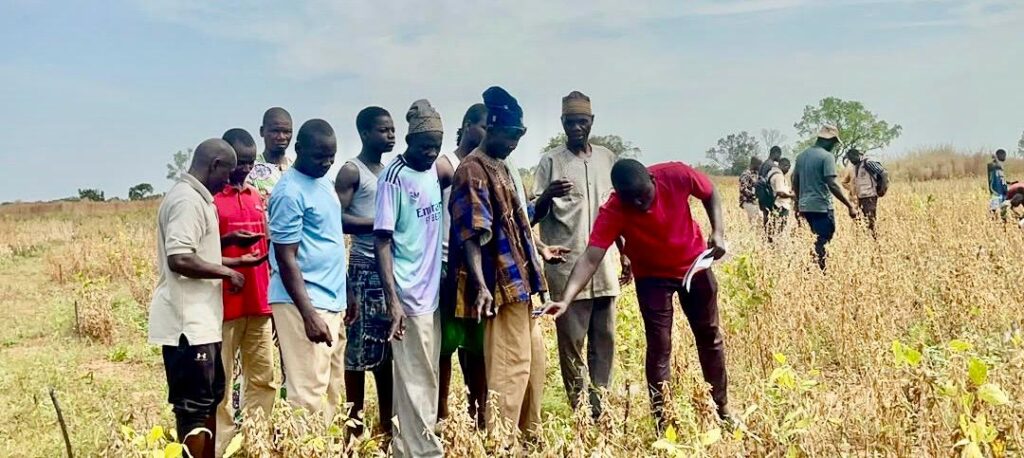
Nyankpala (N/R), Nov 13, GNA – Some farmers and representatives of seed companies have participated in a varietal selection exercise, to identify drought-tolerant soybean varieties to improve production and strengthen farmers’ resilience to changing rainfall patterns in the north.
The Participatory Varietal Selection exercise, organised by the Council for Scientific and Industrial Research-Savanna Agricultural Research Institute (CSIR-SARI) in collaboration with the International Institute of Tropical Agriculture (IITA), sought to ensure that improved soybean varieties developed for the northern part of the country, met the preferences and production needs of farmers and seed companies.
The exercise, held at CSIR-SARI’s experimental fields at Nyankpala, near Tamale, formed part of the Institute’s soybean improvement programme, funded by the Alliance for a Green Revolution in Africa (AGRA).
Participants included farmers from Golinga, Gbulahagu, Kpalsogu, Waribugu-Kukuo and Gawagu as well as representatives of seed companies including BATBAK Services and Heritage Seeds Company Limited.
They assessed 30 soybean lines that had undergone two years of evaluation focusing on desirable characteristics such as drought tolerance, yield potential and other traits that could improve production and harvesting.
Dr Francisca Addae-Frimpomaah, the Head, Soybean Improvement Programme and Soybean Breeder at CSIR-SARI, said involving farmers and seed companies in the selection process was critical to ensuring the adoption of improved varieties.
She noted that “The farmers are the ones who are going to plant them in the field, and without their involvement, most of the time when we send a variety out, they reject it or refuse to adopt it.”
Dr Addae-Frimpomaah said five promising lines would be selected from the 30 assessed for on-farm demonstrations in 2027.
She said selected farmers would receive seeds free of charge to cultivate alongside the soybean varieties they currently grew, enabling researchers to compare their performance under normal farming conditions.
She explained that the farmers’ selections would be analysed alongside data obtained from the research fields before the final varieties were determined.
Dr Addae-Frimpomaah encouraged farmers to adopt certified seeds when the improved varieties became available and cautioned that continuous recycling of seeds could compromise their quality and reduce yields.
Mr Abush Tesfaye Abebe, a soybean breeder at IITA, said the collaboration with CSIR-SARI was aimed at improving soybean production through the development and testing of varieties with better yield potential, quality, maturity and adaptability to changing climatic conditions.
He said IITA supported the programme by providing breeding lines for evaluation and strengthening local capacity in soybean breeding and variety testing.
Mr Abebe said three new soybean varieties were released in the country last year as part of efforts to improve production, adding that the collaboration had strengthened the country’s soybean breeding programme and her capacity to evaluate more varieties.
Mr Samuel Bakaweri, the Founder and Managing Director of BATBAK Services, a Tamale-based seed company, said the exercise offered seed companies opportunity to assess different soybean varieties and identify those suitable for farmers in their respective production areas.
He said important characteristics considered included high yield potential and higher pod clearance, to facilitate mechanised harvesting and low pod shattering.
The exercise also provided an opportunity for seed companies to interact with farmers, understand their needs, and establish relationships with potential customers.
Mr James Majeed, a farmer from Gawagu, lauded the exercise and said it had exposed him to improved soybean varieties and their different characteristics.
He expressed readiness to adopt the selected variety in the next farming season when it became available.
GNA
Edited by Eric K. Amoh/ Christabel Addo
Reporter: Albert Futukpor
Email: [email protected]