By Solomon Gumah, GNA
Tamale, Nov 15, GNA – The Citizen-led Actions for Educational Accountability and Responsiveness (CLEAR) project has recognised Teachers, communities, district assemblies and education directorates in six project districts for their contributions towards improving basic education delivery.
The recognition took place in Tamale at the climax of a two-day annual learning and review session, which provided a platform for stakeholders to assess the project’s achievements, identify persistent challenges and strengthen citizen-led efforts towards accountability, inclusive education and improved learning outcomes across the six project districts in Northern Ghana.
The session was organised under the CLEAR project Consortium, implemented by School for Life in partnership with Youth Empowerment for Life (YEFL Ghana) and the Ghana Developing Communities Association (GDCA) with funding support from the Global Partnership for Education (GPE) through its Education Out Loud programme.
It brought together Chief Executives of Municipal and District Assemblies, district planning officers, directors of education, traditional authorities, community members including representatives of Fulbe communities, and citizen networks among other stakeholders.
Some teachers received laptops and mobile phones to support their teaching activities while others were presented with citations in recognition of their dedication and contributions to education delivery.
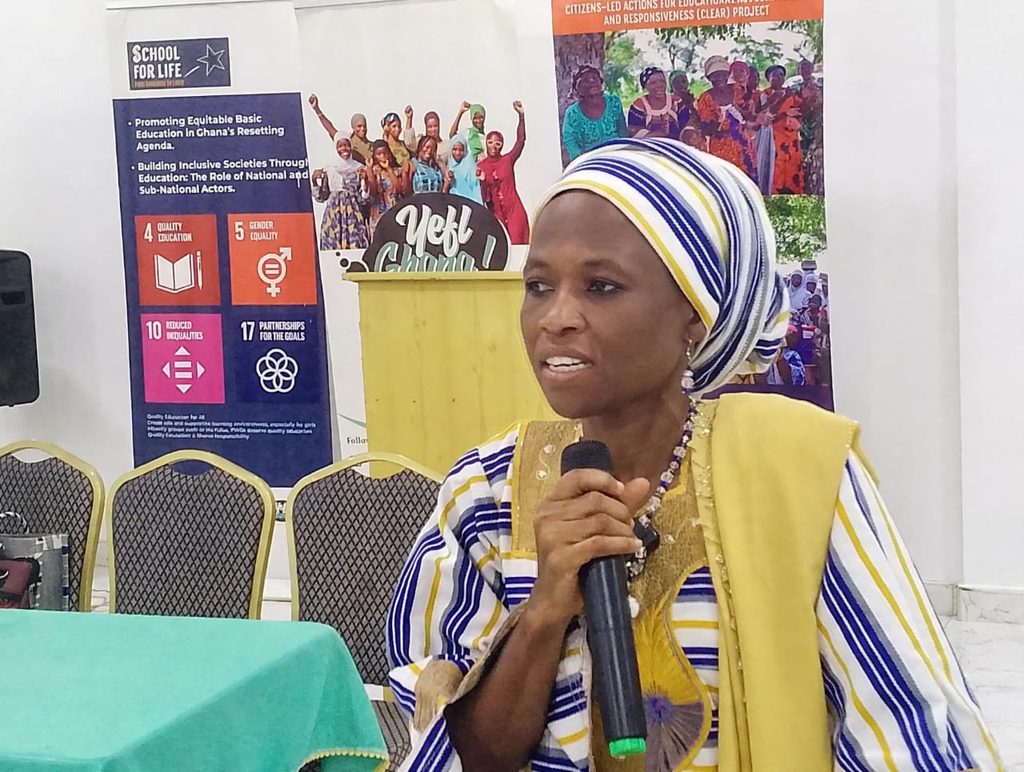
Hajia Wedad Sayibu, Director of School for Life, said the project had been running for almost five years providing opportunities for stakeholders to collectively assess interventions and identify practical approaches to improving educational outcomes.
She said the recognition exercise was intended to appreciate the contributions of district assemblies, education directorates and communities towards advancing the project’s objectives.
She said “The testimonies and experiences shared by our stakeholders at this review session further consolidate the objectives of this project, which seeks to mobilise citizen groups and build their capacities to engage education stakeholders to ensure responsiveness and accountability in addressing challenges affecting basic education delivery.”
Hajia Sayibu explained that communities were assessed based on their levels of participation, commitment and contributions throughout the project implementation period.
She indicated that teachers working within project districts were recognised for their dedication to ensuring that children had access to quality education and described the exercise as an opportunity to appreciate their efforts following the celebration of World Teachers’ Day in October.
Mr Philip Gmabi, Executive Director of GDCA said the consortium was also prioritising social inclusion to ensure that no child was left behind in the country’s basic education system.
He said despite efforts to improve access to education, Fulbe children, and children with disabilities continued to face several barriers particularly in school infrastructure, teaching and learning materials and other essential support services.
He called on Metropolitan, Municipal and District Assemblies to incorporate accessibility considerations into the design and construction of school infrastructure including the provision of ramps to enable children with disabilities to access classrooms.
He stressed need for authorities to provide accessible toilet facilities and ensure that teaching and learning materials catered for the diverse needs of children with disabilities.
Mr Gmabi said pupils with hearing and visual impairments required appropriate learning resources including hearing aids, assistive devices and sign language interpretation services to enable them to participate effectively in classroom activities.
He said district-level education authorities and assemblies had important roles to play in addressing such challenges urging them to explore locally available resources and innovative approaches rather than rely solely on government interventions.
Mr Patrice Sitso Egbadewoe, Municipal Director of Education for Nanumba North Municipality in the Northern Region, who shared the project’s impact in his area, said the intervention had helped address some infrastructure and learning challenges in beneficiary communities.
He cited the provision of school desks to a school at Bincheratanga explaining that pupils previously had to sit on the bare floor during lessons because of a lack of furniture.
He said “Prior to this project, pupils used to learn on the floor and broken benches, which was not suitable for effective teaching and learning.”
He said the project had also leveraged community journalism to draw attention to deteriorating school infrastructure and mentioned particularly a classroom block at Juanayili, which was in a state of disrepair and now has been renovated and given facelift.
Mr Egbadewoe, however, appealed to other non-governmental organisations and development partners to support schools in the municipality with furniture, the renovation of dilapidated classroom blocks and the construction of additional facilities to address existing infrastructure deficits.
GNA
Edited by Eric K. Amoh/Kenneth Odeng Adade
Reporter: Solomon Gumah
Email: [email protected]