By James Amoh Junior, GNA
Accra, Nov. 27, GNA – The Chief of Staff, Dr Julius Debrah, has urged public institutions to prioritise citizens’ needs and improve service delivery to rebuild public confidence and trust in government.
The effectiveness of the Civil Service should be measured not only by policies and decisions taken but, more importantly, by their positive impact on the lives of citizens, he emphasised.
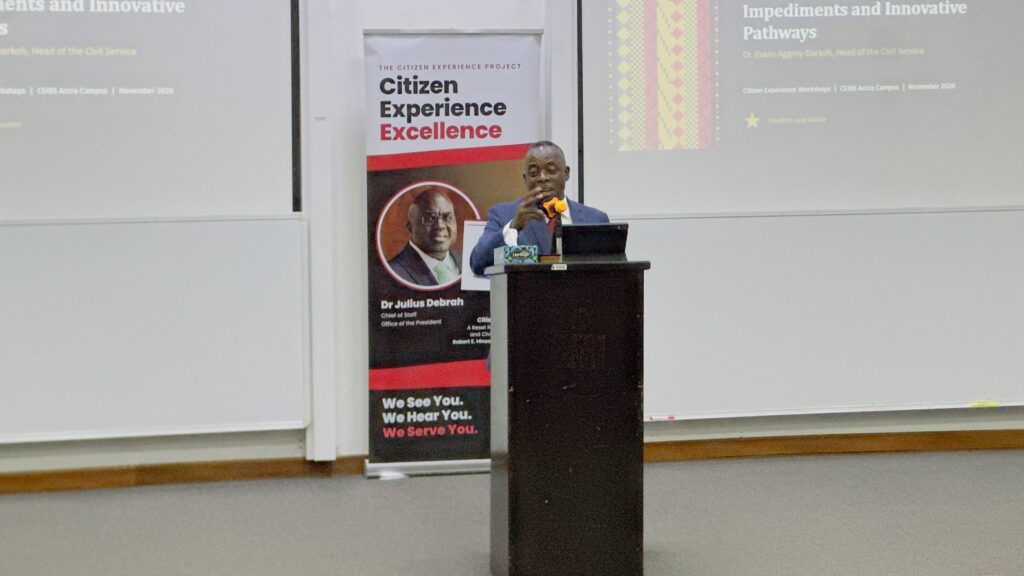
Dr Debrah made the call at the second workshop in a series of engagements under the “Citizen Experience: A Reset for Superior Public and Civil Service Delivery initiative”, aimed at promoting citizen-centred governance across Ghana and Africa.
The workshop, held in Accra on Friday, brought together public sector leaders and other stakeholders to explore practical approaches to improving citizens’ experiences in accessing government services.
It followed the first workshop held on November 11 at the China Europe International Business School (CEIBS), as part of a roadshow to translate the principles and recommendations of the book into practical institutional reforms.
Dr Debrah said the primary purpose of the Civil Service was to improve the lives of the people it served, requiring institutions to move beyond administrative efficiency and focus on meaningful outcomes.

He gave the example of a mother who had to make repeated visits to a district office to register her child because of unclear documentation requirements, saying such administrative shortcomings imposed unnecessary financial and emotional costs on citizens.
Citizens, he said, paid for public services through taxes and fees and sacrificed valuable working hours to access them, making it imperative for institutions to respect their time and treat them with dignity.
“Every time an institution keeps a promise like that, it gives the people a reason to trust in the state they live in,” he explained.
Dr Debrah identified strategy, institutional structures and frontline service as three critical areas for improving service delivery.
He, therefore, urged institutions to incorporate citizens’ needs into their organisational plans, clearly communicate service commitments and provide the necessary resources to fulfil them.
He also called for reviews of internal structures and processes to eliminate unnecessary procedures, duplication of requirements and delays, while ensuring frontline officers received continuous training, adequate resources and authority to resolve routine challenges.

Institutions must also strengthen feedback mechanisms, respond promptly to complaints and communicate improvements made in response to citizens’ concerns.
Dr Debrah urged participants to identify at least one essential service in their institutions, consult users about the challenges they encountered and publish clear information on requirements, costs, processing times and channels for assistance.
Dr Evans Aggrey-Darkoh, Head of the Civil Service, said public institutions represented the practical expression of the state, and their failure to deliver services effectively amounted to a failure of the state.
Speaking on “citizen accountability impediments and innovative pathways”, he noted that accountability required public officials to explain and justify decisions, disclose relevant information, respond to scrutiny and accept responsibility for their actions.
Corruption, excessive bureaucracy, delays and abuse of discretion are, however, among the obstacles undermining effective public service delivery.
Dr Aggrey-Darkoh said public authority was a trust conferred on officeholders by citizens and must be exercised in their interest.
Accountability must thus go beyond answerability to include enforceable standards, corrective measures and institutional learning.
Dr Stella Agyenim-Boateng, Vice-Chairman of the Public Services Commission, said public servants must recognise that their authority to serve came from citizens, with every interaction providing an opportunity to honour the social contract.
Long waiting periods, unclear service requirements, poor communication and ineffective complaint-handling systems contributed to negative perceptions about public institutions, she emphasised.
She urged public servants to reflect on their experiences when seeking services from other government agencies and consider whether they would be satisfied with the treatment they received.
“Even a single negative encounter with a frontline officer could shape a citizen’s perception of an entire institution, making courtesy, accessibility and responsiveness essential to effective service delivery,” she said.
Professor Robert Ebo Hinson, co-author of the book and Professor of Marketing at the University of Ghana, said the initiative would extend beyond the workshops to promote sustained transformation of public service delivery across the continent.
Institutions need evidence-based customer experience strategies supported by measurable service standards, performance indicators and regular monitoring, rather than relying on ad hoc responses to complaints.
The workshop forms part of efforts to advance the ideas contained in Citizen Experience: A Reset for Superior Public and Civil Service Delivery, launched on July 8, 2026, with the Vice-President, Professor Naana Jane Opoku-Agyemang, in attendance.
GNA
Edited by Beatrice Asamani Savage
Reporter: James Amoh Junior
Email: [email protected]