By Jibril Abdul Mumuni
Akropong, Mampong (E/R), Oct. 20, GNA–The Ghana Chamber of Telecommunications and its member, CSquared, have trained over 100 students of the Demonstration School for the Deaf in Mampong on basic coding and robotics.
The initiative aims to promote inclusive digital training for differently-abled children as part of CSquared’s Corporate Social Responsibility (CSR) activities and activities marking the Chamber’s 15th anniversary and its drive towards inclusive digital innovation.
The workshop, held on the school’s premises at Okropong, Mampong in the Eastern Region, exposed the pupils to the fundamentals of coding, visual programming and basic robotics assembly.
Speaking on the sidelines of the event, Madam Sylvia Owusu-Ankomah, CEO of the Ghana Chamber of Telecommunications, said the decision to train the students aligned with the government’s flagship digital innovation programme, the “One Million Coders Initiative”.
She said the Chamber was pursuing an all-inclusive digital agenda to ensure no one was left behind in the country’s technological advancement.
“And that’s why it’s important for us to also be very intentional around, including our differently-abled children in this CSR programme,” she said.
Madam Owusu-Ankomah noted that in an era of evolving technology, particularly with the rapid advancement of Artificial Intelligence (AI), every child ought to have access to basic technological knowledge and visual programming platforms such as Scratch.
This, she explained, would enable them to appreciate how technology operates and apply it to develop solutions that would benefit them in life.
“So whatever field of endeavour the child chooses to pursue, we believe that coding is fundamental, alongside all the other co-curricular activities they engage in,” she added.
Mr Stephen Gefli, Chief Sales and Marketing Officer of CSquared Ghana, said the exercise was designed to help the students build digital skills to solve everyday challenges.
He noted that the workshop was unique because it catered specifically to students with disabilities.
“It’s been an eye-opener for the team to see how intelligent these students are and how capable they are of learning, just like students without disabilities,” he remarked.
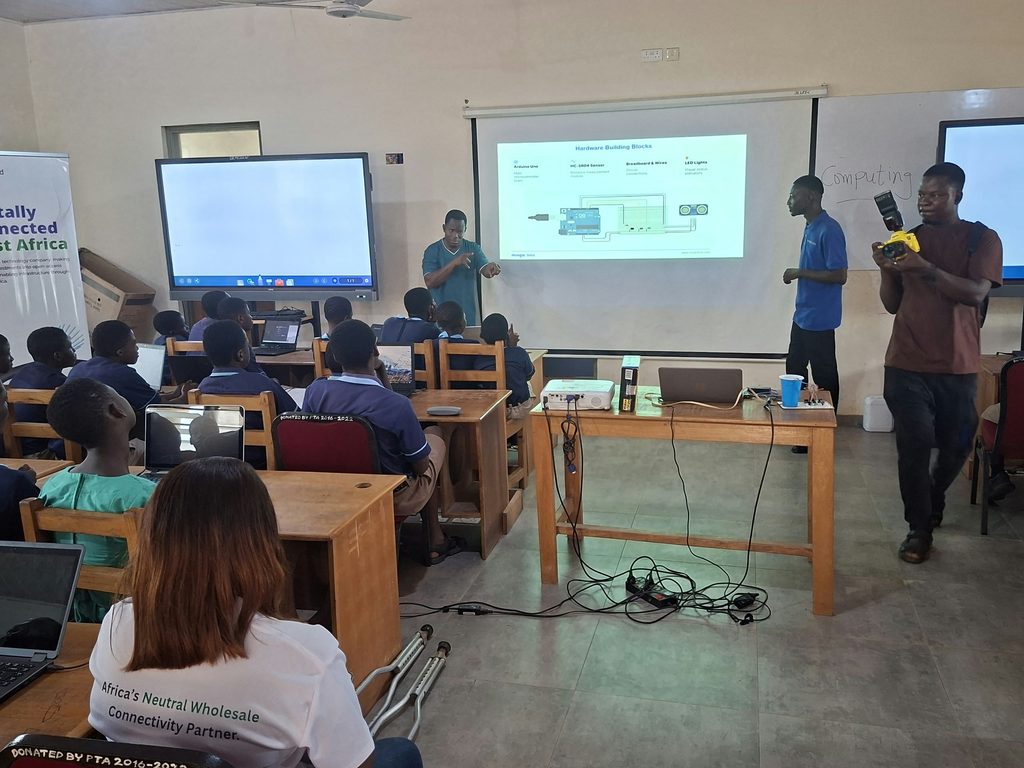
Mr Gefli observed that most technological solutions in Ghana were not inclusive, citing digital payment systems and mobile application transactions where accessibility limitations for persons with disabilities persist.
He urged technology companies to integrate disability-friendly features into their products to enable persons with disabilities to use technology to improve their lives.
Mr Setumte Ametewee, Headteacher of the Demonstration School for the Deaf, expressed gratitude for the training, noting that the students were enthusiastic about robotics and coding.
He appealed for more of such initiatives in the school to benefit a larger number of pupils.
“For me, I think that the numbers are not too big, but I wish we could get larger numbers because our children are very interested in hands-on activities and what they can build through tactile learning,” he said.
Background: Digital Inclusion Gap
Persons with Disabilities (PWDs) in Ghana face persistent digital exclusion despite rapid national technological advancement.
Ghana has an estimated 8% of its population living with some form of disability, according to the 2021 Population and Housing Census, yet mainstream applications, including mobile money platforms and public service portals, largely lack universal accessibility features such as sign language integration, screen-reader compatibility and haptic feedback for hearing and visually impaired users.
Special education institutions also lack technical infrastructure and adaptive digital learning tools, with limited access to assistive devices, stable internet and trained ICT instructors.
The initiative by the Ghana Chamber of Telecommunications addresses these gaps by equipping deaf students with basic coding skills.
Training PWDs promotes digital equity and empowers differently-abled youth to design custom assistive solutions, accelerating their integration into the digital economy.
It also supports key national and global frameworks, including the Government’s Digitalisation Agenda, the One Million Coders Initiative launched to train one million youth in coding and digital skills, the Persons with Disability Act, 2006 (Act 715), and Sustainable Development Goals 4 (Quality Education), 8 (Decent Work and Economic Growth) and 10 (Reduced Inequalities).
The Ghana Chamber of Telecommunications is the industry association of licensed telecommunications and tower companies in Ghana.
Established in 2010, it marks its 15th anniversary in 2025/2026.
CSquared is a pan-African technology company deploying open-access fibre infrastructure across the continent.
The Demonstration School for the Deaf at Mampong-Akuapem in the Eastern Region is one of Ghana’s oldest special needs institutions, providing basic education for children with hearing impairment.
GNA
Reporter: Jibril Abdul Mumuni
[email protected]
Edited by Samuel Osei-Frempong