Accra, Oct. 7, GNA – President John Dramani Mahama has announced a one-billion cedi allocation in the 2027 Budget towards a revolving National Housing Fund to expand access to affordable decent housing.
The President said he had directed the Finance Minister to make the allocation as part of the Government’s contribution to the three billion-cedi fund.
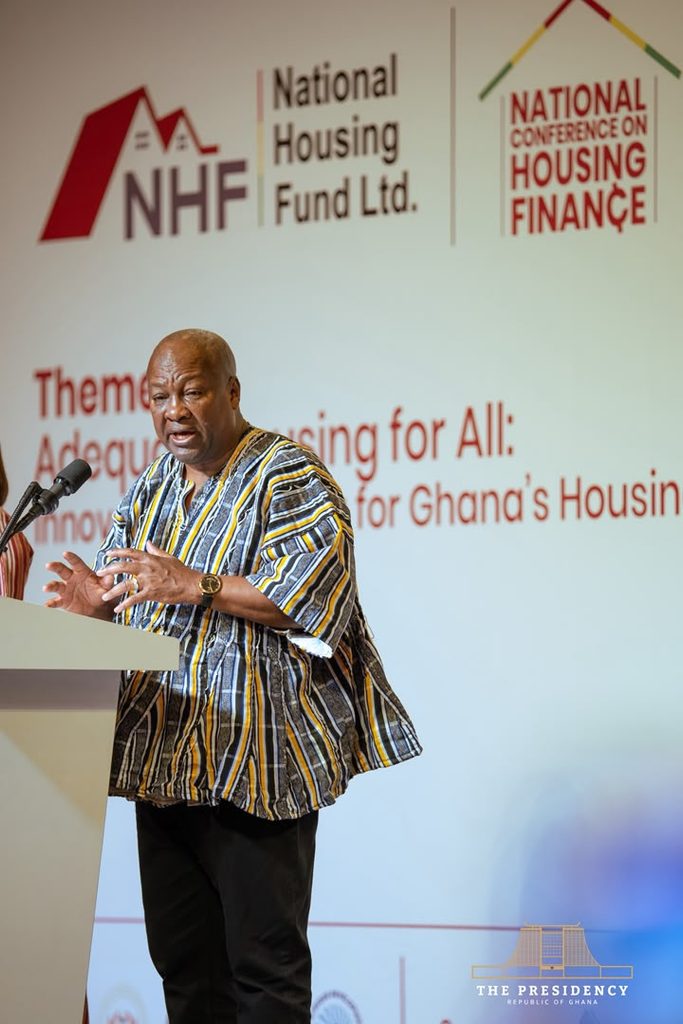
He made the announcement at the opening of the National Conference on Housing Finance in Accra.
The conference was organised by the National Housing Fund Limited in collaboration with the Ministry of Works, Housing and Water Resources.
The two-day conference, held to commemorate World Habitat Day, is on the theme: “Adequate Housing for All, Innovative Financing for Ghana’s Housing Future”.
President Mahama said the Government’s contribution would not be the sole source of financing for the Fund.
Pension funds, insurers, development finance institutions and diaspora investors could also provide capital through structures that protected their interests while supporting viable housing projects.
He said the blended finance approach being promoted under the 24-Hour Economy and Accelerated Export Development Programme offered useful lessons for mobilising such resources.
Carefully targeted public and concessional financing, he said, could also help attract private investment and manage risks.
President Mahama said the transition from the National Home Ownership Fund Limited to the National Housing Fund Limited was intended to broaden the institution’s mandate.
The new focus, he said, would move beyond home ownership financing to supporting housing delivery and expanding affordable housing options.
The President said the Government remained committed to delivering decent and affordable housing at scale.
This would be achieved through the effective use of government and institutional land banks, support for private investment and the revival of stalled housing projects.
President Mahama said the housing programme at Saglemi was expected to deliver 1,500 housing units by next year.
Additionally, a district housing programme was also being piloted in eight districts by the Ministry of Works, Housing and Water Resources in collaboration with the National Housing Fund.
He assured that the Government would accelerate the district housing programme in the next financial year.
The Tema Development Corporation’s Oxygen City in Ho, Volta Region, and the State Housing Company’s Green City at Dedesua in the Ashanti Region would also contribute to the country’s housing stock.
President Mahama noted that economic stability was critical to expanding housing finance.
Lower inflation and more favourable lending conditions could improve prospects for construction and mortgage finance, he added.
The Government’s responsibility, he said, was to ensure that such economic gains translated into tangible benefits for households.
“We must also mobilise capital that is suited to the long life of housing investments,” he emphasised.
The President said housing development must go beyond constructing houses.
It must create integrated communities with roads, water, drainage and sanitation systems, as well as access to schools, healthcare and other social facilities.
He noted that lower house purchase prices would offer little relief to families if they still had to spend excessively on commuting or securing basic services.
“Land administration, planning, planning approvals, infrastructure provision, and housing finance must all work together as a symphony,” he stated.
He also called for housing to be incorporated into the planning of industrial enclaves under the Government’s economic transformation agenda.
Providing residential facilities close to industrial enclaves would reduce commuting costs, improve workers’ productivity and give them more time with their families.
President Mahama, however, noted that uncertainties surrounding land titles and delays in planning approvals increased costs, discouraged investment and ultimately burdened households.
Mr Ahmed Ibrahim, Minister of Works, Housing and Water Resources, in a speech read on his behalf, proposed that the conference be institutionalised as an annual National Housing Finance Conference.
He said the platform would enable government, the financial sector, developers, professionals, labour, academia and development partners to review progress and agree on practical solutions.
Mr Ibrahim said adequate housing was a fundamental human right and an important driver of economic development.
It created jobs, stimulated local industries, deepened financial markets and contributed to improved health, productivity, social stability and dignity.
Mr Mahama Ayariga, Minister of Local Government, Chieftaincy and Religious Affairs, said although housing was a challenge, it also presented an opportunity.
Mr Prosper Hoetu, Chief Executive Officer of the National Housing Fund Limited, said Ghana needed a housing finance system that recognised the different circumstances of households and provided multiple pathways to home ownership.
GNA
Edited by Beatrice Asamani Savage
07 October 2026