By Jibril Abdul Mumuni
Accra, Oct. 1, GNA – Mr Muntaka Mohammed-Mubarak, the Minister of the Interior, has urged industries across Ghana to construct water reservoirs to strengthen fire prevention and firefighting measures.
He said industrial operations involving combustible materials made factories highly susceptible to fire outbreaks.
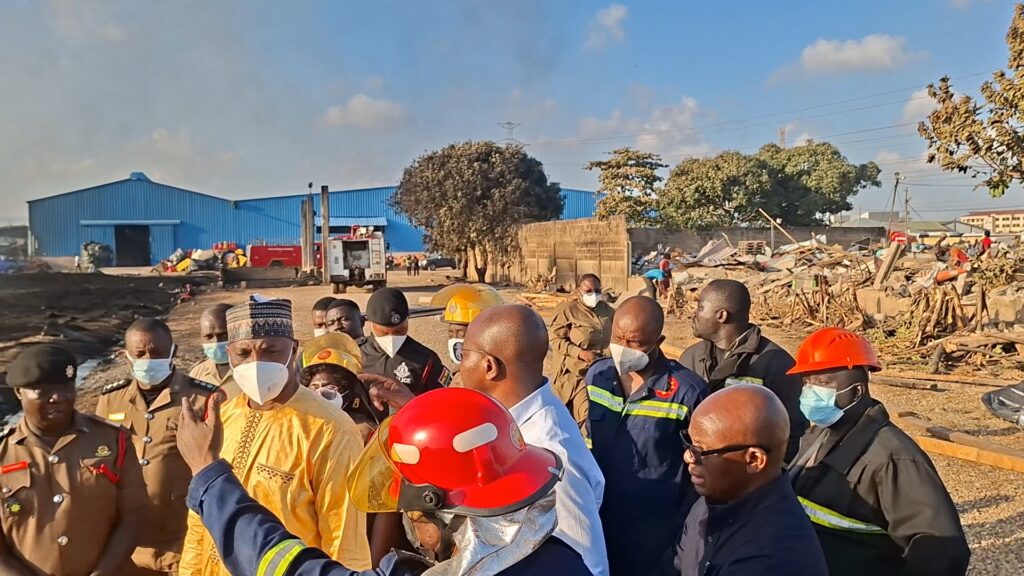
The Minister made the call on Thursday when he visited the scene of a fire that gutted parts of the Duraplast premises in the early hours of the day at the Avenor Industrial Area in Accra.
He was accompanied by Mr Mahama Ayariga, Minister of Local Government, Chieftaincy and Religious Affairs.
The delegation was briefed by ACFO II Rashid Nisawu, Greater Accra Regional Fire Commander.
The delegation toured sections of the Duraplast facility affected by the fire and expressed their sympathies to the management and staff of the company.
Accra has two major industrial hubs, notably the Kwame Nkrumah Circle Industrial Area and Tema, which accommodate numerous factories engaged in various industrial activities.
The Interior Minister said the creation of water reservoirs by industries would make it easier for firefighters to access water during emergencies.
Mr Mohammed-Mubarak also disclosed plans by the Ministry to facilitate the construction of boreholes across the country, particularly in industrial enclaves, to improve access to water for firefighting.
Outlining Government interventions for the Ghana National Fire Service (GNFS), he said the Government intended to introduce the Automatic Fire Compliance and Safety System (AFCSS) to monitor the fire safety systems of industries.
“For me, what we are bringing on board is the Automatic Fire Compliance and Safety System. We will also publish and name companies that have failed to comply with fire safety regulations for a year,” he said.
The Minister expressed concern about institutional and regulatory shortcomings within Ghana’s fire prevention framework.
He noted that many fire outbreaks could have been prevented if the GNFS consistently carried out its regulatory mandate by routinely inspecting factories and assessing their compliance with fire safety requirements.
Mr Ayariga, on his part, attributed many fire incidents to systemic failures, particularly within the decentralisation framework.
He said the absence of effective zoning systems in the capital had resulted in the mixing of commercial, industrial and informal trading activities in the same areas.
“I think there is sometimes a systems failure. Many things have failed to create this situation. The zoning system has failed,” he said.
“This is not a zone for petty trading and the kind of business activities that we see. We are mixing petty trading, the sale of bicycles and similar activities with major industrial operations.”
He stressed that the coexistence of heavy industry and petty trading in the same locations created significant challenges for fire prevention and emergency response efforts.
Mr Ayariga said he would engage Metropolitan, Municipal and District Chief Executives (MMDCEs) to explore practical solutions and strengthen the implementation of zoning plans.
In an exclusive interview with the Ghana News Agency during the firefighting operation, Assistant Chief Fire Officer (ACFO) Rashid Nisawu, the Greater Accra Regional Commander of the Ghana National Fire Service (GNFS), urged industries and factory owners to involve the Service during the planning and establishment of their facilities to help prevent fires.
He said the fire had been brought under control, with firefighters successfully preventing the blaze from spreading to nearby factories and warehouses.
Earlier, when the Ghana News Agency visited the scene, plumes of smoke, ashes and destroyed goods were all that remained of sections of the factory following the fire.
Mechanics, workshop operators and truck drivers working in the area were seen attempting to salvage whatever items remained from the affected premises.
ACFO Nisawu attributed the prolonged nature of the blaze to the presence of flammable hydrocarbon-based materials at the scene.
The materials involved included plastics and other hydrocarbons, which required the use of foam in addition to water to effectively extinguish the fire.
He said water alone was not enough to douse the fire because of the nature of the materials burning, explaining that foam concentrate was mixed with water to blanket the surface of the fire and prevent oxygen from sustaining the flames.
The officer said firefighters also used breathing apparatus to enable them to safely move closer to the fire, noting that the thick smoke was characteristic of Class B fires involving flammable materials.
Meanwhile, salvaged storage tanks belonging to the company at the Avenor Industrial Area near Kwame Nkrumah Circle remained under tight security, with company security personnel maintaining a constant watch over the recovered assets.
GNA
Edited by Agnes Boye-Doe
Reporter: Jibril Abdul Mumuni