By Caleb Kuleke
Ho, Oct. 30, GNA – Legal enforcement and rescue operations alone are insufficient to eradicate child trafficking, Madam Anita Budu, Director of the West Africa Programme of the International Justice Mission (IJM), has stated.
She emphasised that permanently ending the menace required the active involvement of traditional leaders, community members, and families, supported by heightened vigilance at the community level.
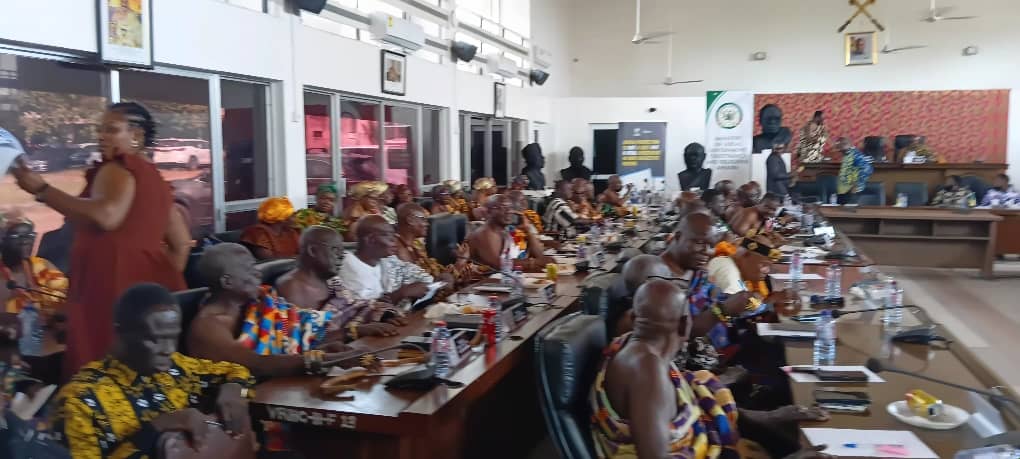
Madam Budu made the remarks at a stakeholder dialogue on child trafficking held in Ho.
The event was organised by IJM in collaboration with the Ministry of Chieftaincy and Religious Affairs and the Volta Regional House of Chiefs.
The dialogue sought to deepen understanding of child trafficking and child protection issues in the region while mobilising traditional authorities to lead efforts aimed at eliminating the practice.
Madam Budu commended the Ministry for its collaboration, coordination and commitment to child protection, noting that government support had created the platform needed for meaningful engagement with influential traditional and religious leaders.
Highlighting IJM’s work in Ghana, she said the organisation had partnered government institutions since 2015 to combat human trafficking and forced labour in the agricultural sector.
According to her, those interventions focused on strengthening the capacity of relevant authorities to identify, remedy, and prevent cases of trafficking.
Madam Budu said IJM also placed significant emphasis on survivor rehabilitation and reintegration, stressing that the fight against trafficking extended beyond rescuing victims to ensuring that survivors recover, heal and rebuild their lives.
She noted that sustained progress could only be achieved when institutions and communities worked together, describing traditional leadership as one of the greatest assets in the campaign against child trafficking because chiefs and queen mothers often served as the first source of trust and guidance in communities.
Madam Budu observed that traffickers sometimes hide behind claims of culture and tradition and urged traditional leaders to use their influence to strengthen local child protection systems.
Mr Moses Asampoa, Volta and Oti Regional State Attorney and a facilitator at the programme, called on chiefs and queen mothers to support local assemblies in the strict enforcement of bylaws aimed at protecting vulnerable groups.
He cautioned traditional leaders against interfering in criminal prosecutions involving their subjects, stressing that shielding perpetrators constituted a violation of the law.
Mr Asampoa identified unemployment and poverty as major drivers of human trafficking and appealed to traditional rulers to encourage affluent individuals within their communities to support vulnerable families.
He also urged them to intensify public education on the dangers of trafficking, describing the practice as a form of modern slavery, and to engage legal and social welfare experts to sensitise community members.
The State Attorney further warned traditional authorities against attempting to settle human trafficking cases at the palace level.
He stressed that such actions were unlawful and that all trafficking-related cases must be reported to the Police, Legal Aid Commission, Department of Social Welfare, or the Commission on Human Rights and Administrative Justice (CHRAJ).
Mr Asampoa reminded participants that Ghana’s future depended on the welfare of its children and warned that persons who subjected children to exploitative labour would face the full rigours of the Children’s Act and the Human Trafficking Act.
He said child exploitation attracted a prison sentence of between five and 25 years. In addition, individuals who failed to report known incidents of trafficking committed an offence punishable by a fine, imprisonment of up to 12 months, or both.
Madam Stella Mawutor, Volta Regional Director of Social Welfare and another facilitator, guided traditional leaders on official reporting procedures and underscored the importance of effective collaboration among institutions.
She advocated stricter punitive measures against traffickers to serve as a strong deterrent and reaffirmed her department’s readiness to work closely with traditional authorities to safeguard the rights and future of children in the region.
GNA
Edited by Maxwell Awumah/Lydia Kukua Asamoah
Reporter: Caleb Kuleke