By Anthony Adongo Apubeo, GNA
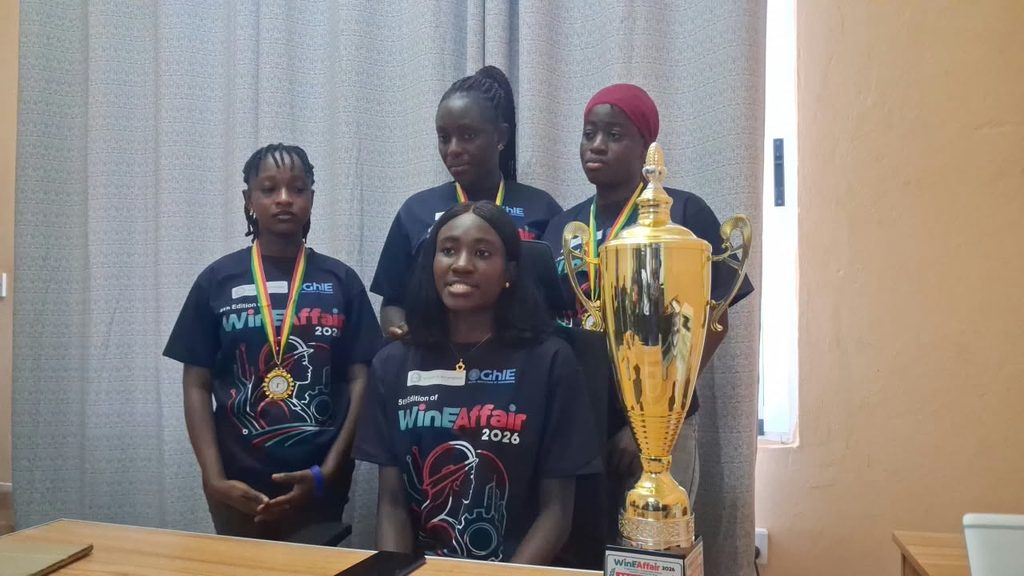
Sumbrungu (U/E), Oct. 8, GNA – The Bolgatanga Technical University (BTU) has won the 2026 Women in Engineering (WinE) Affair, an innovative challenge with a smart emergency communication and flood-monitoring system designed to detect flooding early and help save the lives of people trapped by floodwaters.
The BTU WinE Team emerged winners ahead of students from about 19 universities that participated in the competition organised under the Ghana Institution of Engineering (GhIE).
The victory earned the team a trophy and a cash prize of GH¢20,000.00.
The innovation, developed under the Internet of Things (IoT) category, combines a flood-level sensor, alarm system, emergency communication mechanism and GPS technology to detect dangerous rises in floodwater, alert people in affected areas and transmit their location to emergency responders.
Ms Aurelia Ayamdor, an Assistant Lecturer at the Electrical and Electronics Department of BTU and Patron of the university’s Women in Engineering students, said the team developed the system in response to the increasing incidence of flooding in parts of the country.
She said the system was designed to help people who might become trapped during floods to communicate with emergency responders, including the National Disaster Management Organisation (NADMO) and the Ghana National Fire Service.
Ms Ayamdor explained that the system had a sensor that monitored the height of rising floodwater and detected when it reached a dangerous level.
Once the water reached that level, the sensor would automatically trigger an alarm and activate the emergency communication system.
The system would then send signals to the relevant emergency-response institutions, together with the GPS location of the affected premises, enabling responders to identify where assistance was required.
“With this device, it’s very easy. And you see, the good thing about it is that you don’t need somebody triggering it. Once it senses the flood, it goes ahead to send signals and indicate where you can actually locate whoever is in the problem,” she said.
Ms Ayamdor also said the team planned to collaborate with ministries and Metropolitan, Municipal and District Assemblies (MMDAs) to scale up the project for use in flood-prone communities.
She said the ultimate objective was to develop the system into a practical solution that could contribute to saving lives during floods.
Dr George Dordah, Dean of the School of Engineering and Built Environment of BTU, said the innovation demonstrated the ability of students to apply classroom knowledge to address real-world challenges.
He said the system had a sensor that detected the height of rising water and triggered the alarm when the water reached a predetermined dangerous level.
“The sensor in itself is what we should know is that from the inside, there will be a button that somebody, if you realise that you are in trouble, would press to send the information,” he said.
Dr Dordah said the innovation could help address one of the major challenges associated with floods, where emergency responders sometimes struggled to locate people trapped in their homes.
He said the system could provide early warning before flooding became more dangerous and facilitate faster rescue operations.
“When people are trapped, like they said, in their own homes, sometimes you are looking for them, you can’t find them. With this device, it is very easy.
“When it comes to floods, starting from where we are, the North here, Upper East, the moment the Bagre Dam is opened, you realise that a lot of the places we have within our enclave get flooded. And it is important that we are able to early detect these floods,” he said.
He said the university did not intend to end the project with the competition but would seek partnerships with relevant ministries and emergency-response institutions, including NADMO and the Fire Service, to scale it up.
He disclosed that representatives of the Ghana Institution of Engineering had already approached the team after the competition, creating an opportunity for further discussions on developing the innovation.
He said the School of Engineering and Built Environment would continue to encourage students to connect classroom learning with real-world challenges confronting communities and industry.
Mr Kenneth Nsoyine Atonka, President of the Student Representative Council (SRC) of BTU, congratulated the team and commended them for demonstrating hard work, discipline, determination and teamwork.
He said the SRC was proud of the students and would continue to support initiatives that empowered women in engineering.
GNA
Edited by Caesar Abagali/Kenneth Odeng Adade
Reporter: Anthony Adongo Apubeo
Reporter’s email: [email protected]