By Anthony Adongo Apubeo
Zuarungu (U/E), Oct. 28, GNA – A project to empower women and young people with agricultural skills, employment opportunities and entrepreneurship support in Northern Ghana has been launched.
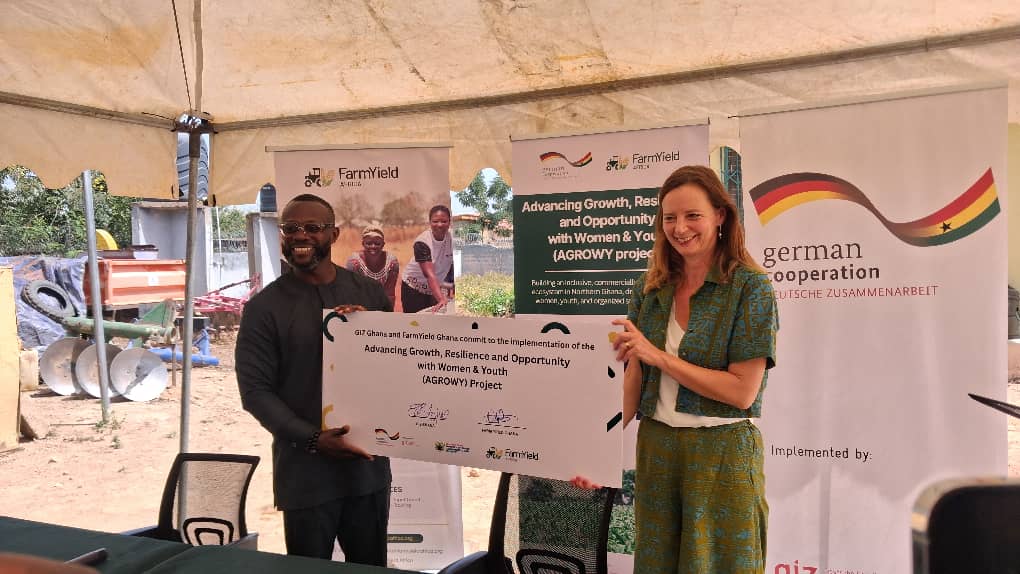
The project, dubbed “Advancing Growth, Resilience, and Opportunity with Women and Youth (AGROWY Project)”, is under the auspices of the Private Sector and Innovation Promotion in Ghana (PSInno) programme of the German Development Cooperation Ghana (GIZ) in partnership with the Ministry of Trade, Agribusiness and Industry and being implemented by Farm Yield Ghana, a non-governmental organisation.
The project seeks to address barriers to mechanisation, skills development, finance and market access facing women and young people in the agricultural sector, especially in Northern Ghana, to promote inclusive and commercially viable agriculture.
It will support 200 beneficiaries through three interventions, including training 40 women in tractor operation, equipping 60 young people with practical farming and entrepreneurial skills, and helping 100 farmers and agribusiness operators to strengthen their businesses and access markets.
Speaking in Zuarungu in the Bolgatanga East District during the signing of a Memorandum of Understanding (MoU) between Farm Yield Ghana and GIZ Ghana, Mr Yaw Agyare, the Board Chair of Farm Yield Ghana, said the initiative was designed to translate training into employment, improved incomes and sustainable agricultural enterprises.
He said women and young people in Northern Ghana continued to face challenges in accessing the skills, machinery, finance and markets needed to participate fully in the agricultural value chain.
“We are not here merely to train. We are here to ensure that training translates into employment, higher incomes and lasting businesses,” he said.
Under the Female Tractor Operator Training component, 40 women would acquire practical mechanisation skills and receive support to transition into internships and employment, with opportunities to establish their own farmer service centres.
The One Youth One Acre component would equip 60 young people with practical farming, entrepreneurship and market development skills to establish sustainable agricultural enterprises.
Additionally, the Farmer-to-Business Transformation component would support 100 farmers and existing agribusiness operators, particularly women and young people, to improve business management, record-keeping, formalisation and market access.
Ms Arlett Stojanovic, Head of Programme for PSInno at GIZ Ghana, said the project represented a shared commitment to creating economic opportunities for women and young people while strengthening smallholder farmers and building a more resilient agricultural sector.
She said an earlier collaboration between GIZ and Farm Yield Ghana had enabled 15 young women from different parts of Northern Ghana to become tractor operators and mechanics, as well as drone operators, with most still employed in commercial farming operations.
Ms Stojanovic said the new project would build on those gains by challenging traditional perceptions about women’s roles in agriculture and promoting farming as a viable business for young people.
Mr Rasheed Imoro, the Nabdam District Director of Agriculture, who spoke on behalf of Alhaji Zakaria Fuseini, Upper East Regional Director of Agriculture, welcomed the initiative, saying it addressed some of the persistent challenges confronting farmers, particularly women and smallholder producers.
He said access to tractor services during the planting season remained a major challenge for many farmers, making the training of women to operate agricultural machinery a timely intervention.
Mr Imoro, however, urged the project implementers to place greater emphasis on market access to ensure that beneficiaries could sell their produce profitably.
He said young people needed to see tangible economic benefits from agriculture to remain in the sector, adding that stronger links between production and markets could help reduce the tendency of young people to abandon farming.
He also called for greater attention to women’s contributions to agriculture, noting that their participation extended beyond household food production to commercial activities that supported family livelihoods and children’s education.
GNA
Edited by Caesar Abagali/Benjamin Mensah
Reporter: Anthony Adongo Apubeo
Reporter’s email address: [email protected]