A GNA Feature by James Amoh Junior
Accra, Sept 22, GNA – By the time Maame Akosua Konadu sets out from her farm at Akroso in the Asene Manso Akroso District in the Eastern Region of Ghana, the weight on her head is not the only burden she carries.
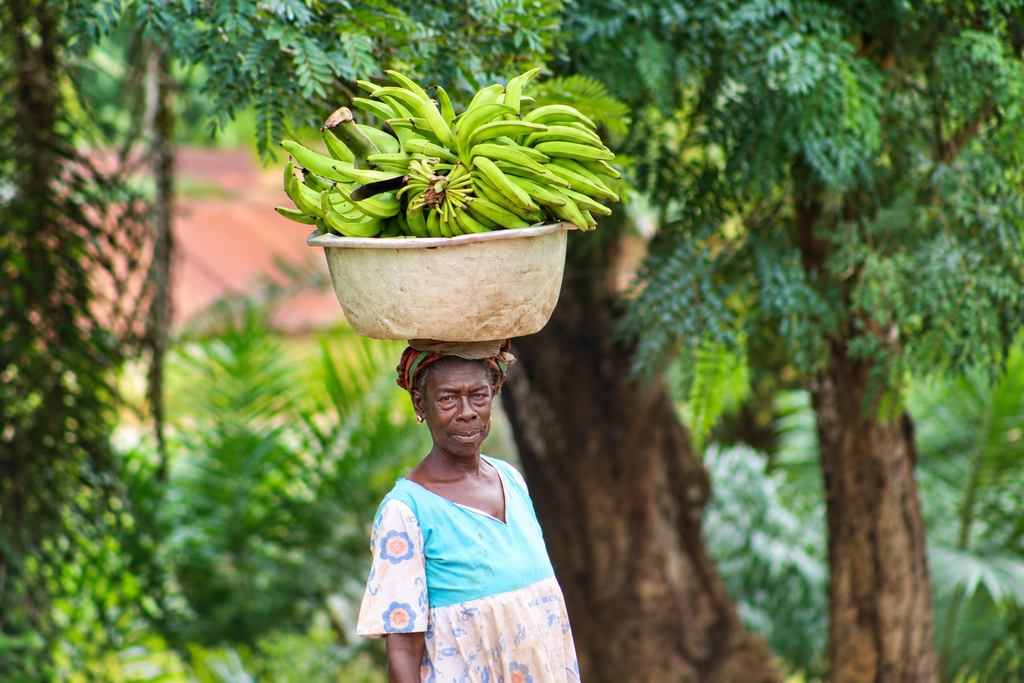
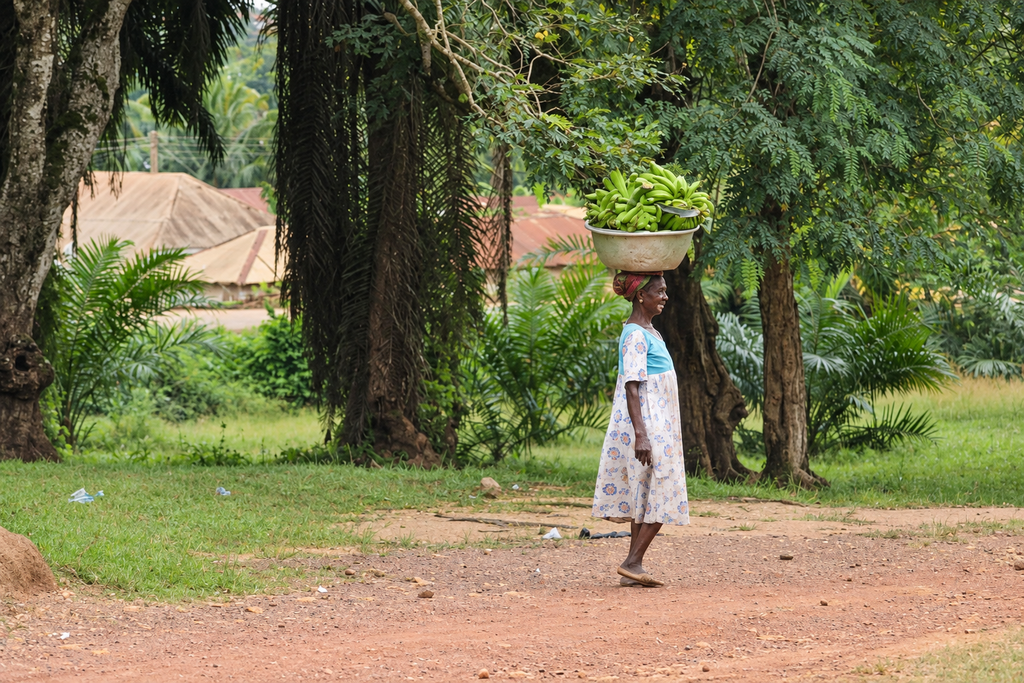
Balanced on her head is a large pan filled with freshly harvested plantains. Beside her is her small dog, keeping pace as she makes the long journey towards the local market.
For Maame Akosua, the journey can stretch well beyond 20 kilometres.
She makes the trip almost every day of the week, walking with her produce to the market where much of the plantain is sold.
“It is not easy,” she says of the journey. But stopping is hardly an option.
She has a family to cater for, and the farm and the market are among the few means available to her to earn an income.
Her story is a simple one, but it captures a much bigger reality confronting thousands of women in rural Ghana, where the struggle for income, food and family survival often begins and ends with work that is physically demanding, poorly rewarded and largely informal.
For women like Maame Akosua, poverty is not an abstract statistic. It is the distance between the farm and the market.
It is the weight of a pan carried on the head. It is the choice between spending money on transportation or preserving the little income earned from a day’s sales.
And it is the responsibility of returning home with enough to meet the needs of a family.
Across Ghana, agriculture remains an important source of livelihood. The Ghana Statistical Service’s 2025 Quarterly Labour Force Survey shows that agriculture is the country’s second-largest employment sector, with about five million people engaged in it.
The survey also points to the dominance of own-account work, particularly among women, rural workers and people engaged in agriculture – a pattern that reflects the persistence of informal and less secure livelihoods.
For rural women, however, the challenge is not simply having work. It is having productive work that can generate enough income to provide security.
A woman may cultivate the land, harvest crops, carry them to the market, negotiate with buyers and return home to prepare food and care for her family.
Much of this labour takes place outside the protection and security associated with formal employment.
A 2025 paper on women and sustainable community development in Africa identifies limited access to financial resources, discrimination, inadequate property rights, educational barriers, healthcare inequalities and unequal care responsibilities as major obstacles to women’s economic advancement.
For a farmer, such as Maame Akosua, access to finance can make the difference between subsistence and a more secure livelihood.
Yet rural women often struggle to access credit because they lack collateral, particularly land and other assets that financial institutions recognise.
The paper notes that women may work agricultural land without owning or controlling it, limiting their ability to use it as collateral for loans to improve production.
That exclusion can create a cycle. Without capital, a farmer cannot easily expand production.
Without increased production, income remains low. With low income, transportation, storage, processing and other improvements become difficult to afford.
So the woman continues walking. The long journey also illustrates another dimension of women’s poverty: time.
Women frequently combine income-generating activities with unpaid care work.
The same study notes that women carry a disproportionate share of household and caregiving responsibilities, limiting the time available for education, employment and economic advancement.
For Maame Akosua, every kilometre walked is time spent securing an income that must compete with the other demands of family life.
The challenge is particularly significant because poverty and gender inequality reinforce each other.
The 2026 study of women’s empowerment in Ghana, using Ghana Demographic and Health Survey data from 2003 to 2022, found that progress in women’s empowerment has been uneven.
It reported that social independence remained particularly unequal, with differences linked to wealth, education, age and place of residence.
For women such as Konadu, the burden extends beyond earning an income.
United Nation’s Women data show that women and girls aged 15 and above in Ghana spend 15.5 per cent of their time on unpaid care and domestic work, more than three times the 4.6 per cent recorded for men.
Her 20-kilometre journey reflects a wider rural reality as according to the United Nations, poverty in Ghana is heavily concentrated in rural areas, where it is particularly prevalent among households dependent on self-employed agricultural work.
The implication is important. A woman cannot easily escape poverty when she lacks the resources that could enable her to make different economic choices.
Education, access to finance, ownership of productive assets, healthcare, transportation and markets are not separate concerns. They are interconnected pieces of the same economic puzzle.
This is why Maame Akosua’s walk to the market is more than a personal struggle. It is also a societal development story.
The United Nations’ Sustainable Development Goals recognise the links between poverty, gender equality, decent work and economic growth.
Indeed, empowering women economically can strengthen households and local economies because women often reinvest earnings in their families and communities.
Yet empowerment cannot simply mean asking women to work harder. Women such as Maame Akosua are already working hard.
The question is whether the systems around them can reduce the barriers that make survival so physically and economically costly.
Better rural roads could shorten the journey to market. Affordable transportation could reduce the physical burden of carrying produce long distances. Access to affordable credit could enable farmers to expand production.
Storage and processing facilities could reduce losses and increase the value of agricultural produce. Secure land rights could give women greater economic independence.
And education and skills could open opportunities beyond subsistence farming. These interventions matter not only for women but for families and communities.
The Ghana Statistical Service’s latest food insecurity assessment also shows how closely livelihoods, poverty and household welfare are connected. Its 2024 Q1–2025 Q3 report found that food insecurity remained uneven across Ghana and that female-headed households, particularly in rural areas, faced consistently higher risks.
Maame Akosua’s journey therefore ends where another begins – at home, where the money from the market must be converted into food, education, healthcare and other necessities.
Her dog may walk beside her, but the responsibility and insecurities she carry is much heavier. Every morning, she takes the same road. Twenty kilometres is a long distance to walk for a living.
For Maame Akosua, it is simply the distance between what her family needs and what she must do to provide it.
Until rural women get greater access to land, capital, markets, infrastructure and opportunities that can transform their labour into secure livelihoods, many will continue to make that tortuous journey, because turning back has dire consequences.
GNA
Reporter: James Amoh Junior
Email: [email protected]
Edited by: Samuel Osei-Frempong