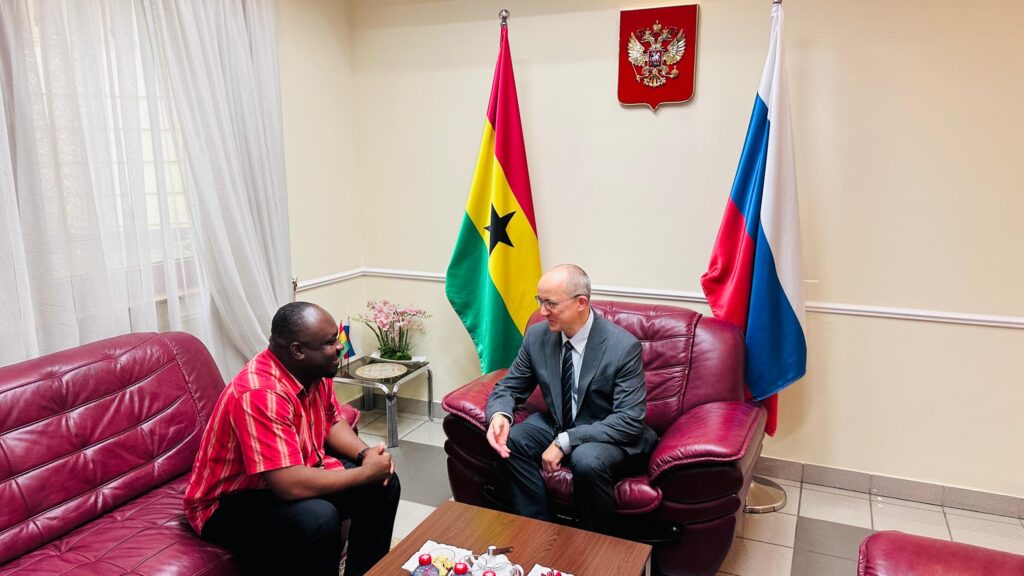
Accra, July 20, GNA – Russia is seeking to elevate its longstanding partnership with Ghana through expanded cooperation in trade, technology, education, energy and diplomacy, according to the country’s Ambassador to Ghana, H.E. Andrei Ordash.
In this exclusive interview with the Ghana News Agency (GNA), the Ambassador outlines Moscow’s vision for a stronger strategic relationship, describing Ghana as a reliable and promising partner in West Africa with significant potential for deeper bilateral engagement.
Ambassador Ordash discusses Russia’s plans to support Ghana’s economic transformation through investments in agriculture, nuclear energy, digital innovation and artificial intelligence, while highlighting opportunities under the African Continental Free Trade Area (AfCFTA).
He also speaks about expanding educational exchanges, people-to-people relations and preparations for the Third Russia-Africa Summit, offering insights into Russia’s evolving partnership with Ghana and the African continent.
1. Ghana and Russia have maintained cordial diplomatic relations since 1958. How would you assess the current state of bilateral relations, and what priorities will guide your efforts to deepen political, diplomatic and institutional cooperation between our two governments during your tenure?
Thank you for raising this important question. In 2028, we will mark the 70th anniversary of diplomatic relations between our countries – they were established on 14 January 1958. The decades that have passed since then represent an impressive history, imbued with a spirit of solidarity and mutual support, which took shape even during the early stages of Ghana’s sovereignty.
Today, I regard the state of Russian-Ghanaian relations as highly positive and dynamically developing. My initial impressions following meetings with the Ghanaian leadership are extremely positive: they clearly confirm that Ghana is a reliable and promising partner for Russia in West Africa. We see a sincere willingness on the part of Ghana to strengthen our long-standing friendly ties, particularly as President John Dramani Mahama, who was educated in Russia and retains fond memories of Moscow, is our like-minded partner on many issues.
Our economic performance speaks for itself: trade between our countries has grown from $247 million in 2022 to more than $800 million in 2024. Ghana has demonstrated impressive macroeconomic stability and, by the end of 2025, had risen to eighth place in Africa in terms of GDP.
Taking into account this solid foundation, my efforts as Russian Ambassador will focus on the following priority areas.
Ghana pursues a pragmatic and multi-vector foreign policy. We intend to take our political dialogue to a qualitatively new level, including coordination within the UN and other international organisations.
Our countries stand united in upholding the principles of a just world order. A striking example is the recent vote at the UN on Resolution 80/250, where Ghana took the initiative to recognise the slave trade of Africans as a crime against humanity.
Russia did not merely vote ‘in favour’ – it became one of the most active supporters of this document. We strongly condemned the stance of the countries that voted against (the US, Israel, Argentina) and those that abstained (including all EU countries and the UK), highlighting their hypocrisy and unwillingness to take responsibility for colonial crimes.
Moreover, Russia offered concrete practical assistance: the Institute of African Studies at the Russian Academy of Sciences expressed its readiness to provide its scientific and legal expertise to help quantify claims for reparations, working in partnership with African researchers.
This episode is not merely a diplomatic success for Ghana. It is a moral choice that brings our peoples closer together. It proves that our relations are built on shared values, respect for history and a commitment to justice.
We see enormous untapped potential in our trade and economic ties. Ghana is keen to modernise its economy and sees Russia as a partner in achieving a technological leap forward. My efforts will, among other things, be directed towards involving Russian businesses in the implementation of Ghana’s national ‘24-hour economy’ strategy.
Education has always been, and remains, a hallmark of our cooperation. There are currently more than 600 Ghanaian students studying in Russia. We will expand this area of cooperation, including in the training of engineers and specialists in the field of agriculture. Our plans include increasing educational scholarships, developing Russian language teaching programmes, and supporting youth exchanges and academic contacts. We want every Ghanaian to feel like a welcome guest in Russia, and every Russian to feel the same way in Ghana.
I am deeply convinced that we will be able to take our partnership to a whole new level – one that will serve the interests of the peoples of both countries. Ghana and Russia have every opportunity for successful cooperation, and I am determined to contribute to realising this potential.
2. Although Ghana and Russia enjoy longstanding relations, trade and investment remain below their potential. What practical measures are being considered to stimulate stronger business-to-business partnerships, particularly in agriculture, energy, mining, manufacturing, infrastructure and the opportunities presented by the African Continental Free Trade Area (AfCFTA)?
I share the conviction that the current level of trade and investment between Russia and Ghana is far from its limit. Our economic potential runs much deeper, and today I would like to focus on the practical steps we are taking to realise it.
The energy sector could become an area where we can achieve breakthrough cooperation. The memorandum of understanding signed between the Ghana Atomic Energy Commission and the state corporation Rosatom lays a solid foundation for the implementation of a project to build a nuclear power station in Ghana with the involvement of Russian specialists. The model proposed by Rosatom involves not only the construction of the facility, but also the training of Ghanaian specialists to work there.
We are seriously considering a shift from simple trade in agricultural produce to a deep technological partnership. Russia is ready to increase its exports of fertilisers to Ghana. We are interested not only in supplying Russian grain, but also in establishing agro-industrial production facilities directly on Ghanaian territory. Ghana is showing keen interest in joint projects with Russian research centres in the field of agriculture and other areas. Accra sees Russia as a partner for a ‘technological leap forward’ in the agricultural sector.
Ghana is one of the world’s leading countries in terms of gold and bauxite reserves. We are interested in jointly developing these deposits.
We regard Ghana as a key partner for accessing the vast African market within the framework of the African Continental Free Trade Area (AfCFTA). Ghana, which positions itself as the ‘Gateway to Africa’, offers unique opportunities. Russian companies, for example, can cooperate with Ghana to establish a production and logistics base for supplying their products to other countries on the continent. A delegation of 65 leading Ghanaian businesspeople already attended the ‘Made in Russia’ international forum in November 2025 to establish direct contacts.
Ghana is attractive to Russian investors as a dynamically developing economy with political stability and favourable conditions. We are determined to turn our enormous potential into real projects that benefit the peoples of both countries.
3. Thousands of Ghanaians have studied in Russia, creating enduring bonds between the two countries. How does Russia intend to strengthen people-to-people relations through educational exchanges, scholarships, tourism, youth engagement, cultural cooperation and scientific collaboration?
Ghanaian citizens who have been educated in the USSR and Russia represent a living link between our peoples and a solid foundation upon which we are building our future. We regard human capital as our top priority, and our efforts are focused on several key areas.
Educational cooperation has been, and remains, the flagship of our humanitarian ties. Interest among Ghanaian young people in Russian education is enormous and continues to grow.
For the 2026/27 academic year, the government quota for Ghanaian citizens stands at 120 places. According to Rossotrudnichestvo (our Federal Agency for international humanitarian cooperation), Ghana is among the leading countries on the African continent in terms of the number of people wishing to study in Russia.
Russian universities are actively establishing direct links with Ghanaian partners. Kuban State Agrarian University is collaborating with Ghana in the field of agricultural education and the introduction of innovative agricultural technologies. Northern (Arctic) Federal University is developing cooperation with Ghana in engineering and technical disciplines. The university’s main partner is Takoradi Technical University (TTU), which also became the first Ghanaian member of the Russian-African Network University (this opens up new opportunities for exchange programmes, joint research projects and summer schools, in which dozens of students and young researchers from Ghana are already taking part).
The cooperation between Yaroslavl State Pedagogical University and the University of Ghana is key to promoting the Russian language there. Volgograd State Agrarian University has signed a framework agreement on cooperation with the Ghana Union of Professional Students (GUPS). Contacts are being established through Novosibirsk State Technical University, Tomsk State University, the Siberian Institute of Management and others.
We aim to make the Russian language and culture accessible to as many Ghanaians as possible, using modern technology. At the University of Ghana and the University of Media, Arts and Communications (UniMAC), over 500 students are studying Russian with lecturers from Russia.
In February 2026, the international news agency Sputnik signed a memorandum of understanding with UniMAC. The parties agreed to set up joint educational and awareness-raising projects for future Ghanaian journalists as part of the SputnikPro programme.
We support the participation of Ghanaian specialists in international academic events.
Strengthening people-to-people ties is an investment in our shared future. We will continue to develop educational programmes, expand the network of ‘Russian Houses’, and support youth and professional exchanges. Our aim is for every Ghanaian who has visited Russia or studied the Russian language to become a goodwill ambassador and to strengthen the unique bond that has existed between our peoples for almost 70 years.
4. As Ghana accelerates its digital transformation, what opportunities exist for collaboration in artificial intelligence, cybersecurity, digital innovation, research, healthcare and food security, and how can these partnerships contribute to Ghana’s long-term development?
Ghana’s digital transformation opens up truly vast horizons for our cooperation, which will contribute to your country’s long-term and sustainable development. Russia possesses significant technological expertise and is ready to offer Ghana not merely individual solutions, but a comprehensive partnership in the field of high technology.
We see enormous potential for a mutually beneficial exchange of expertise and technology in the fields of artificial intelligence and digital innovation.
Russia has accumulated unique experience in creating large-scale digital platforms for citizens. Our ‘Gosuslugi’ (‘StateServices’) portal and ‘Smart City’ technologies enable us to build effective and transparent interaction between the state and society, manage urban infrastructure and improve the quality of life. We are ready to share this experience to help Ghana build a modern system of public administration capable of minimising bureaucratic red tape and increasing transparency.
Ghana is one of Africa’s leaders in the development of financial technologies and digital payments. We see clear scope for cooperation here, including in the creation of reliable and independent payment systems, which is one of the priority issues at the upcoming Russia–Africa Summit.
In the era of digital transformation, ensuring security is becoming critically important. Russia’s expertise in the field of cybersecurity is of considerable interest for cooperation. We are ready to offer a partnership in creating reliable systems to protect state information resources, critical infrastructure and citizens’ financial data. This includes the exchange of expertise in the field of regulatory and legal frameworks, staff training and the implementation of cutting-edge technological solutions.
We aim to expand partnerships between universities, particularly in the fields of science, engineering, technology and medicine.
Ghana is keen to train high-calibre specialists to stimulate economic growth. Russian universities are prepared to increase the intake of Ghanaian students into technical and specialist degree programmes, as well as to develop continuing professional development programmes.
We see great potential for cooperation in the field of digital healthcare. This includes the introduction of telemedicine and electronic document management systems, as well as the use of artificial intelligence for diagnosis and the analysis of medical data.
All these initiatives will receive a significant boost at the Third Russia–Africa Summit. The summit will focus on the development of artificial intelligence, digitalisation and the creation of independent payment systems. The participation of the Ghanaian delegation will be a key event in defining the strategic direction of our technological partnership for years to come.
5. The forthcoming Russia-Africa Summit is expected to deepen cooperation between Russia and the continent. What outcomes does Russia hope to achieve, what role does Ghana play in that vision, and how does Russia see its partnership with Africa evolving in an increasingly multipolar world?
The forthcoming third Russia–Africa Summit is truly a key event, not only in our foreign policy calendar but also on the global agenda. It will take place in Moscow on 28–29 October 2026 and, as we expect, will mark a crucial milestone in the shaping of a new, multipolar world.
For us, this summit is not merely a ceremonial event, but a platform for moving from words to concrete action. We are focused on achieving tangible results that will consolidate our strategic partnership with Africa for years to come.
The main document we plan to adopt is the new Action Plan of the Russia–Africa Partnership Forum for 2027–2029. It will replace the current plan and serve as a roadmap for our cooperation, setting out the agreements reached and defining new objectives.
Building on the experience of the second summit in 2023, when more than 160 agreements were signed, we expect to conclude a new package of documents in the fields of the economy, trade, investment, culture and education.
The summit’s agenda covers not only traditional areas such as energy (including nuclear energy), but also digital technologies and artificial intelligence. A discussion on the creation of reliable and independent payment systems will be a crucial topic, as this will strengthen the financial sovereignty of our countries.
In our view, Ghana plays a special role in the preparations for the summit. We regard Ghana as one of our most reliable partners in West Africa. In March this year, bilateral political consultations took place in Accra between representatives of the foreign ministries of both countries, which, among other things, focused on preparations for the summit. Our Ghanaian partners are making an important contribution to defining the key areas of cooperation between Russia and Africa as a whole.
Our vision is based on the understanding that the world is ceasing to be unipolar, and that Africa is playing one of the leading roles in this process. Economic and demographic trends, as well as the continent’s desire to independently determine the direction of its development, define Africa’s role as one of the pillars of the emerging multipolar world order. Africa will play an increasingly significant role in global politics, the economy and finance. Russia’s mission is to help our African friends strengthen their positions and find their place in this new context.
Our approach is underpinned by the principles of solidarity, mutual respect, sovereign equality and non-interference in internal affairs. This fundamentally distinguishes us from the colonial approach, which held back the continent’s development for decades.
The forthcoming summit is therefore not merely a meeting, but a manifestation of a new geopolitical reality. It is an opportunity for Russia and Africa – and Ghana in particular – to work together to build a fairer and multipolar world, where every country has the right to choose its own path of development.
6. As you begin your diplomatic mission in Ghana, what message would you like to convey to the Government, the private sector and the people of Ghana about the future of Ghana-Russia relations, and what lasting legacy do you hope your tenure will leave?
To the Government of Ghana, and above all to His Excellency President John Dramani Mahama, I would like to say: Russia regards Ghana as an equal and respected partner. We value your multi-faceted and pragmatic foreign policy, which enables us to build relations on a solid foundation of mutual respect.
Let us strive for a constant, dynamic dialogue at all levels. We already have all the necessary instruments in place: the Joint Intergovernmental Commission on Trade, Economic, Scientific and Technical Cooperation, political consultations and inter-parliamentary ties. My task is to give these mechanisms real substance, so that every visit or meeting yields concrete agreements that are swiftly put into practice.
We are ready to share our experience and technology and to open up our markets. But most importantly, we are ready to listen and take on board your priorities. Our cooperation must serve the interests of Ghana, its long-term development, its technological sovereignty and the prosperity of its citizens.
Addressing the Ghanaian business community, I would like to emphasise that Russian businesses are ready to establish a serious and long-term presence in Ghana. We see you not merely as buyers or sellers, but as strategic partners. Let us explore new forms of cooperation. Do not limit yourselves to importing our wheat, energy resources or fertilisers; let us work together to build joint production facilities and logistics centres. Ghana can become a partner for Russia in gaining access to the entire continent within the framework of the ACFTA. Rosatom, our agro-industrial, manufacturing and engineering companies are already looking your way.
I would like to address my warmest and most sincere words to the people of Ghana. I have felt your hospitality, friendliness and genuine interest in our country from the very first days.
Russia remembers its friends. The thousands of Ghanaian specialists who have been educated at our universities form a living bond that unites our peoples. We intend to strengthen this bond through new scholarships, cultural projects, youth exchanges and Russian language courses. We want every young Ghanaian to have the opportunity to get to know Russia, to see it with their own eyes, to gain knowledge there and to return home to help build a prosperous Ghana.
Our friendship is not something imposed from above. It was born of mutual respect and shared values. And it will endure as long as there are people who remember it and pass it on to future generations.
In conclusion, I will be frank: an ambassador cannot single-handedly change the world or build factories. His legacy lies in strengthening the foundations and creating the conditions for relations between our countries to realise their full potential.
I hope that, years from now, we will be able to say: trade between our countries has reached a qualitatively new level; the number of Ghanaian students in Russia has increased many times over; joint ventures have become operational; Ghana has been given real tools for a technological leap forward; and our countries have grown even closer to one another on the international stage.
But the most important legacy I would like to leave behind is trust. Trust between governments, trust between businesspeople and, most importantly, trust between ordinary people – Russians and Ghanaians. If I succeed in strengthening this trust, making it deeper and more enduring, I will consider my mission accomplished.
I look to the future with optimism and am confident that the very best chapters of our cooperation are yet to come.
GNA
Reporter: James Amoh Junior
Email: [email protected]
Edited by: Edited by Beatrice Asamani Savage