By Prince Acquah
Cape Coast, Nov 14, GNA – The University of Cape Coast (UCC) has offered research support grants to some 43 individual faculty members and groups to facilitate and enhance quality research outputs as the school intensifies its commitment to impactful research.
The university also celebrated and awarded some seven faculty members for their outstanding research works at the school’s 10th Research Awards and Grants (RAG) ceremony and second Research and Innovation Week.
They included Dr Edward Wilson Ansah, College of Education Studies; Dr Kwamena Sekyi Dickson, College of Humanities and Legal Studies; Dr Isaac Tabiri Henneh, College of Health and Allied Sciences; and Dr Moses Segbenya, College of Distance Education.
The rest are Prof Ransford Opoku Darko, College of Agriculture and Natural Sciences; Dr Peterson Owusu Junior, College of Humanities and Legal Studies; and Prof Ernest Teye, College of Agriculture and Natural Sciences.
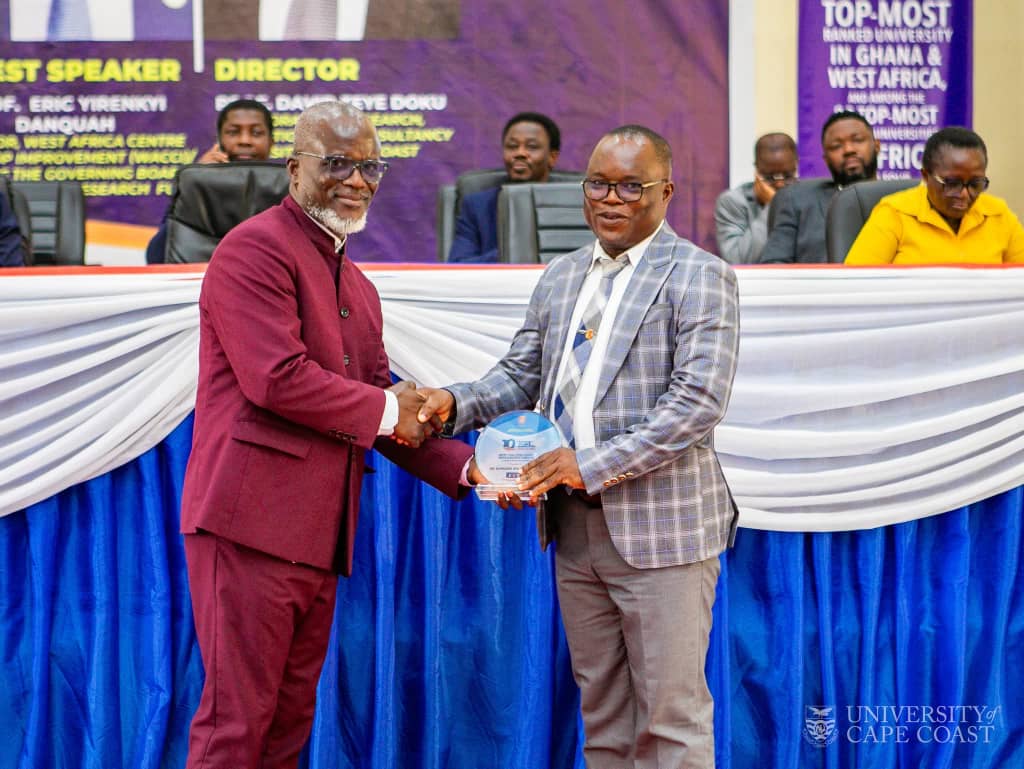
The RAG ceremony is held annually by the Directorate of Research, Innovation and Consultancy (DRIC) of the university to celebrate and promote quality research and champion research excellence and innovation among faculty.
This year’s edition was held on the theme: “National Research Fund for sustainable development: A strategic developmental agenda or a political rhetoric?”
Among other activities, it featured exhibitions of cutting-edge research and innovations from faculty members, demonstrating the university’s contribution to national development and justifying the need for increased stakeholder support for research.
Professor David Teye Doku, the Director of DRIC, explained that the grant provided seed funding for faculty to explore new ideas, test concepts, and position themselves for larger external grants.
He said a total of 77 applications were received for the grants but only 43 qualified.
Stressing the need for greater investments in research, he said there was an urgent need for research-driven innovations in Ghana to address economic hardships, environmental degradation and public health challenges.
“Through research, creativity, and collaboration, we can discover new pathways to enhance education, improve healthcare, and promote sustainable economic growth.
“Investing in research, therefore, is not a luxury; it is a strategic imperative. It is how we turn challenges into opportunities and ensure that knowledge becomes the foundation of a more equitable future,” he said.
Prof Doku touted some achievements of UCC in research but acknowledged that some critical areas were underserved.
Consequently, he called for improved research infrastructure, reliable internet connectivity, modern computing resources and analytical software, and expanded modern laboratories.
“These are not mere conveniences; they are the enablers of world-class research,” he stressed.
Prof. Eric Yirenkyi Danquah, the inaugural Governing Board Chair of the Ghana National Research Fund, reiterated the need for a sustainable public research fund to promote national development, pointing to the return on investments in places like China and UK.
He observed serious gaps in research in Ghana evidenced largely by substandard labs, inadequate human capital, and lack of funding to train researchers.
“Africa’s problem is not the absence of vision but the lack of support. Public funding for research is not a luxury, it is a necessity. Our future development depends on research, which turns knowledge into national power,” he said.
“We need a critical mass of scientists but we don’t have it and we have no funding to train them. Every year, the brightest students leave Africa and about 80 per cent don’t return.
“Until we are able to attract the smartest in every graduate programme, we should forget about getting to the top,” he added.
Prof Danquah announced that Ghana National Research Fund would be officially launched on June 4, 2026 with a seed money of 50 million Cedis to support the work of researchers in the country.
Prof Denis Worlanyo Aheto, the Acting Vice-Chancellor of UCC, commended the staff for their relentlessness in sustaining research as a core mandate of the university.
For him it would only take impactful and trans-disciplinary research to tackle global phenomena such as climate change, food insecurity, and health crisis.
To that end, he expressed UCC’s commitment to seeing through their 2023 – 2027 research plan, the Transdisciplinary Research and Innovation for Sustainable Development in a Changing World.
Prof Aheto argued that it had become more critical than ever for government to show real commitment to the Ghana National Research Fund, citing progress chalked in places like Nigeria and South Africa where a similar system had been instituted.
He also expressed gratitude to the funding partners of UCC, industry collaborators, and international bodies for offering consistent assistance, and encouraged all other stakeholders to put their shoulders to the wheel to drive Ghana forward.
GNA
Edited by Alice Tettey/Christian Akorlie